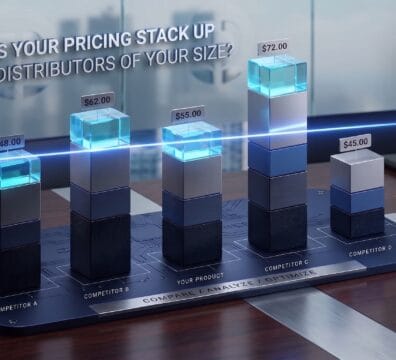


What causes lost price realization at mid-market distributors?
Overview: Price Realization Recovery
This case study shows how rigorous price realization analytics helped a mid-market distributor reclaim $1.7MM in lost price realization over twelve months — reversing a persistent year-over-year pricing headwind. Disciplined price-cost governance, a same-customer and same-SKU decomposition, and a refreshed discount waterfall all contributed to the price realization recovery. For mid-market commercial teams, the playbook shows that price realization is rarely a single-lever fix; it is a compounding capability built on monthly monitoring, category-level insight, and executive-visible pricing controls. See the full case study below, or read our related case study on Price-Cost Discipline at a Mid-Market Manufacturer.
Client Situation
A mid-market plumbing, electrical and HVAC distributor was experiencing a persistent, roughly $(140K) monthly year-over-year headwind from pricing — equivalent to a ($1.7MM) hit to the top line over a trailing 12-month period, or approximately 1.8% of sales.
On the surface, financial performance looked acceptable because favorable purchasing cost was masking the price erosion. In reality, internal cost productivity gains of roughly $1.6MM were being passed through to customers instead of falling to the bottom line — a classic symptom of legacy cost-plus pricing practices and a lack of price-cost governance.
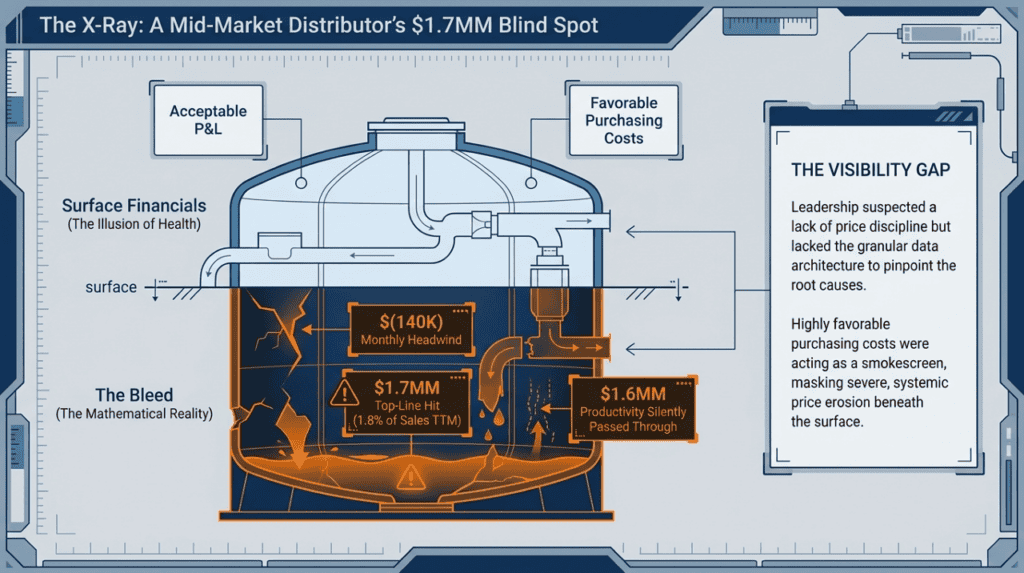
The leakage was concentrated in three categories: Electrical ($850K), Pipe & Fittings ($739K), and Water Heaters ($127K). Leadership suspected price discipline issues but lacked the granularity to pinpoint root causes or quantify recovery potential.
The Revify Approach
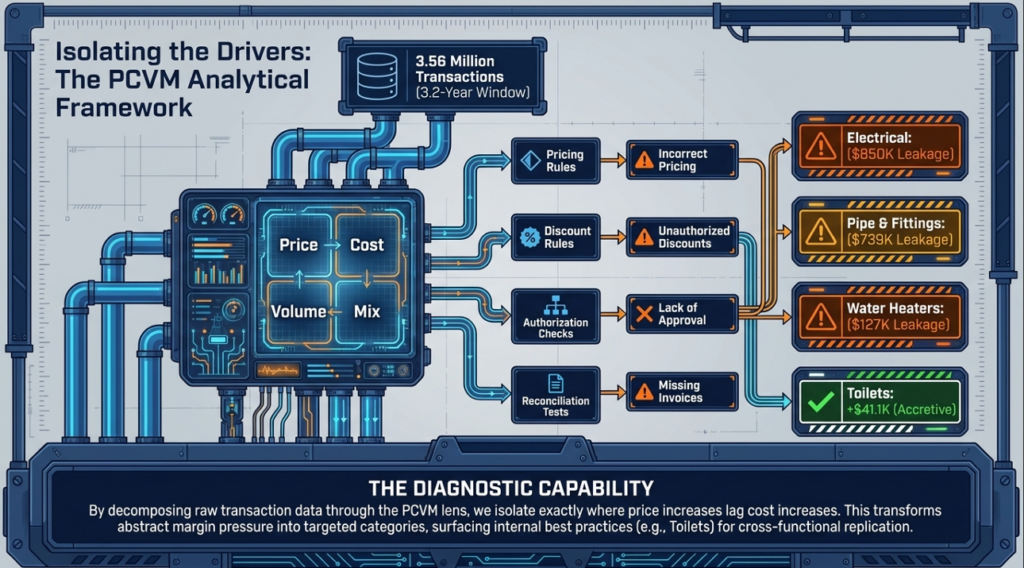
Diagnose — Price-Cost-Volume-Mix (PCVM) at Category and Customer Level
- Decomposed 3.56M transactions across a 3.2-year window into Price, Cost, Volume and Mix drivers at monthly and TTM cadence.
- Isolated categories where price increases were lagging cost increases and the internal cost savings were being ceded to customers.
- Identified categories with accretive price (Toilets: +$41.1K price, +$3.2K cost) to surface internal best practices worth replicating cross-functionally.
Stabilize — Discount Governance & External Benchmarks
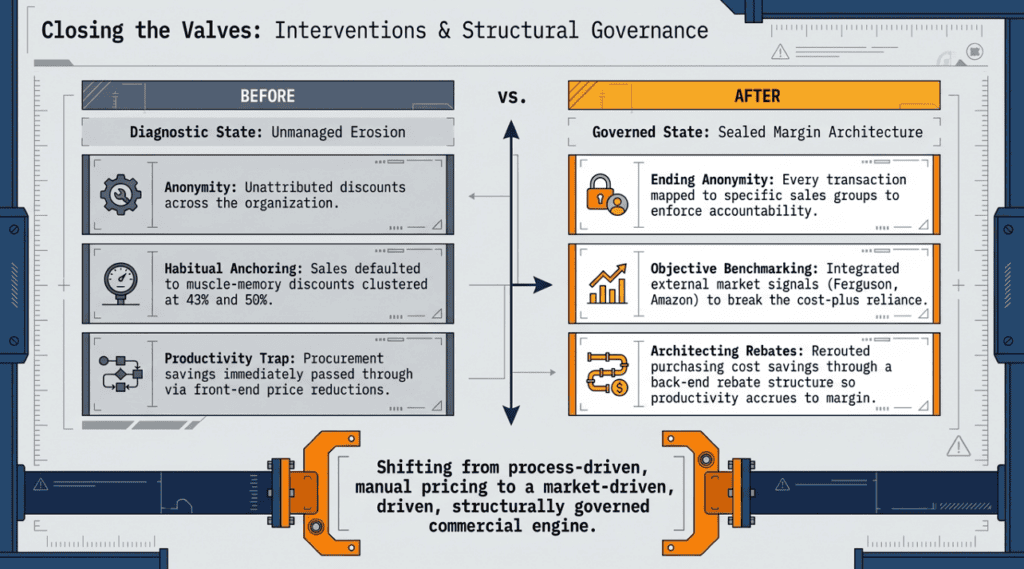
- Mapped every transaction to the responsible sales group to end the practice of unattributed discounts.
- Exposed discount ‘anchoring’ — habitual clustering at 43% and 50% marks — indicating process-driven rather than market- or customer-driven pricing.
- Established a framework for incorporating external benchmarks (Ferguson, Amazon, Trade Services) into list-price and discount decisions, beginning the migration away from cost-plus.
Scale — Back-End Rebate Architecture
- Recommended re-routing purchasing cost savings through a back-end rebate structure, so cost productivity accrues to margin rather than leaking back to customers through front-end price concessions.
Key Findings & Results
With clean data and a driver-based view in place, the client had, for the first time, a defensible quantification of price leakage and a prioritized roadmap to recover it. The largest and most urgent recovery targets were isolated to three categories totaling 1.8% of net sales in margin pressure — directly addressable with the governance controls deployed.
Beyond the quantified recovery, the engagement ended the ‘cost savings bleed’ that had been structurally eroding margin for multiple quarters, and gave leadership a repeatable monthly Price-Cost scorecard to manage the business going forward.
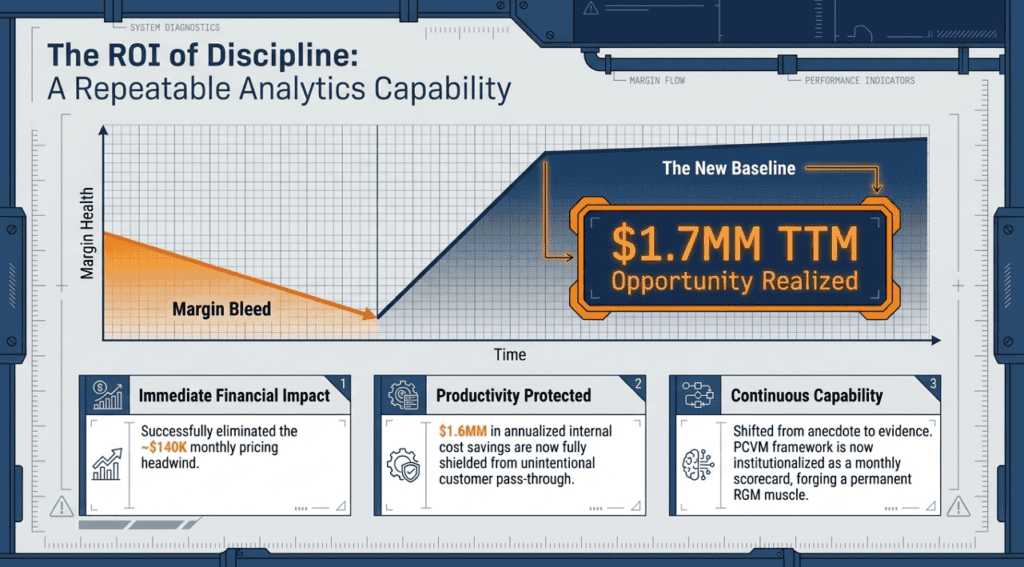
| IMPACT DIMENSION | QUANTIFIED BENEFIT |
| Identified price realization opportunity (TTM) | $1.7MM |
| Monthly price headwind eliminated | ~$140K / month |
| Internal cost productivity now protected from pass-through | ~$1.6MM annualized |
| Categories prioritized for immediate action | Electrical, Pipe & Fittings, Water Heaters |
Why This Matters
| The client was unknowingly trading hard-won cost productivity for softer prices — a silent margin transfer from the income statement back to customers. Quantifying it changed the conversation from ‘are we disciplined?’ to ‘where, specifically, do we tighten?’ |
Conclusion
By replacing anecdote with driver-level evidence, the distributor moved from reactive, cost-plus pricing to disciplined price-cost management. The $1.7MM figure is not theoretical — it reflects value that was already being generated operationally and then given away commercially.
The same PCVM framework and discount-governance controls are now used monthly to prevent recurrence — turning a one-time recovery into an ongoing pricing capability.
Related Case Studies
- Protecting $1.6MM of Margin: Price-Cost Discipline and Category Strategy at a Mid-Market Manufacturer
- From Discount Chaos to Disciplined Tiers: Redesigning a Manufacturer’s Pricing Architecture
Further reading
For broader industry perspective on revenue growth management and pricing analytics, see McKinsey’s Growth, Marketing & Sales insights.