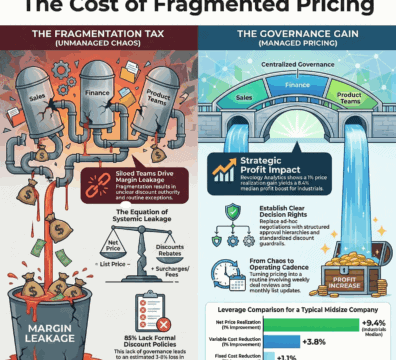


This guide clarifies price concessions, why they escalate, and how mid-market manufacturing and distribution leaders can design price architecture and guardrails to protect margins without slowing sales.
Cost volatility and tariff changes in Q1 2026 challenge mid-market manufacturers and distributors as customers resist price increases and margins erode due to unmanaged concessions, including absorbed freight, extended terms, waived fees, and bundled services, often hidden across business processes.
McKinsey research shows pricing directly affects profit: raising the average price by 1 percent can boost operating profit by 8 percent if volume stays the same. Small, scattered concessions cut into margins. Managing concessions takes robust upstream pricing and downstream approvals. Focusing solely on discount approvals—while neglecting price setting, service design, and customer-specific rules—leads to ongoing exception requests.
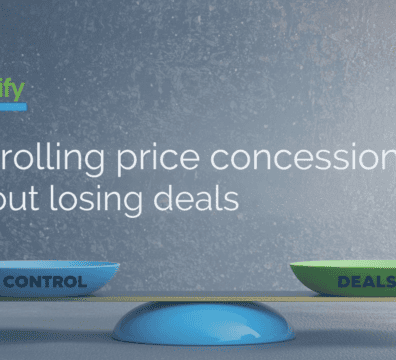
The main takeaway: businesses must balance flexibility and control to protect margins. By managing price concessions thoughtfully, companies can approve good deals, avoid unnecessary margin loss, and ensure concessions deliver reciprocal value—all without harming customer relationships or slowing sales.
What Price Concessions Are (and Why They Are Different From Discounts)
Definition: explicit vs. implicit price concessions
A price concession is any reduction from the intended price—whether list, target, or quoted—that lowers the realized net price or increases the cost to serve a deal. This broader definition matters because concessions impact profitability beyond what most companies classify as discounts.
Explicit concessions are visible line items that reduce the invoice price, such as percentage discounts, negotiated rebates, credit memos issued after delivery, manual price overrides in the ERP, or promotional allowances. These appear in reporting when properly tracked.
Implicit concessions are less visible. They are embedded in deal economics but do not appear as explicit price reductions. Examples include free or absorbed freight, waived minimum-order surcharges, extended payment terms, free returns, expedited handling at no charge, unbilled engineering or service time, unreconciled free samples, or packaging and kitting work absorbed by operations.
This distinction matters for operations. Discounts show as visible cuts on invoices, while concessions cover any value given away that lowers the net price or raises service costs. Tracking only discounts leaves unseen concessions unmanaged, leading to bigger margin losses.
Common examples in manufacturing and distribution
In a typical mid-market distributor or manufacturer, concessions accumulate throughout the entire quote-to-cash cycle:
· On-invoice: volume discounts, customer-specific discounts, promotional pricing, and manual price overrides.
· Off-invoice: rebates, early-pay discounts, credit memos, returns allowances, cooperative funds, and claims settlements.
· Embedded cost-to-serve: freight absorption, waived small-order fees, expedited handling, extended payment terms, unbilled engineering or technical support, special packaging or kitting, free samples, vendor-managed inventory support, and free returns.
The pocket-price-waterfall perspective is important because off-invoice leakage can exceed executive expectations. In McKinsey’s classic lighting-company example, off-invoice revenue reductions not shown on invoices totaled 16.3 percentage points before the full waterfall was considered. This highlights that realized pocket price can fall well below invoice price when concessions are spread across sales, customer service, logistics, finance, and channel programs.
Separate commercial concessions from service-failure compensation
Not all credit memos should be grouped together. Some concessions are commercial decisions to win, retain, or grow business, while others are service-recovery credits from late deliveries, quality issues, fill-rate misses, returns, or claims. Both reduce the realized price but have different root causes and owners. Combining them can result in pricing teams being held accountable for operational failures, while operations teams may overlook the true economic impact of poor execution.
Best practice is to measure both types of credits within the waterfall but code them separately. This allows commercial leaders to understand the value given by choice, while operations leaders can identify margin loss from avoidable service failures.
Why Price Concessions Spiral (the Operational Root Causes)
Concessions often result from rational, one-off decisions by well-intentioned employees who lack clear guidelines. The root causes are structural, not just policy failures.
Quote-to-cash gaps: who can change price, when, and why
In many mid-market organizations, the authority for pricing is unclear. Sales representatives can adjust quotes, customer service agents can issue credits, branch managers can waive surcharges, and logistics coordinators can absorb freight costs. These concessions occur in separate systems—CPQ, ERP, CRM, rebate tools, and ticketing systems—and are often not visible across functions.
Inconsistent rules across reps, branches, and channels
Without standard rules for concession requests, two reps selling similar products to similar customers may offer different terms. This inconsistency signals low pricing maturity, legacy pricing, inconsistent logic across segments or locations, and no clear playbook for inclusions, charges, or escalations. Treating every deal as unique means there’s no real governance.
‘One-time’ exceptions that become the new price
This pattern is common and damaging. A rep offers a freight concession to win a deal, and the customer soon expects it every time. Within months, the concession becomes standard. Without governance and set review dates, temporary concessions turn into permanent expectations, destroying margins on repeat orders.
A weak upstream price architecture creates downstream exceptions.
Many concession problems stem from weak price setting. Bain distinguishes between price setting, which involves structuring the target price waterfall and defining discounts or fees, and price getting, which is executing that structure on each deal. If segment logic, list-price credibility, service definitions, and customer-specific terms are unclear, the organization compensates with overrides.
This is why organizations with low pricing maturity get constant exception requests. Prices follow old structures, service levels are unclear, and discount logic varies by rep, branch, or geography. Field teams have to negotiate around weak pricing. Fix upstream pricing to stop downstream concessions.
What Changes Operationally When You Control Concessions
The main takeaway: effective concession control replaces unmanaged flexibility with governed flexibility. This means building robust price structures, creating clear rules, outlining escalation paths, and measuring each concession’s business impact to safeguard margins without limiting sales effectiveness.
Start with price architecture, not just approvals.
Before debating who can approve a 7 percent discount, define what the base offer includes. For each product family and customer segment, establish the target price waterfall, base service package, chargeable add-ons, allowed discount types, and situations that justify deviation. This is the core of price setting.
If list prices lack credibility, the base offer gives too many free services, or channels use inconsistent rules, an approval matrix can’t stop leakage. It just speeds up exceptions for bad offers.
Lead with nonprice value before price
Buyers rarely evaluate suppliers on price alone. McKinsey found that pricing ranked sixth among distributor attributes. Bain found that even in bulk raw-material categories, buyers pay premiums for higher quality and reliable delivery, and many prefer to pay more rather than switch suppliers. The operational implication is clear: representatives need a structured way to present and defend nonprice value before discussing discounts.
This value covers delivery reliability, product availability, breadth of assortment, expertise, technical support, forecasting support, reduced downtime, simple ordering, and reduced working-capital risk. A clear concession process spells out these elements and prevents reps from giving them away by default.
No concession without a give-get
Every concession should secure something in return. This is the give-get principle used by experienced pricing and negotiation teams. If a customer requests a lower price, the company should receive a concrete commitment in return, such as larger volume, better mix, longer duration, earlier payment, forecast visibility, reduced customization, standard lead time, digital ordering, consolidated shipments, or reference rights. This keeps price and value aligned and prevents one-sided concessions from becoming precedent.
| Lower unit price | Limited price relief | Annual volume commitment, broader basket, or named-SKU share gain |
| Free freight | Freight absorption on specific orders | Full-truckload pattern, consolidated shipments, or standard delivery window |
| Extended payment terms | Selective term extension | Multi-year commitment, electronic payment, or financing charge trigger |
| Rush handling at no charge | Priority slot or shorter lead time | Rush fee, forecast visibility, or standard lead-time compliance on future orders |
| Free engineering or technical support | Scoped support package | Paid project, minimum annual spend, or design-in commitment |
| Waived small-order fee | One-time fee waiver | Order aggregation, minimum mix, or recurring order cadence |
The guiding principle is clear: every concession should have a documented business case, a reciprocal customer action, a designated owner, and a scheduled review date.
Turn hidden concessions into a service menu.
A quick way to improve margins is to stop treating costly services as implicit entitlements. Freight tiers, rush handling, engineering hours, packaging and kitting, returns, vendor-managed inventory, installation support, and technical assistance should be clearly categorized as billable, bundled, or available through a give-get arrangement. If it is unclear whether a service is included, chargeable, or conditional, sales teams will often offer it for free.
This is especially important in manufacturing and distribution, where service variation often causes more margin leakage than invoice discounts. A clear service menu enables the sales team to defend the base offer, allows finance to quantify cost-to-serve, and encourages customers to select the services they value most.
Clear guardrails: floors, corridors, and exception paths
A guardrail framework has three elements. First, price floors: the minimum net price or pocket margin for each product family and customer segment, below which senior approval is required. Second, discount corridors: defined ranges of acceptable concession levels, tiered by deal size or strategic importance, specifying what a representative can approve independently. Third, exception paths with standardized reason codes, requiring documented justification and a clear business outcome when exceeding corridor limits.
The objective is to expedite standard deals and reserve senior management attention for unique decisions. The more precise the corridors and the stronger the price architecture, the fewer deals will require escalation.
Deal desk workflows that speed approvals (not slow sales)
A common objection to concession governance is that it will slow the sales cycle. In practice, the opposite is usually true. When representatives have clear guidance—pre-approved corridors, visible floor prices, a give-get library, and automated routing—they spend less time negotiating internally and more time selling. A well-designed deal desk accelerates approvals by removing ambiguity.
Approvals should occur within hours or days, not weeks. Exception workflows should be integrated into the quoting process, not managed through offline spreadsheets and email searches.
Tariff, inflation, and cost-volatility playbook
In volatile input environments, companies need more than broad, permanent price cuts or across-the-board increases. A better approach is segment-specific action: test cost changes at the SKU or component level, use pocket-price waterfalls to identify leakage, apply surcharges or fees only where specific behaviors drive cost increases, and implement index-based clauses or shorter reset intervals where volatility persists.
For distributors and manufacturers affected by changing trade policies, SKU-level tariff mapping and customer elasticity analysis should inform price decisions before automatically passing costs through. Some customers can absorb cost increases better than others, and certain services should be priced separately rather than included. In volatile markets, targeted actions are more effective than broad adjustments.
Channel discounts, rebates, and stacked programs need their own redesign
For companies selling through distributors, wholesalers, or resellers, quote-level governance is insufficient. Legacy front-end and back-end discounts, new-account funds, growth rebates, geographic promotions, and special programs can combine to reduce profitability and obscure deal economics. These programs may also enable double-dipping, where partners qualify for multiple discounts on the same activity.
Best practice is to regularly update the incentive portfolio, focusing on a limited number of programs with clear economic objectives. Eliminate outdated programs, align incentives with desired behaviors, and prioritize performance-based discounts over demographic criteria. Channel incentives should be straightforward for both internal teams and partners, and robust enough to track margin impact by program.
Governance and control: roles, cadence, and accountability
Guardrails are ineffective without ongoing governance. Effective concession control requires clearly defined roles, regular review cycles, and consequence management.
· Defined roles: name an owner for pricing policy, an owner for deal exceptions, a finance partner for pocket-margin measurement, and an operations owner for service-failure credits.
· Recurring cadence: run monthly or bi-weekly reviews of concession rates, override rates, win rates, service-recovery credits, and channel-program performance by rep, branch, and segment.
· Consequence management: reward net price realization and margin quality, not just booked revenue or quarter-end volume.
Discount approvals should be evaluated against customer lifetime value, strategic fit, cost-to-serve, share-of-wallet potential, compliance history, and contract quality—not just quarterly quota pressure. A low-margin deal can be justified if it creates durable future economics, but that case should be explicit, time-bound, and reviewable.
Digitize after the commercial logic exists.
CPQ, approval engines, contract analytics, peer-pricing dashboards, AI-based recommendations, and price-performance reporting can enhance consistency. However, technology should support and accelerate a well-defined pricing strategy, not replace it. Digitizing flawed pricing logic only results in faster inconsistent decisions.
The correct sequence is to first establish sound pricing logic, then define rules, clean the data, and finally automate processes.
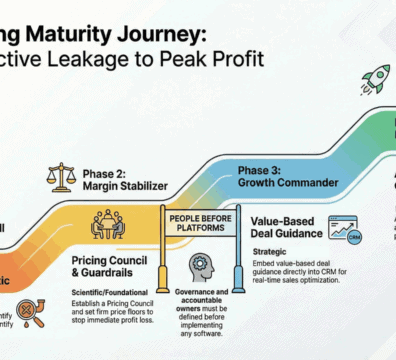
At Revify, we position concession control within a comprehensive Revenue Growth Management (RGM) maturity model. This is an ongoing capability-building process with distinct phases, each building on the previous one.
Profit Diagnostic: find where concessions happen and why
The first step is achieving visibility. Before addressing concessions, identify them across invoices, credit memos, rebate accruals, service charges, and cost-to-serve data. A Profit Diagnostic analyzes transactional data at the customer, product, and channel level to determine where net price realization is weakest, which concession types are most common, which free services are being absorbed, and where the greatest margin-recovery opportunities exist.
At this stage, it is essential to distinguish commercial concessions from service-failure credits and to map channel-program expenditures. This prevents misclassifying all margin issues as discounting when some are related to service, claims, or incentive design.
Margin Stabilizer: stop leakage with rules, approvals, and cleanup
With diagnostic insights in hand, the next phase is to install the operating infrastructure: guardrails, approval workflows with reason codes, a give-get library, and a structured review of legacy concessions. This is where you clean up ‘one-time’ exceptions that have become permanent, standardize pricing rules across branches and channels, and convert hidden giveaways into a deliberate service menu.
Once concessions are governed, the focus shifts from defense to offense. Growth Commander leverages analytics such as segmentation, willingness-to-pay logic, scenario simulation, and contract analysis to improve price setting, optimize customer terms based on volume or behavior commitments, and capture value through targeted price customization. At this stage, indexation clauses, surcharge logic, and channel-program redesign become strategic initiatives.
Digital decision support should be implemented at this stage, after pricing logic is established. Once the foundation is in place, tools can enhance speed, consistency, and adoption.
Managed Services: sustain discipline with a virtual pricing team
Mid-market companies often lack the resources to staff a fully functional pricing function. Revify’s Managed Services tier offers ongoing governance-as-a-service, including monthly reviews, exception monitoring, concession trend analysis, contract risk identification, and periodic strategy recalibration. This provides the benefits of a virtual pricing team, maintaining discipline without the overhead of a large internal department.
Quick Wins and a Realistic Timeline (What You Can Fix First)
A lengthy transformation is not required to begin recovering margin. The following is a practical implementation cadence proven effective in mid-market manufacturing and distribution.
Weeks 1-2: identify top leakage pockets, service giveaways, and policy gaps
Step 1: Pull 12 months of transactional data at the customer-SKU level. Include invoiced prices, credit memos, rebates, freight, returns, and any available service or handling charges.
Step 2: Build a pocket-price waterfall for your top 50 customers by revenue. Calculate the gap between the list price, the invoice price, the net price, and the pocket margin.
Step 3: Code every credit and allowance as one of three buckets: commercial concession, service-recovery credit, or channel or incentive spend.
Step 4: Inventory the services you routinely provide for free – freight, expedite, tech support, engineering, packaging, vendor-managed inventory, samples, and returns.
Step 5: Audit your current discount authority matrix and your stacked channel or rebate programs. If either is undocumented or outdated, that is your first policy gap.
Weeks 3-6: implement guardrails, give-gets, and priced-service rules
Step 6: Define price floors by product family and customer segment, based on minimum target pocket margin.
Step 7: Establish discount corridors with mandatory reason codes and approval SLAs.
Step 8: Publish a give-get library for the 10 to 15 most common customer asks.
Step 9: Create a simple service menu: include, optional paid, or conditional trade.
Step 10: Where volatility justifies it, add surcharge and indexation rules for freight-intensive, rush-order, or tariff-exposed categories.
Weeks 6-12: tighten terms, retrain the selling motion, and improve realization
Step 11: Review legacy concessions for your top accounts and test whether the original volume, mix, or behavior commitments are still being met.
Step 12: Redesign stacked channel incentives and retire low-ROI programs that create complexity without clear economic return.
Step 13: Train reps to defend nonprice value, use give-gets, and distinguish commercial flexibility from free service.
Step 14: Track override rates, give-get usage, service-recovery credits, and win rate by concession level weekly. Target visible improvement within the first quarter of enforcement.
Worked Example: The $1,325 You Did Not Know You Were Giving Away
Consider a mid-market distributor with a $10,000 list quote for an order. Here is how concessions accumulate:
| 8% invoice discount | -$800 | Explicit |
| Credit memo (post-delivery) | -$200 | Explicit |
| Free freight (company cost: $250) | -$250 | Implicit |
| Waived small-order fee | -$75 | Implicit |
| Total value given away | -$1,325 |
The invoice reflects revenue of $9,200 (list price minus discount). However, actual net revenue after the credit memo and waived fee is $8,925. The total profit impact includes both the $1,075 revenue reduction and $250 in absorbed freight costs. Effective net price realization is 86.75 percent of the list price.
If this product family was intended to deliver a 30 percent pocket margin at list, the $1,325 in concessions would reduce expected profit from $3,000 to $1,675, a 44 percent decrease, before considering any secondary effects. The key point is not that all concessions are negative, but that unmanaged concessions are easy to grant, difficult to detect, and even harder to recover.
A more effective approach would be to negotiate a trade rather than simply grant concessions. For example, offer standard delivery instead of free rush freight, require a minimum quarterly volume for unit-price relief, or request a consolidated order pattern in exchange for waiving the small-order fee.
KPIs That Prove Price Concessions Are Under Control
Effective management requires measurement. The KPI set should indicate not only whether concessions are decreasing, but also whether the organization is becoming more disciplined in granting concessions and securing reciprocal value.
Concession rate and override rate (by rep, customer, and product)
Concession Rate % = Total Concession $ / List or Target Price. Track this metric by representative, customer, product family, and channel. Break down by concession type to identify sources of value leakage.
Override Rate = Percentage of deals where the representative exceeded corridor limits and required exception approval. A declining override rate typically indicates that guardrails are properly calibrated and the sales team is adapting.
Price realization and pocket margin movement
Net Price Realization % = Net Price / List or Target Price. This is the most important metric for assessing concession health. Improvements here directly enhance pocket margin and operating profit.
Pocket Margin (dollar and percentage) represents the amount remaining after accounting for on-invoice, off-invoice, and cost-to-serve concessions. Pricing excellence programs deliver significant returns on sales only when companies have visibility into their actual pocket margins.
Approval speed, deal quality, and hidden-leakage KPIs
Approval Cycle Time measures the average number of hours from the exception request to resolution. Standard exceptions should be processed within 24 hours.
Win Rate by Concession Level assesses whether deeper concessions result in more closed deals. In many organizations, this relationship is weaker than sales teams commonly assume.
Give-Get Rate is the percentage of approved concessions linked to a documented reciprocal customer commitment. A low rate indicates the company continues to grant one-sided concessions.
Service-Recovery Credit Rate equals service-failure credits divided by net sales. This metric ensures pricing teams are not held responsible for operational failures and provides operations with a clear view of service-related margin leakage.
For channel businesses, include Channel Program ROI or Rebate Efficiency as KPIs. For volatile categories, track Indexation Coverage, which measures the proportion of eligible revenue covered by reset clauses or index-linked pricing.
Key formulas for measuring concession impact
| Net Price | Invoice Price – (Discounts + Rebates + Credits + Waived Fees) |
| Total Concession $ | (List Price – Net Price) + Quantified Implicit Concessions |
| Concession Rate % | Total Concession $ / List or Target Price |
| Net Price Realization % | Net Price / List or Target Price |
| Pocket Margin $ | Net Price – Cost of Goods Sold – Incremental Cost-to-Serve |
| Give-Get Rate % | Concessions with documented reciprocal commitment / Total concession approvals |
| Service-Recovery Credit Rate % | Service-recovery credits / Net sales |
| Indexation Coverage % | Revenue under contracts with price-reset or index clauses / Eligible revenue |
FAQ: Price Concessions
What is a price concession?
A price concession is any give-away that reduces the realized net price versus the intended price. It includes discounts, rebates, credits, and embedded giveaways such as free freight, extended payment terms, or free services.
What does ‘price includes concessions’ mean?
It means the stated price already reflects reductions or give-aways – discounts, rebates, credits, bundled services, or expected post-sale adjustments – so the net price is lower than the base or list price.
Who qualifies for concession prices?
Qualification should be a policy decision, not an ad hoc sales call. Best practice ties concession eligibility to contracted agreements, volume or mix commitments, strategic-account logic, documented competitive situations, or cost-to-serve trade-offs.
What are implicit price concessions?
Implicit concessions are non-discount give-aways that reduce profit without appearing as a line-item price reduction. Common examples include freight absorption, waived surcharges, extended payment terms, free returns, expedited handling, and unbilled services.
What is the difference between a price concession and a discount?
A discount is one type of concession – specifically, a price reduction shown on the invoice. A concession is the broader category and includes any value given that lowers the net price or increases cost-to-serve.
What is a give-get?
A give-get is a structured trade-off. If the customer asks for something of value, the supplier agrees only if it receives something concrete in return, such as higher volume, a longer term, easier ordering, standard lead time, or faster payment.
Are service-failure credits the same as price concessions?
They both reduce realized price, but operationally, they are not the same. Commercial concessions are deliberate pricing or deal choices. Service-failure credits result from late delivery, quality issues, claims, or other operational misses. They should be measured together but managed separately.
How do you control concessions without losing customers?
Set floors and approval tiers to allow flexibility within defined limits. Lead with nonprice value before discussing discounting. Replace blanket give-aways with give-gets tied to volume, mix, behavior, or service-level choices. Measure win rate and retention by concession type to see which concessions actually matter.
Common Misconceptions About Price Concessions
‘Concessions are only discounts.’ They also include freight, payment terms, waived fees, unbilled services, and channel incentives.
‘If revenue is up, concessions are not a problem.’ Concessions can grow faster than revenue, compressing margins even as the top line expands.
‘Higher list prices will fix leakage.’ Without governance, higher list prices simply create more room for give-aways.
‘Software will fix concession problems.’ Technology helps only after the pricing logic, service rules, and approval criteria are coherent.
‘All credits are pricing decisions.’ Many credits are actually the economic cost of operational failures and should be owned accordingly.
‘Tariff pressure justifies blanket permanent discounts or pass-throughs.’ Volatility requires precision – segmented moves, clauses, surcharges, and elasticity checks – not blunt reactions.
Getting Started: Start Your Profit Diagnostic with Revify Analytics
If your organization’s concession management has been reactive or lacking, the first step is to assess your current state. A Profit Diagnostic provides this essential baseline.
What we review
We examine transactional data (12+ months of invoices, credits, rebates, and service or handling charges), discount authority and approval policies, channel or rebate programs, quoting and order-entry workflows, and the roles and governance structures around pricing decisions. The diagnostic maps the full price waterfall by customer and product, quantifies the gap between list and pocket price, and separates commercial concessions from service-recovery credits.
What you get
You receive a prioritized list of margin-recovery actions, ranked by impact and ease of implementation. Additionally, you receive a guardrails plan tailored to your business, including recommended floors, corridors, give-gets, service-menu rules, and approval tiers, as well as a governance cadence with defined roles, review frequency, and KPIs.
How Revify acts as your virtual pricing team to execute
Most mid-market companies neither have nor require a large internal pricing department. Instead, they need a combination of analytics, expert guidance, and operational discipline. Revify delivers all three: analytics to identify concession patterns, consultative expertise from pricing professionals, and managed-service support to maintain ongoing discipline. The result is a commercial operating system that governs concessions, protects margin, and enables your team to focus on profitable growth.
To identify where your margin is leaking, begin with a Profit Diagnostic. Book a discovery call at myrevify.com to assess the opportunity in your business within two weeks.