

Why is pricing the highest-leverage post-acquisition lever?
As M&A activity is set to accelerate in 2026, turning deal theses into value is critical. Elevated valuations and competition require flawless execution and rapid operationalization of synergies. Most deals fall short because pricing is often postponed post-integration, eroding margins and affecting expectations, sales, and results. Post-acquisition pricing requires speed, acceptance of imperfect data, and immediate accountability. The goal is fast stabilization and establishing guardrails before adding sophistication.
The problem post-acquisition pricing actually solves
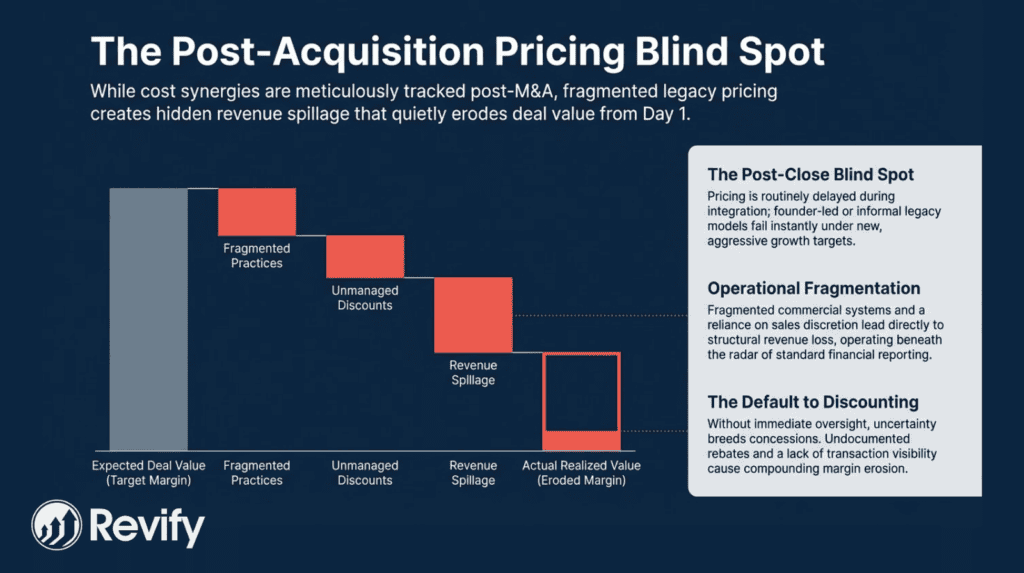
After a change in ownership, commercial processes often lack the structure that financial reports suggest. Pricing is fragmented across sales teams, legacy practices, and informal agreements. While this may work under founder-led management, it fails under new ownership, especially for synergy targets. Common issues include inconsistent customer pricing, informal discount approvals, undocumented rebates, and limited transaction visibility. These lead to uncertainty and default discounting, causing sustained margin erosion. Studies show that while cost synergies are tracked, pricing often lacks ownership and governance, resulting in lost value.
Where pricing fits inside the integration model
A major challenge is the lack of clear ownership for pricing within the Integration Management Office (IMO). While the IMO manages systems, cost synergies, and alignment, post-acquisition pricing often falls between finance and sales, creating costly ambiguity. Without an accountable leader, delivering pricing synergies becomes optional. Leading acquirers address this by assigning explicit accountability, appointing a dedicated pricing or commercial strategy leader, and supporting them with a cross-functional pricing council. The IMO coordinates, but execution follows a defined structure with weekly reviews and clear KPIs. Shifting from implicit ownership to explicit accountability ensures pricing synergies are achieved.
Why post-acquisition pricing efforts fail in practice
Most pricing initiatives fail not due to poor strategy, but because post-acquisition complexities are underestimated. Without a single accountable owner, decisions are slow and inconsistent. Misaligned sales incentives weaken discipline. Fragmented data further stalls pricing efforts. Poor customer communication creates opportunities for demands and continued sales concessions. Legacy agreements are often ignored, letting margin erosion persist. These challenges require a structured operating model under real-world constraints, as ideal conditions are rare.
What changes when pricing becomes a capability
Distinguishing between pricing as a project and as a capability is essential. Projects offer temporary gains, while capabilities create governance, cadence, and feedback loops to sustain results. Firms like Simon-Kucher stress this, especially in fluid, time-limited post-acquisition settings. Capability starts with governance—a pricing council from commercial, finance, product, and operations meets weekly to drive execution, not just report. Over time, these routines form a commercial operating system that supports consistent decisions and reduces reliance on individuals.
A structured, phased approach is crucial for pricing transformation. The most successful efforts align with how organizations absorb change. Revify Analytics uses a three-stage model for value capture post-acquisition. First, a rapid Profit Diagnostic uses transaction data to identify margin leakage and quick wins, delivering a prioritized plan within weeks. Next, Margin Stabilizer introduces governance mechanisms, such as deal desk approvals and dashboards, to prevent leakage and secure gains. Only after this foundation is Growth Commander added, with segmentation and elasticity modeling. This sequencing mirrors broader integration frameworks that prioritize combinational over transformational synergies.
The first 100 days: where outcomes are determined
While post-acquisition pricing capability develops over the hold period, the first 100 days are crucial. This phase resets behaviors, shapes expectations, and enables early wins that build momentum. In the first month, confirm the deal thesis and pricing assumptions, and launch a diagnostic to identify immediate opportunities. By the second month, establish governance structures, such as a pricing council and a deal desk. By the third month, initial actions, especially on rebate and discount guardrails, should yield measurable results. This timeline shows how early actions drive lasting outcomes and why delays are rarely recoverable.
The often-overlooked role of sales incentives
Sales compensation is a powerful yet often overlooked lever in post-acquisition pricing. When sales teams are rewarded only on revenue, they prioritize volume over margin, leading to aggressive discounting and weak discipline. Even strong policies fail if incentives are misaligned. Simple changes—such as introducing margin metrics or linking incentives to pricing guardrails—quickly shift behavior. Without alignment, pricing capability stays fragile, and advanced tools can’t compensate for broken incentives.
What results look like when this is done well
When pricing is a discipline, results are rapid and lasting. Early gains come from rationalizing rebates and reducing discount variance, yielding measurable EBITDA improvement within 90 days. With ongoing governance and advanced methods like elasticity modeling and segmentation, gains compound. The business captures deal thesis synergies and builds commercial resilience, with benefits including faster decisions, less internal friction, and stronger customer relationships.
Getting started
For most acquirers, the best starting point is a focused diagnostic to identify where pricing value is lost and how to recover it. This approach brings clarity, aligns stakeholders, and sets a roadmap for the first 100 days. Establish governance and cadence before introducing complexity. Starting with a structured approach, such as Revify Analytics’ Profit Diagnostic, followed by stabilization and optimization, is more effective than launching a broad transformation. Access to experienced experts is essential to drive sustainable change. Successful organizations do not rush into advanced analytics; they first build a disciplined operating system and then scale it.
Final Perspective
Post-acquisition pricing is a high-impact and highly reversible lever for value creation. Unlike structural cost changes or long-term strategic initiatives, pricing improvements can be implemented quickly and refined over time. The main challenge is not identifying the opportunity, but executing with the speed, discipline, and structure needed to capture it before it dissipates. In a market where many deals miss synergy targets, building a true pricing capability with a clear phased approach and embedded operating model is increasingly essential for consistent outperformance. Engaging firms like Revify Analytics offers expert guidance for fast and accurate implementation.