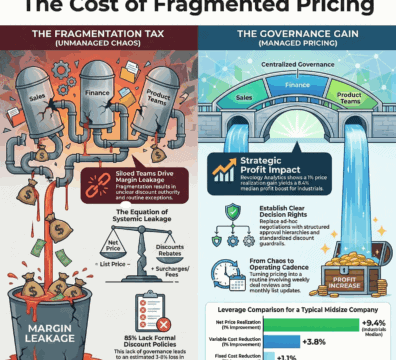


Most manufacturers and distributors have a pricing strategy, but very few have enforceable pricing policy strategies.
In the 2026 margin environment, characterized by tariff volatility, flat industrial demand, and aggressive competition, the distinction between strategy and policy directly impacts pocket margin on every deal.
How Pricing Policy Strategies Differ from Pricing Strategy
Pricing strategy defines how a company competes and captures value. Pricing policy determines how that intent is executed and controlled across daily decisions. Strategy sets direction, while policy enforces consistency. Without policy, strategy devolves into negotiation variability.
Pricing policy strategies establish guardrails and governance rules that specify who can change prices, by how much, and through which approval workflow. This ensures pricing decisions remain consistent, auditable, and aligned with the margin objective
Research across consulting firms and academic pricing literature has consistently shown why this matters. McKinsey has documented that pricing transformations can deliver two to seven percentage points of sustained margin improvement, often within months. Long-standing Harvard Business Review analysis has demonstrated that pricing has a disproportionately large impact on operating profit compared to volume or cost changes. Bain’s B2B pricing research shows that uncontrolled discounting compounds quietly and becomes cultural if not governed. Empirical studies in industrial sales governance similarly show that structured approval systems reduce discount dispersion and improve price realization.
Implementing pricing policies can feel bureaucratic and introduce friction, often requiring difficult conversations for sales teams. In this sense, pricing governance is sometimes viewed as a necessary challenge. High-performing companies recognize that some exceptions are necessary. They expect a defined percentage of transactions to require formal approval. If no deals require escalation, the guardrails are ineffective. If every deal requires escalation, the system is inefficient. The goal is disciplined flexibility.
This guide explains how to build effective pricing strategies without hiring a full pricing department.
Why Pricing Policy Strategies Fail in Mid-Market Manufacturing and Distribution
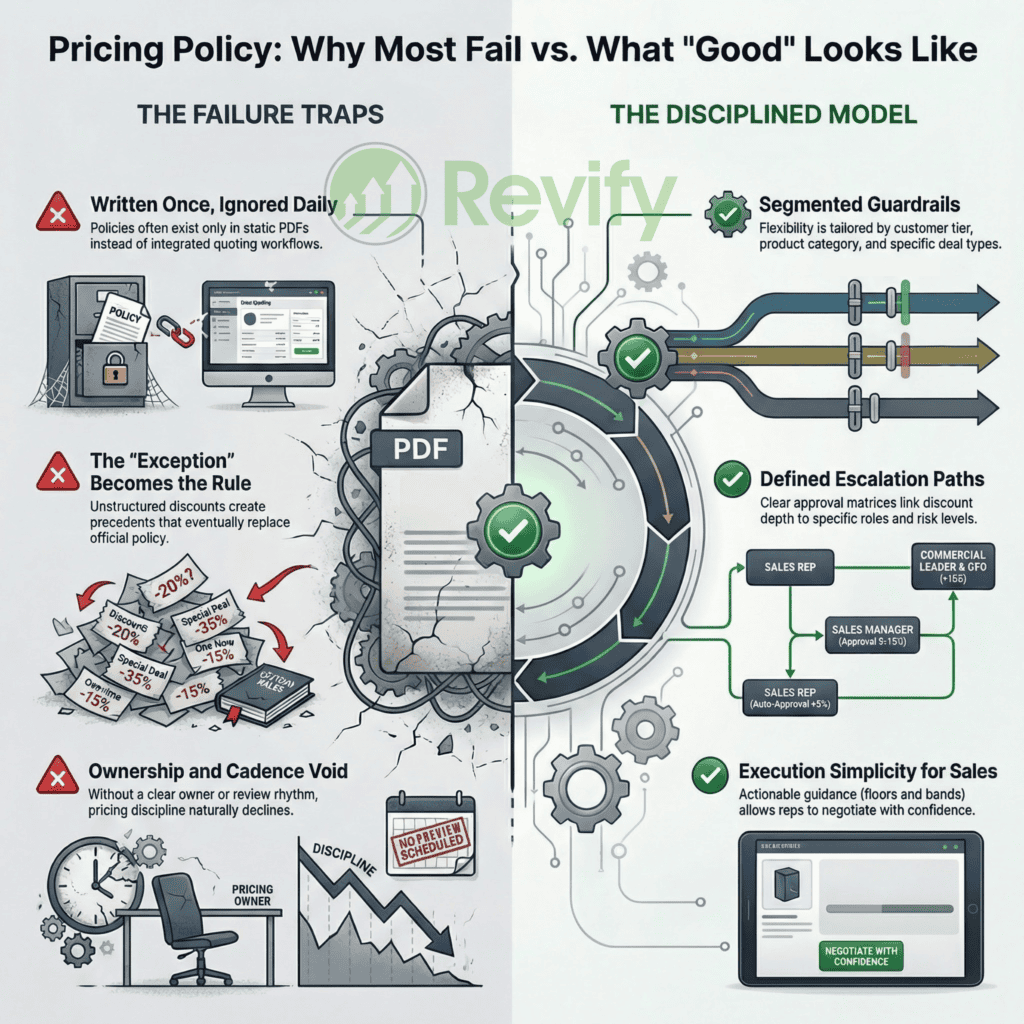
Policies Written Once, Ignored Daily
Most pricing policies are created during ERP implementations, strategy sessions, or margin crises. They are stored in shared drives or internal wikis, but are not integrated into the quoting workflow.
If your CPQ or ERP does not reflect the policy in real time, the policy is ineffective. Behavior follows workflow, not documentation. Sales teams will default to actions that expedite deals. If the system permits uncontrolled discounting, it effectively sets the policy.
Exceptions Become the Real Pricing Policy
In many mid-market firms, the exception process gradually replaces the official pricing policy. Sales representatives discount to secure deals, managers approve to protect revenue, and these precedents become new benchmarks. Over time, special cases account for the majority of transactions.
Research into B2B discount governance shows that without structured reason codes and defined approval scoring, discounting becomes reactive rather than strategic. Margin erosion compounds invisibly, one exception at a time. When every deal is “strategic,” none of them are governed.
No Owner, No Cadence, No Consequences
Pricing policies fail when there is no clear ownership or established review cadence. Without regular exception reviews, threshold adjustments, and segmentation updates, pricing discipline declines. High-performing organizations treat pricing governance as seriously as capital allocation or credit risk, with explicit decision rights, ongoing oversight, and visible accountability. Without this structure, enforcement weakens even if the written policy appears sound.
What “Good” Pricing Policy Strategies Look Like in Practice
Clear Guardrails by Customer, Product, and Deal Type
A flat maximum discount rule is not a sufficient pricing policy. Effective policies segment guardrails by customer tier, product category, channel, contract duration, and volume commitment. For example, a commodity SKU sold to a national distributor requires different flexibility than an engineered solution sold to a specialty OEM. Strong pricing governance aligns with the underlying economics of each deal rather than administrative convenience.
Segmented guardrails ensure flexibility aligns with contribution margin and cost-to-serve differences. Without segmentation, companies risk over-governing low-risk deals or under-governing high-risk ones.
Defined Approval Paths and Escalation Rules
An effective approval matrix links discount authority to both role and risk. Sales can handle small deviations from guidance pricing autonomously. Moderate deviations require managerial oversight and a documented rationale. Large deviations require cross-functional review, documented trade-offs, and visibility in governance meetings. Deals below calculated price floors require executive approval and strategic justification.
Disciplined companies expect a reasonable percentage of transactions to be escalated for approval, typically between 5 and 20 percent, depending on the business model. Zero escalations suggest weak guardrails, while excessive escalations indicate misaligned guidance pricing. The objective is intelligent escalation, not unnecessary bureaucracy.
Simple Rules That Sales Can Execute
If a pricing policy is overly complex, it will be ignored. Sales teams need clear, actionable guidance for live negotiations: know the price floor, understand discount bands, document rationale, and follow the defined approval path when required. Analytical complexity can remain behind the scenes, but frontline execution must be simple. Simplicity encourages adoption, while complexity leads to workarounds.
The Operational Changes That Make Policies Enforceable
A Virtual Pricing Team to Own Governance
A dedicated pricing department is not required to enforce pricing discipline. Instead, a cross-functional governance group with defined authority is essential. This group typically includes a pricing or finance lead, sales leadership, finance representatives, and operations support. The team is responsible for floor calculations, discount thresholds, approval logic, and exception reviews. Without clear ownership, policies become mere suggestions.
Governance Cadence: The Rhythm That Creates Discipline
Sustainable pricing governance requires a defined cadence. Weekly meetings review high-risk and below-floor transactions to identify patterns and coaching opportunities. Monthly sessions adjust thresholds based on win rates, competitive dynamics, and cost changes. Quarterly reviews update segmentation and guidance pricing to reflect market changes. This ongoing rhythm transforms pricing policy from static documentation into an active management system.
Deal Desk Workflow: Preventing Margin Leakage
An effective deal desk workflow integrates pricing policy into the quote-to-cash process. Guidance pricing should auto-populate in the quoting tool, deviations should trigger alerts, and reason codes must be required when discounts exceed set thresholds. High-risk discounts should require documented commitments, ensuring concessions are exchanged for tangible value such as volume commitments or contract extensions. All approvals should generate audit trails for performance tracking and compliance reporting.
Modern ERP and CPQ platforms support these workflows, but software alone does not ensure discipline. Governance design, clear thresholds, and leadership reinforcement determine whether tools influence behavior or merely document it.
Core Policy Components to Include (and How to Structure Them)
Price Architecture: List, Invoice, and Pocket Price
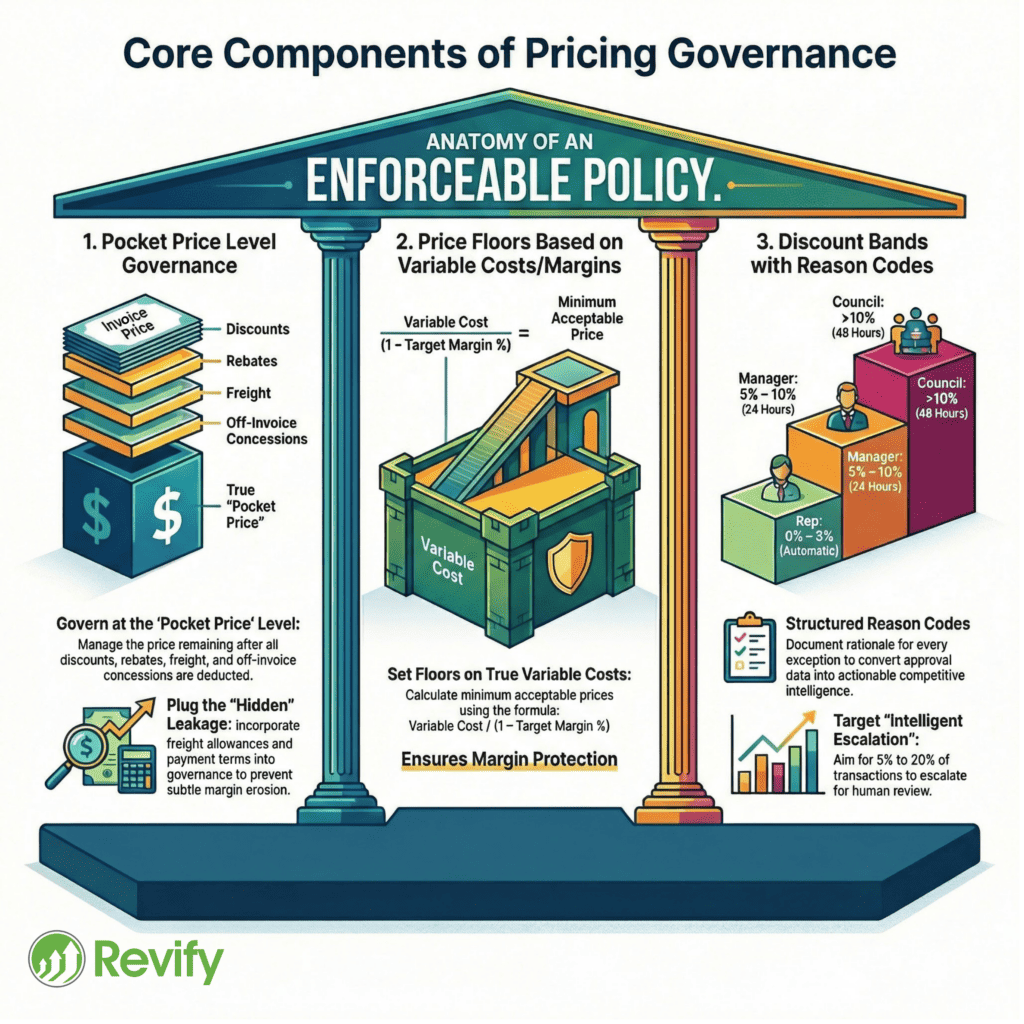
An enforceable pricing policy governs at the pocket price level, where margin actually lives. Pocket price equals invoice price minus all discounts, rebates, freight allowances, credits, and other concessions. The pocket margin percentage reflects the difference between the pocket price and the true variable cost-to-serve.
Many organizations focus on list-price adjustments while allowing uncontrolled off-invoice leakage to undermine those gains. Governance must operate where economic value is realized, not where it is most visible.
Price Floors Based on Minimum Margin Policy
Price floors should be derived from the true variable cost and target contribution margin. The formula is straightforward: variable cost divided by one minus the target margin percentage. For example, if variable cost equals $70 and the target margin is 30%, the minimum acceptable price is $100. Any deal below that threshold requires structured escalation.
The credibility of price floors relies on accurate cost data. Floors based on incomplete cost-to-serve information quickly lose legitimacy with the sales team.
Discount Bands and Structured Reason Codes
Discount bands introduce graduated flexibility tied to risk. Lower-risk discounts flow quickly through the system. Higher-risk discounts require justification and review. Crucially, deviations must be accompanied by structured reason codes that convert approval data into competitive intelligence. Over time, recurring reason codes reveal where guidance pricing is misaligned with market conditions and where structural pricing gaps exist.
Without reason codes, approvals create friction without generating actionable insights.
Customer-Specific Terms: The Hidden Leakage
Margin erosion often occurs outside the scope of standard discount analysis. Freight allowances, rebate structures, extended payment terms, and service commitments can erode profitability more subtly than headline discounts. An enforceable pricing policy incorporates these elements into pocket margin governance and sets thresholds for their use. In volatile cost environments, particularly those affected by tariffs or supply disruptions, surcharge and passthrough logic must also be clearly governed.
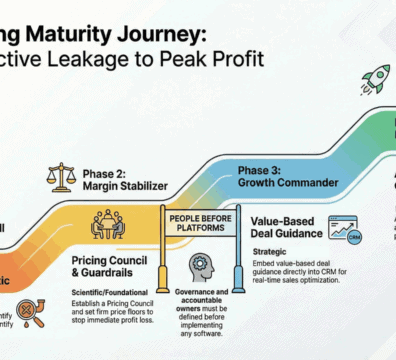
The RGM Maturity Journey: From Policy Ideas to Pricing Discipline
Revify Analytics (myrevify.com) helps manufacturers and distributors translate pricing strategy into margin-accretive pricing discipline. Through a data-driven Profit Diagnostic, structured guardrail design (price floors, discount bands, approval matrices), and ongoing governance support, we embed pricing policy directly into your quote-to-cash workflow—so margin improvement is measurable, sustainable, and scalable without hiring a full pricing team.
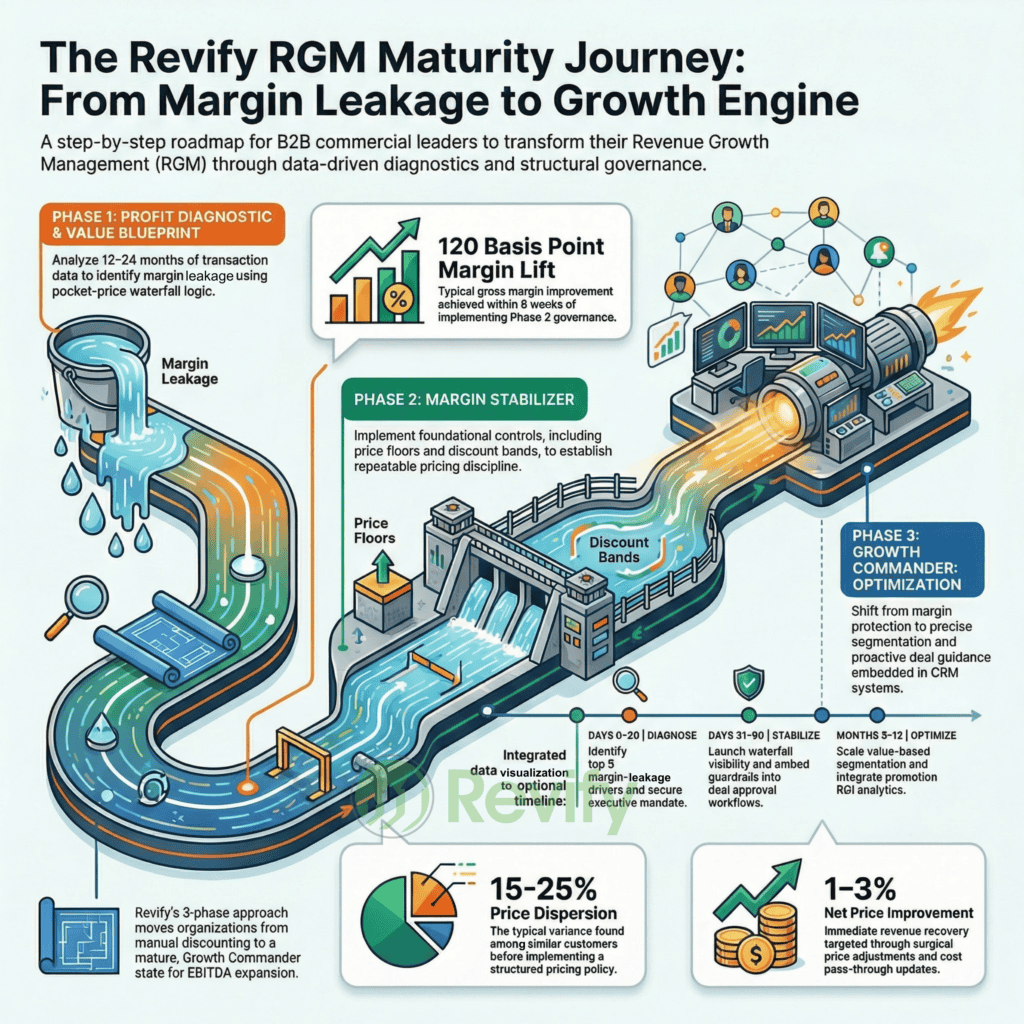
The proven Revify approach is structured in 3 phases:
1. Profit Diagnostic and Value Blueprint
The process begins with data. A Profit Diagnostic analyzes twelve to twenty-four months of transactions to identify margin leakage by segment, SKU, customer, and sales representative. It quantifies economic exposure and prioritizes the most impactful guardrails. Evidence replaces assumptions.
2. Margin Stabilizer
Once leakage is identified, foundational controls are implemented. Price floors are calculated, discount bands are defined, approval authority is clarified, and weekly governance begins. Within 60 to 90 days, most companies achieve measurable margin stabilization as the largest leakage areas are addressed first.
3. Growth Commander
After stabilization, the focus shifts from protection to optimization. Segmentation becomes more precise, guidance pricing improves, and price realization increases systematically. Governance evolves from preventing poor deals to enabling better ones.
Quick Wins and a Realistic Timeline
In the first two weeks, extract transactional data and identify the top ten to twenty percent of segments responsible for most margin leakage. Prioritize these segments instead of attempting enterprise-wide reform. Between weeks three and six, implement floors, discount bands, and approval thresholds for these high-impact deal types. Thereafter, maintain discipline through ongoing governance and coaching.
Incremental enforcement in high-impact areas is more effective than broad but unenforced policy changes.
KPIs That Prove Your Pricing Policy Is Working
Price realization percentage measures the ratio of realized net price to guidance price and provides a direct indicator of discipline. The exception rate indicates whether guardrails are appropriately calibrated. Approval cycle time ensures governance does not cripple quoting speed. Win rate by discount band reveals whether higher discounts genuinely improve competitiveness. Ultimately, the pocket margin trend remains the definitive scoreboard.
Even small improvements in price realization can lead to significant gains in operating profit due to the leverage effect of pricing.
Common Mistakes That Cause Margin Leakage
Common failures include treating policy as documentation rather than a workflow, adding excessive approvals that slow quoting, governing list price rather than pocket price, applying a single discount structure across diverse segments, and relying solely on software tools for enforcement. Sustainable pricing governance depends on clarity, segmentation, and cadence, not automation alone.
FAQ
What are pricing policy strategies?
They are the governance rules and guardrails that define who can change price, by how much, and through what approval workflow, so pricing decisions remain consistent, auditable, and margin-aligned.
How is a pricing policy different from a pricing strategy?
Strategy defines how you compete and capture value. Policy defines how pricing decisions are executed and controlled in practice.
What should a B2B pricing policy include?
It should include price architecture, price floors, discount bands, approval matrix, structured exception management, reason codes, documentation requirements, and compliance reporting.
How do you enforce pricing discipline with sales teams?
Embed guidance, pricing, and approvals into the quote-to-cash workflow, require documented rationale for deviations, run recurring exception reviews, and reinforce learning through coaching rather than punishment.
What metrics show whether the pricing policy is working?
Net price realization, pocket margin trends, discount leakage, exception rate, approval cycle time, win rate by discount band, and churn or retention by segment collectively indicate whether governance is tightening margins while preserving competitiveness.
Getting Started: Build Pricing Confidence with a Profit Diagnostic
Most mid-market manufacturers and distributors do not need additional pricing theory. They require enforceable discipline supported by data and a consistent governance rhythm.
A Profit Diagnostic delivers a quantified leakage map, prioritized guardrail recommendations, and a ninety-day stabilization roadmap. Hiring a pricing department is not necessary to create discipline. What is needed is the right design, cadence, and ownership structure.
Begin your Profit Diagnostic today, connect with us at support@myrevify.com.