

What five pricing disciplines must every mid-market firm master?
Why Effective Pricing Capability Matters
Although many companies turn to new software or dashboards to build pricing capability, this is rarely effective on its own. For mid-market manufacturers and distributors, achieving real pricing capability requires mastering price setting, discount management, exception approval, profitability measurement, and cross-functional review. Recent studies highlight that technological tools alone are not enough: Simon-Kucher’s 2025 Global Pricing Study found that average price realization dropped to 43%, while BCG reports that only 10% of revenue growth management success comes from tools, and 90% relies on internal capabilities. Overall, the main driver of pricing success is the development of strong internal pricing practices, not technology alone.
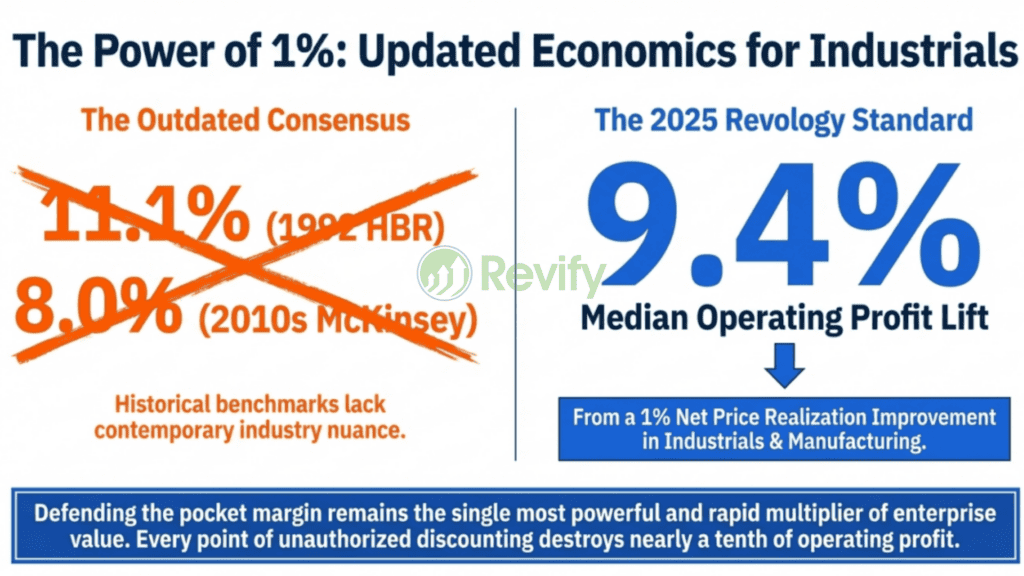
Focusing broadly on pricing matters because it drives profit: A 1% price increase can lift operating profit by 8%, and full pricing transformations can boost earnings significantly with limited impact on volume.
Why “revenue management solutions” often fail in manufacturing and distribution
The hidden cost of ad hoc pricing and unmanaged discounting
With this in mind, it’s important to consider why pricing challenges persist. In manufacturing and industrial distribution, such challenges typically arise from a series of small decisions: discounts set by individual reps instead of strategy, renewals that overlook cost or value changes, contracts lacking adjustment clauses, and price lists misaligned with product value or customer willingness to pay. Building on these examples, McKinsey’s research identifies poor segmentation, weak product taxonomy, inconsistent discounting, and unclear authority as common causes of poor price realization and margin leakage.
Why insights don’t change outcomes without execution and governance
Despite awareness of these root causes, many organizations struggle to convert insight into improved outcomes. Rather than lacking visibility, most companies actually struggle with execution. Studies highlight that tools alone rarely drive revenue management success; instead, stronger execution capabilities are now recognized as the main barrier between commercial ambition and realized value. As a result of this gap, companies may have strong reporting but still struggle to maintain pricing, enforce discount guidance, or coach teams effectively.
Misaligned incentives further complicate pricing. Bain’s pricing database shows that 54 percent of deals in misaligned organizations fall outside pricing guidelines, compared to 13 percent in aligned firms. These companies also experience twice as many approval handoffs and significantly weaker transactional profit outcomes. In such cases, pricing becomes a policy on paper rather than a field discipline.
What a revenue management solutions company should change operationally
A strong revenue management partner transforms daily pricing decisions by clearly defining decision rights. Sellers know their quoting limits, managers distinguish between routine exceptions and strategic deals, and finance tracks where net price is protected or compromised. Legal and operations identify standard terms and those requiring escalation. McKinsey’s research highlights layered escalation processes and pricing war rooms that provide real-time guidance to the field, replacing generic policy language.
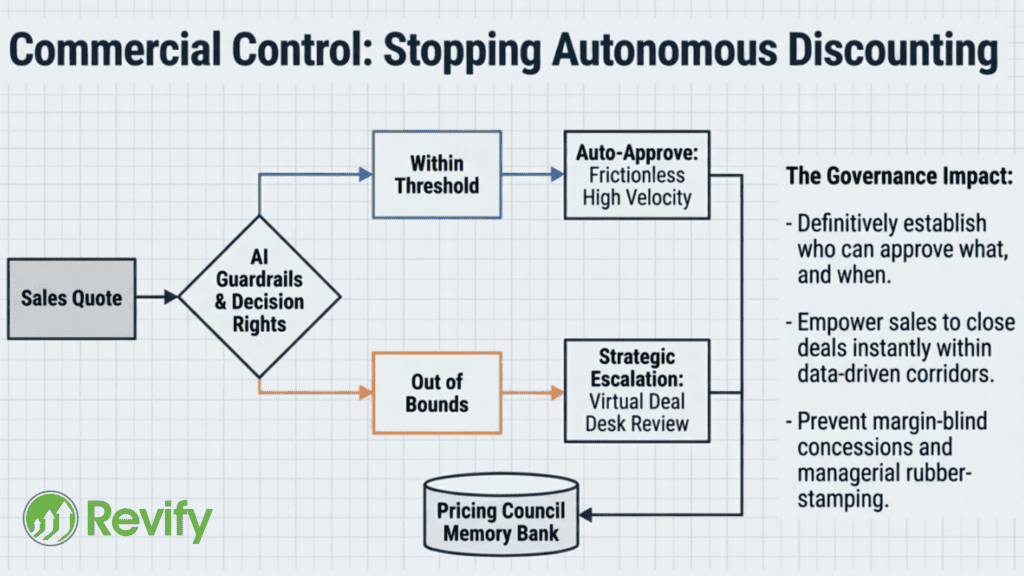
This discipline must apply to quoting, renewals, exceptions, and price changes. To achieve this, companies should: (1) establish clear price increase processes, (2) set defined renewal triggers, (3) include effective adjustment logic in contracts, and (4) standardize workflows that ensure consistent enforcement. Simon-Kucher’s 2025 Global Pricing Study found that while 53 percent of companies use contract indexation, only half enforce it consistently. This highlights the need for standard workflows. Pricing discipline is not just about strategy; it ensures the commercial system implements the strategy through to renewal, quote, and invoice.
Cadence is equally important in sustaining pricing discipline. Weekly deal reviews prevent exceptions from becoming standard practice. Monthly margin reviews link price realization, pocket margin, approval cycle time, and mix shifts to specific actions, reinforcing ongoing improvement. Effective governance should reduce, not increase, friction. In support of this, McKinsey’s quote-to-cash research shows that clearer guidance, stronger bid desk support, and pre-approved fallback terms improve deal velocity and win rate by 5 to 10 percent. However, simply tightening approvals may not be enough—McKinsey also cautions that over 90 percent of escalated deals are still approved, leading to rubber-stamping.
The capability you’re really buying: a virtual pricing team

Most mid-market businesses need a dedicated pricing function, not more software. In this context, Bain distinguishes between price setting, which defines the target price waterfall and discount structure, and price getting, which is the daily discipline to win deals at the right terms. A strong revenue management solutions company supports both, going beyond analysis to help businesses set and achieve the right prices. This integrated approach helps close the gap highlighted earlier between commercial ambition and realized value.
The virtual pricing team model is effective for mid-market manufacturers and distributors because it provides access to essential roles: a pricing lead for governance, a deal desk for exceptions and quoting, an analyst to track net price realization and margin leakage, and an enablement layer to support sellers and managers. Research recommends building a more strategic and technically capable pricing team, supported by hands-on field support to align decisions with management objectives.
Pricing discipline must be implemented, not just announced. Sellers need reliable guidance, managers need actionable scorecards, and leadership needs visibility into value capture. McKinsey’s research shows strong pricing comes from combining analytics, process, governance, negotiation support, and changes in frontline behavior.
People + process + platform: what “durable pricing capability” means
Durable pricing capability starts with process and is reinforced by technology. Consistent with earlier findings, McKinsey advises that pricing transformations are most effective when technology decisions follow a full redesign of the pricing process. Simon-Kucher’s February 2026 study on pricing and quoting automation supports this: only 40 percent of implementations succeed fully, underscoring the importance of scope, integration, and organizational readiness. Ultimately, better tools are helpful, but only after the business defines its pricing approach.
To ensure clarity at this stage, explain the price waterfall now. List price is the start. The invoice price is quoted and billed. Net price accounts for discounts, rebates, credits, surcharges, and freight. Pocket margin includes variable cost to serve. This sequence clarifies “margin pressure” by pinpointing value leakage.

AI has a role in pricing, but it should not be the primary focus. Simon-Kucher’s 2025 GPS notes that AI is being adopted in pricing, though most applications remain basic and transactional. The stronger message is to prioritize governance, then execution, and finally automation. This approach is more credible and stands out in a market dominated by software-focused solutions.
How Revify’s RGM maturity journey works
Revify’s RGM maturity journey is most effective when presented as a sequence. The Profit Diagnostic phase establishes a common fact base, identifies margin leakage by customer, SKU, channel, contract, and seller behavior, validates net price calculations, highlights gaps between expected and realized margin, and creates a prioritized action plan. The result is a practical roadmap for recovering value, including quick wins, not just a generic presentation.
The Margin Stabilizer phase establishes control. Guardrails, approval thresholds, exception workflows, quote guidance, and weekly pricing routines are integrated into daily operations. McKinsey’s research outlines three steps for durable gains: set the right price, optimize discounts and rebates, and manage leakage. This sequence is important because tightening execution delivers the fastest results. McKinsey’s logistics pricing research confirms that reducing margin leakage can account for up to one-third of a pricing transformation’s impact and often produces the quickest results by enforcing existing terms.
The Growth Commander phase advances the organization from control to precision. Once discounting is stable, the business can then refine price architecture, improve segmentation, model price-volume-mix effects, target specific price actions, and focus growth on higher-margin customers and offers. At this stage, advanced deal guidance and optimization become effective because the commercial system is stable. BCG’s revenue management framework reinforces that tools add value only when supporting capabilities are established, linking back to earlier themes.
Now is the time to take action: Sustain pricing routines, enforce disciplined approvals, empower managers to coach using data, and actively track outcomes against your targets. Close the execution gap and ensure your pricing capability delivers real results.
Quick wins and a realistic 30–90 day timeline
Act now: In the next 30 days, define your net price measurement, validate transaction data, pinpoint your highest-leakage areas, and flag exception patterns harming margin. Implement targeted actions immediately to achieve pricing gains.
From 30 to 60 days, the focus shifts to operational control. Implement discount guardrails, approval bands, exception handling, and a weekly review cadence to provide sales with faster guidance. McKinsey notes that well-designed pricing transformations can deliver benefits in 3 to 6 months, and quote-to-cash redesigns have produced 20 to 40 percent improvements in contract speed, order provisioning, and invoice accuracy when processes are well designed.
From 60 to 90 days, the focus is on reinforcement. Managers receive coaching materials, sellers get deal guidance and negotiation support, finance gains visibility into realized versus expected margin, and leadership uses scorecards to track behavioral change. BCG’s 2024 compensation research found that fewer than 10 percent of B2B sales incentive plans include price-based metrics, which explains why many companies ask sellers to protect margins while compensating them mainly on volume.
KPIs that prove pricing capability is working
Price realization is the primary measure, indicating whether the organization captures intended value. Net price and pocket margin are also important, as invoice revenue alone can hide rebate drag, freight, service costs, and other leakage. Explaining these measures clearly helps leadership move from anecdotal pricing frustration to measurable commercial control.
Process metrics are also important. Discount rate, exception rate, approval cycle time, quote turnaround time, and the share of deals within guidance are leading indicators of pricing discipline. Bain’s research shows that misalignment leads to more deals outside guidelines, increased approval handoffs, and weaker profit outcomes.
Commercial leaders must address the real trade-off: win rate versus margin. Poor governance can slow sales, while good governance should accelerate it. McKinsey’s quote-to-cash research found that clearer guidance and more flexible, preapproved terms improved both deal velocity and win rate. Their sales-support research also showed that stronger support models increased win rates by 5 to 10 percent and reduced deal closing time by up to 40 percent. The true objective is a profitable win rate, not just higher volume.
How to evaluate a revenue management partner
Evaluate a revenue management partner based on their ability to execute within your workflows, not just diagnose from the outside. The key test is whether they can help your team deploy price actions, manage exceptions, support quoting, coach managers, and track outcomes against plan.
They should also establish governance that endures beyond the engagement. This is a higher standard than simply delivering a dashboard. A strong partner leaves behind decision rights, routines, templates, scorecards, and manager behaviors that persist after the project concludes.
They must also understand the realities of manufacturing and industrial distribution. Channels, rep autonomy, terms and conditions, rebates, freight, cost to serve, customer-SKU complexity, and contract structure all impact realized price. A revenue management solutions company that cannot address these details will not achieve lasting improvements in net price realization.
FAQ
What does a revenue management solutions company actually do?
It builds and runs the commercial operating system behind pricing. That includes price setting, discount governance, deal guidance, exception handling, profitability visibility, and the recurring cadence that helps sales, finance, and operations act on pricing decisions consistently. In Bain’s terms, it helps with both price setting and price getting, not just analysis.
How is Revify different from a revenue management software provider?
A software provider offers a tool. Revify is best positioned as a virtual pricing team that uses technology as an enabler, not the product itself. This distinction aligns with both the brief and external research, which shows that capabilities and execution, rather than tools alone, drive most of the value in pricing and revenue management.
How fast can we see margin improvement?
The fastest gains typically come from controlling leakage, enforcing discount discipline, and improving exception handling, rather than advanced modeling. McKinsey reports that digital pricing transformations can show initial benefits in three to six months, and its logistics pricing research finds that leakage reduction delivers results quickly by enforcing existing commercial terms and charges more consistently.
Will this slow down sales or quoting?
Poorly designed controls can slow sales, but well-designed governance should accelerate it. McKinsey’s quote-to-cash research found that clearer bid guidance and more flexible, preapproved deal structures improved deal velocity and win rate by 5 to 10 percent. The goal is to replace uncertainty and unnecessary escalation with faster, more confident decisions, not to add friction.
Do we need to hire a pricing manager first?
Not necessarily. Many mid-market companies benefit from starting with a virtual pricing team, especially when they need enterprise-grade capability without adding full-time staff. This approach aligns with external research, which shows that practical pricing capability and field support are often the missing elements, not additional software.
What data do you need to start?
Begin with the core inputs identified in the brief: invoice or transaction data, customer and product masters, cost data, price lists or agreements, and discount and rebate structures. Perfection is not required initially, but definitions must be clear so that net price, margin leakage, and price realization are measured consistently enough to support action.
Start Your Profit Diagnostic
Start your Profit Diagnostic to identify where margin leakage occurs, which actions will improve net price realization fastest, and what operational changes are needed to sustain those gains. The most effective call to action is not “come see a dashboard,” but rather “get a prioritized margin opportunity backlog, clear guardrails, and an execution plan your team can implement.”
To learn more about how Revify Analytics supports companies, please visit us at myrevify.com.