

What does predictive analytics actually deliver for mid-market pricing?
Overview: Predictive Analytics for Mid-Market Pricing
This case study shows how enterprise-grade predictive analytics and prescriptive models are delivered to mid-market manufacturers and distributors through the Revify service model — Double Machine Learning for elasticity, association rules for cross-sell, and RFM-based customer segmentation. Traditional predictive analytics programs require seven-figure budgets and specialized data-science teams, placing them out of reach for mid-market commercial teams. The Revify predictive analytics stack closes that gap as a repeatable service, so mid-market leaders get the same decision quality as the enterprise without the cost structure or the timeline. Predictive analytics, delivered this way, is not a deck; it is a compounding pricing capability. See the full case study below, or read our related case study on Building the AI Analytical Foundation.
Unlike one-off dashboards, Revify predictive analytics delivers statistically grounded pricing decisions every month. The Revify team refreshes elasticity, cross-sell, and customer segmentation models on a regular cadence — making predictive analytics a compounding commercial capability rather than a one-time report. For mid-market leaders, embedded predictive analytics means every quarterly planning cycle gets smarter, not staler.
Client Situation
Clean data is necessary but not sufficient. Mid-market manufacturers and distributors typically hit a ceiling: they can describe what happened, but cannot predict what will happen or prescribe what to do about it.
Traditional enterprise ‘AI initiatives’ require seven-figure budgets and specialized data-science headcount — placing genuine predictive analytics permanently out of reach for mid-market commercial teams.
Revify Analytics’ mission is to close that gap: deliver enterprise-grade predictive and prescriptive analytics as a repeatable service, so mid-market teams get the same decision quality without the cost structure.
The Revify Approach
Price Elasticity — Double Machine Learning (DML)
- Aggregated daily transactions to weekly SKU-Customer grain to reduce noise and surface meaningful trends.
- Selected the optimal modeling level automatically (e.g., CompanySize × Category) based on data density (≥80 weeks of sales) and price variation (CV > 5%).
- Isolated the true causal price effect using DML — one Random Forest predicts quantity from non-price factors, another predicts price from non-price factors, and the residuals reveal an unbiased elasticity estimate free of seasonal and promotional confounders.
- Cascading imputation assigns every SKU-customer pair a data-driven elasticity score, even when direct modeling is not feasible at the lowest grain.
Market Basket Analysis — Apriori Association Rules
- Surfaces ‘customers who buy A also buy B’ relationships at Product Line and SKU levels, filtered by Support, Confidence, and Lift thresholds.
Upsell & Cross-Sell — Customer-Level Gap Analysis
- Operationalizes the association rules by flagging specific missing SKUs for every customer and sizing the revenue and GM upside of each gap.
RFM Customer Segmentation
- Quintile scoring on Recency, Frequency and Monetary value across 12- and 24-month windows, mapping each customer to an actionable segment (Champions, Loyal, At Risk, Cannot Lose Them, etc.).
ITE / ITC Product Segmentation
- Scores every SKU on Importance to Enterprise (revenue + GM contribution) and Importance to Customer (breadth + frequency of purchase) to build a 2×2 portfolio matrix (Stars, Workhorses, Niche, Thin-value) — directly informing inventory, marketing, and sales-focus decisions.
Key Findings & Results
The full predictive & prescriptive analytics stack — previously the exclusive domain of Fortune 500 commercial teams — is now accessible to mid-market businesses as a repeatable, structured engagement, typically deployed within weeks rather than quarters.
Across engagements, this stack has directly underwritten the outcomes quantified in the sister case studies: $1.7MM price-readthrough recovery, $0.7MM negative-margin remediation, $10MM cross-sell pipeline, $130K tail-portfolio lift, and more.
| IMPACT DIMENSION | QUANTIFIED BENEFIT |
| Predictive models deployed | Price Elasticity (DML), Market Basket, RFM, ITE/ITC |
| Time to first-actionable-insight | 2–3 weeks |
| Data-science headcount required at client | Zero |
| Typical data set-up timeline | 1–2 weeks (post data onboarding) |
| Pricing decision quality (vs spreadsheets) | Causal, not correlational |
Why This Matters
| Predictive analytics is only valuable when it is actually used. Packaging Double ML elasticity, Apriori affinity, RFM, and ITE/ITC into a single repeatable service — usable by commercial teams without a data-science org — is what makes the difference between a ‘nice deck’ and ‘next month’s pricing action list.’ |
Conclusion
Mid-market companies no longer have to choose between the spreadsheet swamp and a seven-figure AI platform. Revify delivers the full predictive and prescriptive stack — causal elasticity, association-rule-based cross-sell, behavioral customer segmentation, and portfolio-level product segmentation — on a timeline and cost base built for their scale.
It is not an analytics deck; it is an ongoing pricing capability that compounds in value every time it is refreshed.
Related Case Studies
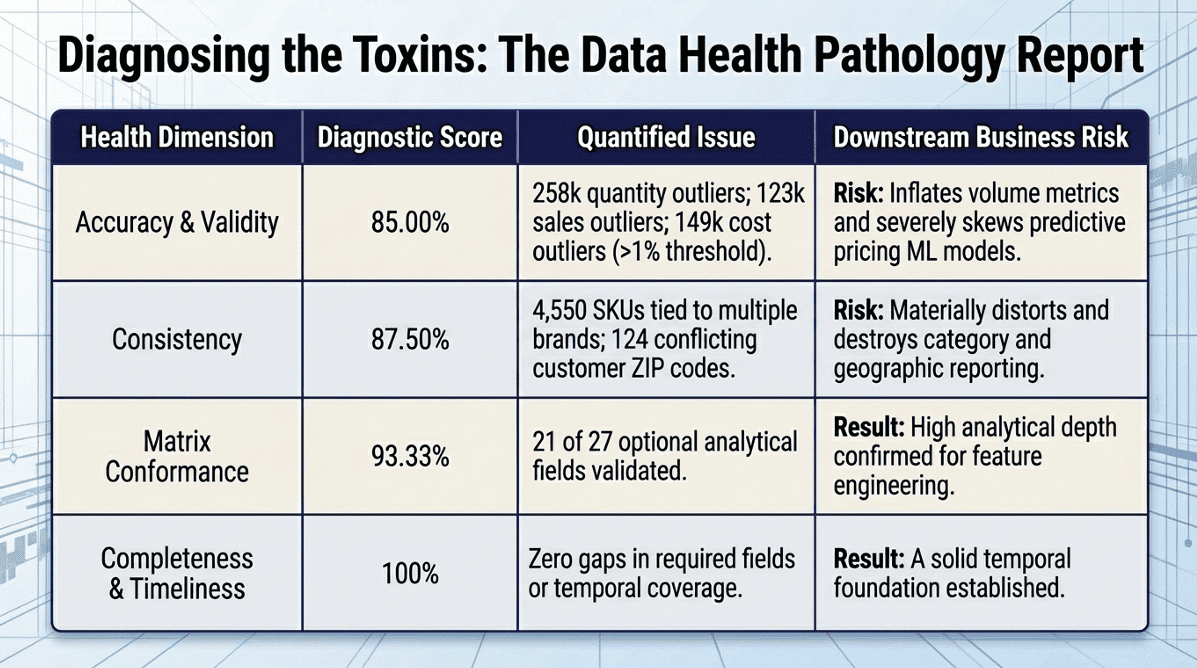
- Building the AI Analytical Foundation: A 93.17 Data Health Score Across 3.56M Transactions
- From ‘Good’ to ‘Excellent’: Engineering a Trustworthy Data Foundation Across 1.3M Transactions
Further reading
For broader industry perspective on revenue growth management and pricing analytics, see McKinsey’s Growth, Marketing & Sales insights.