


How do you turn loss-making customers into margin without losing volume?
Overview: Gross Margin Lift Playbook
This case study shows how an elasticity-driven gross margin lift playbook produced a 15% gross margin lift on chronically loss-making customer-SKUs at a mid-market distributor — without triggering unacceptable volume loss. The gross margin lift was delivered by isolating bottom-of-book accounts, simulating price moves with price elasticity evidence, and segmenting customers into recoverable versus structural loss leaders. The approach is now part of the client ongoing pricing playbook, proving that a sustainable gross margin lift requires both elasticity evidence and operational discipline, not just a pricing spreadsheet. See the full case study below, or read our related case study on Repairing the Customer Portfolio Tail.
Client Situation

Approximately $6MM of annual net sales at the distributor was transacted at gross margins below 5%, with a meaningful share of it carrying outright negative gross margin.
These transactions survived in the book of business because no one had the combined customer-SKU visibility to identify them, nor the elasticity evidence needed to act confidently on pricing without triggering unacceptable volume loss.
Leadership’s hesitation was rational: raising prices on chronically low-margin business felt risky without knowing which customers would walk and which would accept.
The Revify Approach
Identify — Bottom-of-Book Segmentation
- Isolated every customer-SKU combination transacting below a 5% gross margin floor over the trailing twelve months.
- Separated recoverable low-margin accounts from structurally correct loss-leaders (e.g., strategic lines, loss-leader bundles) to protect real commercial logic.
Simulate — Elasticity-Driven ‘What If’
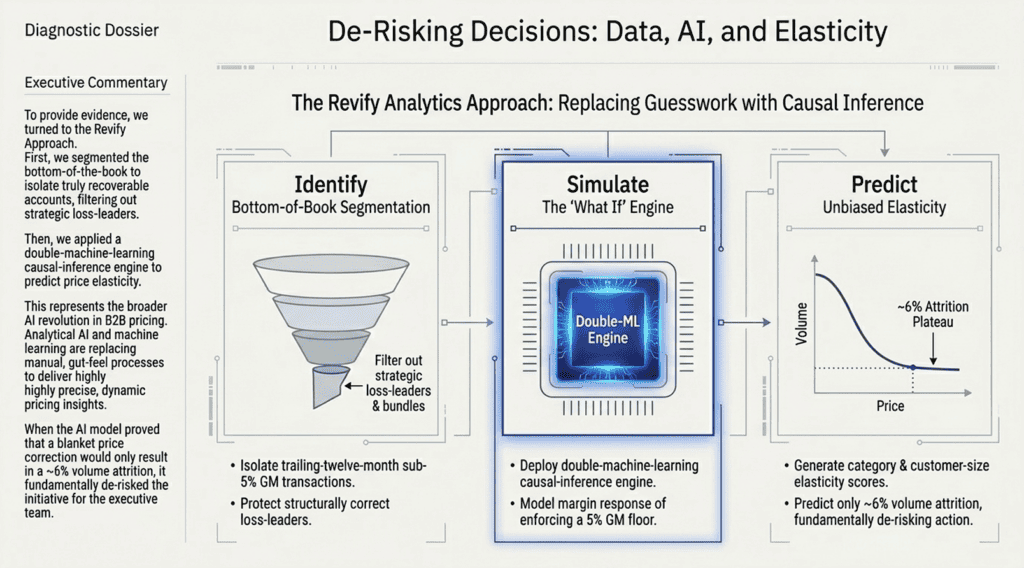
- Ran the Revify elasticity-aware simulation across the affected book to model the margin response of moving every sub-5% line to a 5% GM floor.
- Price elasticity models, built with a double-machine-learning causal-inference engine, produced unbiased elasticity scores at category and customer-size level.
- Simulation output predicted ~6% volume attrition on the affected book, not a blanket customer loss — the key insight that de-risked the move for leadership.
Execute — Staged Price Correction
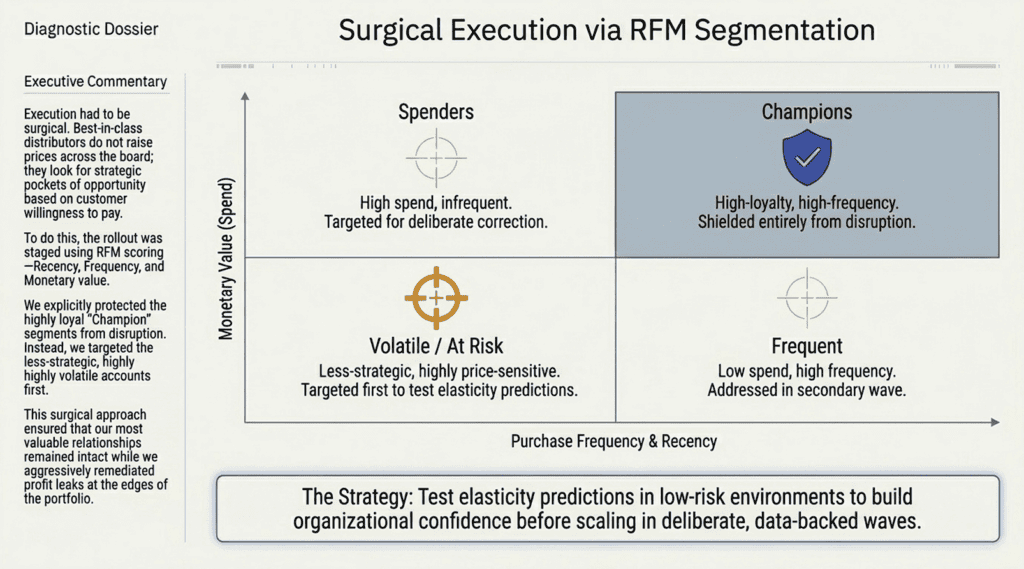
- Rolled out the margin-floor correction in waves, informed by RFM customer scoring (customer erosion predictions) to protect Champions and target less-strategic and less volatile accounts first.
- Built a monthly monitor to flag any new low-margin transactions for immediate sales review before they could take root.
Key Findings & Results
Moving the affected book to a minimum 5% gross margin delivered a net top-line improvement on the remediated accounts (a $0.4MM sales uplift, as pricing more than offset the modeled volume attrition) and a substantial gross margin lift.
Equally important, the engagement installed a persistent governance layer: the client now catches sub-5% GM transactions at invoicing cadence rather than discovering them in an annual review.
Starting with addressing this “low hanging fruit” has given management the confidence to tackle larger pricing initiatives and be data-driven in their decision making.
| IMPACT DIMENSION | QUANTIFIED BENEFIT |
| Top-line uplift from remediation | +$0.4MM |
| Gross margin uplift (minimum) | 15% |
| Volume attrition on affected book | Only ~6% (modeled & confirmed) |
| Annual sales audited for margin compliance | $6MM |
| New governance | Automated sub-5% GM monitor |
Why This Matters
| Every distributor has loss-making business hidden in plain sight. The unlock is not raising prices — it is knowing which prices to raise, by how much, and at what volume cost. Elasticity is what turns that judgment call into a decision. |
Conclusion
The combination of diagnostic rigor, elasticity-aware simulation, and disciplined staged execution turned a chronically unprofitable sub-5% book into a 15% GM contributor — with minimal volume loss and none of the strategic accounts disrupted.
The reusable methodology is now part of the client’s ongoing pricing playbook, not a one-time consulting project and the start of their roadmap towards pricing excellence.
Related Case Studies
- Repairing the Customer Portfolio Tail: $130K of Margin Recovered Without Losing Volume
- Stemming the Flow: $1.5–$3MM in Sales Recovery Through Customer Retention
Further reading
For broader industry perspective on revenue growth management and pricing analytics, see McKinsey’s Growth, Marketing & Sales insights.