

Why does category-level price-cost discipline matter more than aggregate?
Overview: Price-Cost Discipline at Category Level
This case study shows how rigorous price-cost discipline and category-level analytics protected $1.6MM of margin at a mid-market manufacturer by exposing divergence in the largest category before it compounded. Price-cost discipline, applied on a same-customer and same-SKU basis, eliminated mix contamination and surfaced the true pricing signal. The playbook proves that price-cost discipline at the aggregate level is not enough; category-level visibility is where structural margin leaks and replicable pricing excellence both show up — and monthly price-cost monitoring is now standard commercial cadence at the client. See the full case study below, or read our related case study on Reclaiming $1.7MM in Lost Price Realization.
Client Situation
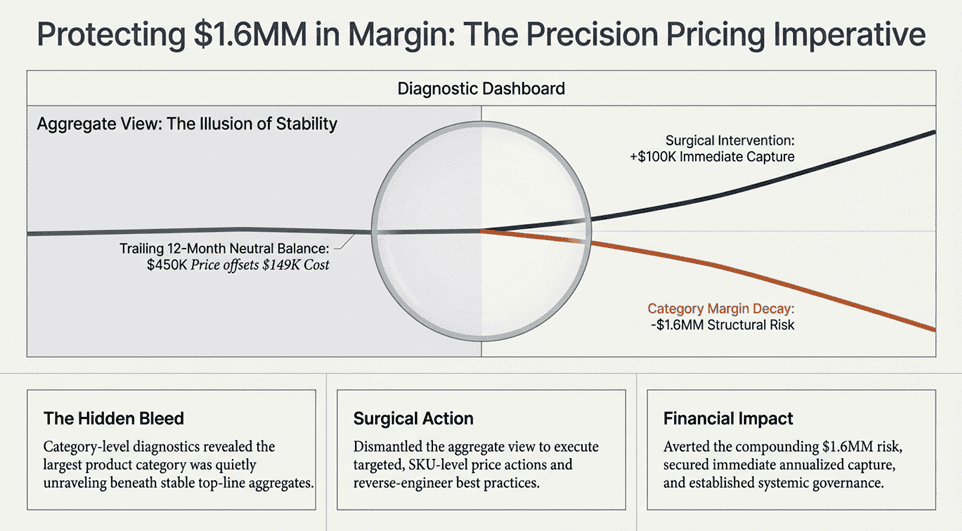
A mid-market industrial equipment manufacturer had managed aggregate Price-Cost through the trailing twelve months ($450K TTM YoY price benefit, roughly offsetting $149K of cost headwinds), but the aggregate hid a dangerous trend underneath.
Category-level analysis revealed an accelerating divergence: their largest category had price increases that were lagging cost increases, meaning margin-percent erosion was already underway and the opportunity — if left unaddressed — would expand past $1.6MM.
Smaller categories also showed important signal: one was the worst pricing performer (saved only by a favorable cost trend), while three others demonstrated replicable pricing excellence that no one had formally codified.
The Revify Approach
Diagnose — Same-Customer / Same-SKU Price-Cost Decomposition
- Analyzed Price-Cost on a same-customer, same-SKU basis to eliminate mix contamination from the true pricing signal.
- Trended Price and Cost YoY by category to separate one-off movements from structural deterioration.
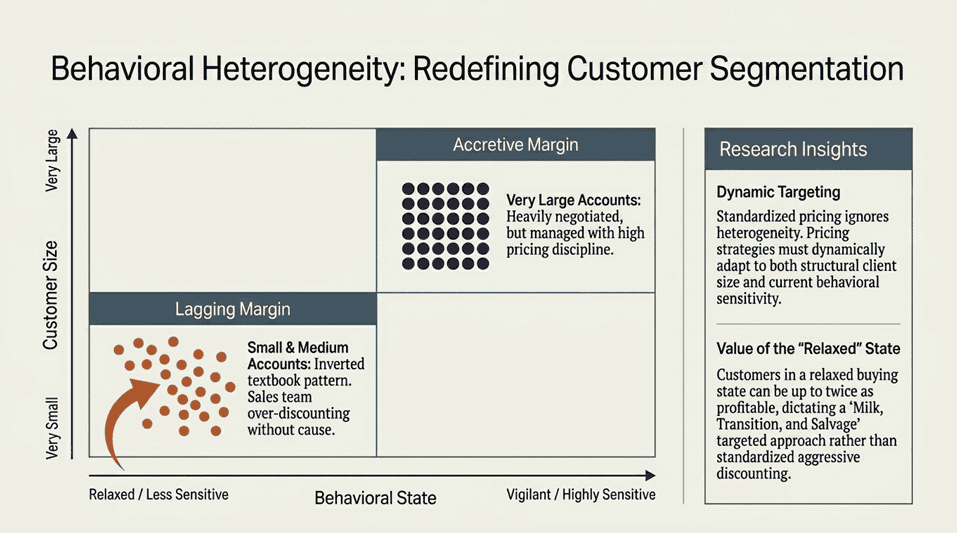
- Broke out Price-Cost by customer size tier and found the opposite of the textbook pattern: Price-Cost was accretive with Very Large customers and lagging with Medium and Very Small accounts.
Identify — Best Practices Worth Replicating
- Analyzed the three categories with the strongest price capture, with neutral or favorable cost — and identified key patterns worth reverse-engineering and applying elsewhere (discount management, customer price increase communication, etc.).
- In the biggest challenge category, East and South regions posted positive price alongside volume lift; West and Central did not. Isolated the regional playbooks behind the successful outcomes for potential scaling.
Prescribe — Category-Specific Actions
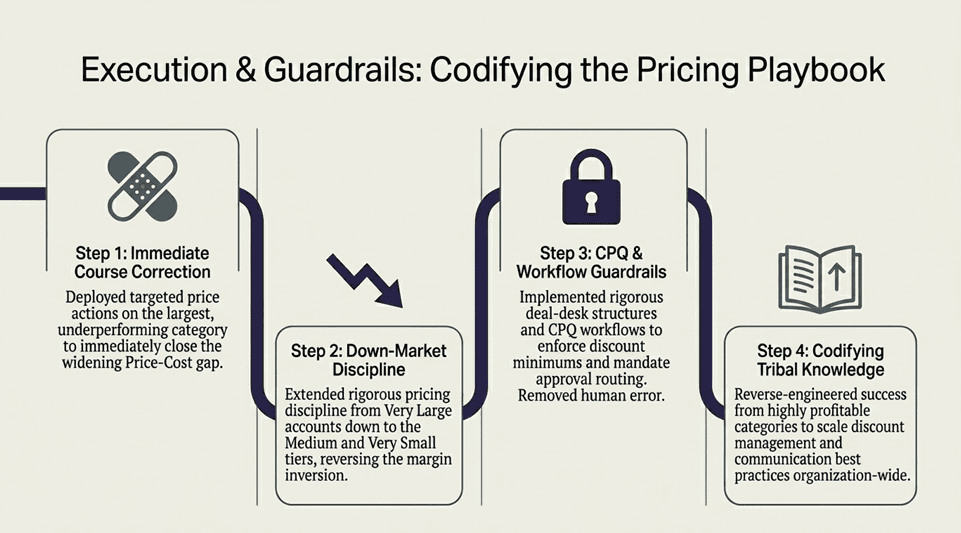
- Immediate price action on the largest category to close the widening Price-Cost gap before further GM% deterioration.
- Extension of Very Large-account pricing discipline down-market to Medium and Very Small segments, reversing the inverted Price-Cost pattern.
Key Findings & Results
The diagnostic quantified an immediate TTM opportunity of $100K+ and a growing opportunity of over $1.6MM as Price-Cost was lagging sequentially — with a category-by-category playbook for capture.
Replicable pricing practices from three high-performing categories were codified into cross-functional guidance, ending the reliance on tribal knowledge.
| IMPACT DIMENSION | QUANTIFIED BENEFIT |
| Immediate price opportunity (TTM) | $100K+ annualized |
| Growing opportunity if unaddressed | >$1.6MM |
| Price-Cost inversion by customer size | Corrected: discipline extended to Medium & Very Small tiers |
Why This Matters
| Aggregate Price-Cost was neutral. Category-level Price-Cost was quietly unraveling. The two-digit precision mattered — it exposed a $1.6MM divergence that would have stayed buried inside a ‘manageable’ top-line number. |
Conclusion
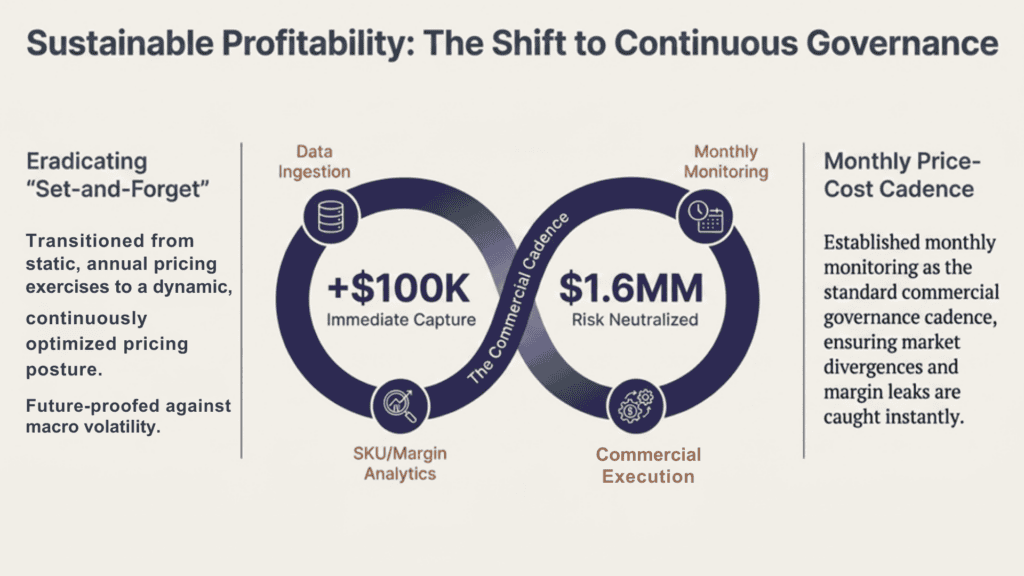
By refusing to settle for the aggregate view, the manufacturer identified and neutralized a structural margin leak before it compounded — and turned three high-performing categories into a pricing playbook the whole organization could learn from.
Monthly Price-Cost monitoring is now standard commercial cadence at this client, ensuring the same divergence is never allowed to build up again.
Related Case Studies
- Reclaiming $1.7MM in Lost Price Realization for a Mid-Market Distributor
- From Discount Chaos to Disciplined Tiers: Redesigning a Manufacturer’s Pricing Architecture
Further reading
For broader industry perspective on revenue growth management and pricing analytics, see McKinsey’s Growth, Marketing & Sales insights.