


By Enrico Sieni·Revify Analytics·July 2026·~13 min read
Table of Contents
| Most price increases fail after the announcement — not because customers say no, but because companies quietly give them back. Research shows the average B2B company realizes just 43% of the price increases it announces. Announce 6%, keep 2.8%. The rest leaks away through exceptions, delayed effective dates, and quiet discounts nobody tracks. In this guide, Enrico Sieni draws on two decades of pricing work with manufacturers and distributors to show what actually makes an increase stick: the account-level data to gather before you write a word, five ready-to-use letter and script templates, and the 30-60-90 day governance that separates announced increases from realized ones. It includes a real case where a $140MM distributor lifted realization from 45% to 81% — worth $2.1MM in annualized gross margin. If your last increase barely moved your margin, this article explains why — and exactly what to do differently next time. |
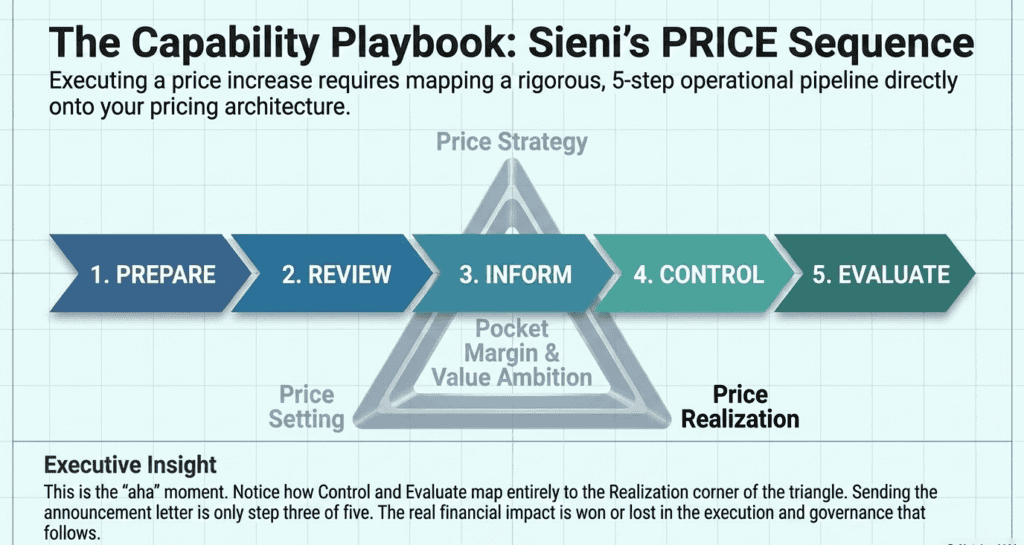
A practical framework for managing price increases is the PRICE sequence: Prepare the organization, Review account economics, Inform customers, Control concessions, and Evaluate realization. Preparation and review occur before any communication. Informing customers is the letter itself. Most financial impact is determined during the control and evaluation stages.
Part 1: Before the letter
Why do most price increases fail before the letter is sent?
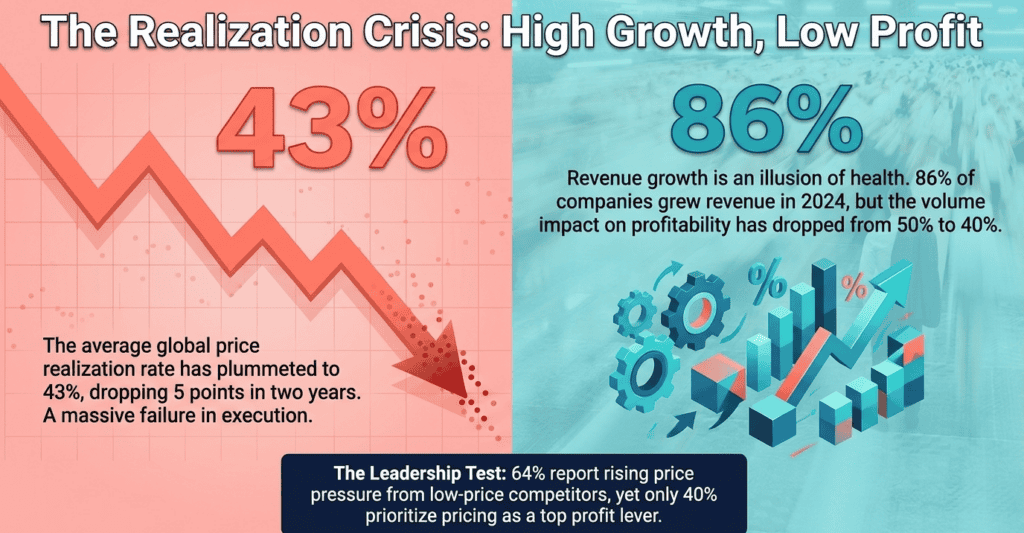
Announced and realized price increases are rarely the same, yet most mid-market companies only track the announced figure. Simon-Kucher’s 2025 Global Pricing Study, surveying over 2,200 business leaders in 28 countries, found average price realization at 43 percent, a five-point decline in two years. Announcing a 6 percent increase typically results in less than 3 percent realized. While the study cites customer resistance as the main barrier, our experience shows internal factors are more critical: sellers extending old pricing, expanding exception lists, and delayed effective dates.
Revify’s 2025 research found that 51 percent of companies lack a basic price waterfall, leaving them unable to track accumulating concessions. Price increases typically fail not in the customer’s inbox, but due to unmanaged leakage between list and pocket price over the next two quarters.
How do you set the expectation that prices will change?
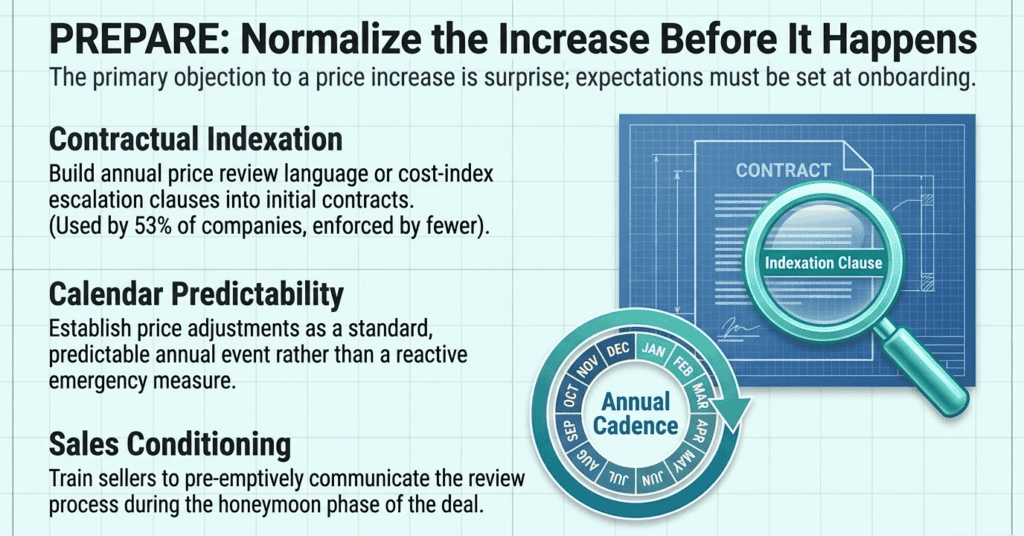
The primary objection to a price increase is often surprise, not the amount. Customers accustomed to years of unchanged pricing come to expect stability. When prices eventually rise, it can feel like a breach of trust rather than a standard business adjustment. Setting expectations should begin at onboarding, well before any formal communication.
Three practices help normalize future price increases. First, include review language in contracts from the outset, such as an annual price review clause or an escalation clause linked to a published cost index. Simon-Kucher highlighted a payment processor whose contracts allowed annual adjustments above a public index, making enforcement easier. Second, establish the annual price review as a predictable calendar event, communicated consistently each year. Third, train sales teams to communicate the review process clearly during initial negotiations. Sellers who set expectations early avoid apologetic negotiations later.
A consistent schedule distinguishes routine adjustments from exceptional ones. When unforeseen costs require an off-cycle increase, customers familiar with your annual process are more likely to view the change as credible. Base routine increases are tied to delivered value, service improvements, and supporting investments, as these justifications remain relevant longer than general market trends.
How do you remind customers of the value you already delivered?
A price-increase letter that focuses solely on your costs positions you as a vendor. Opening with the value delivered to the customer positions you as a partner. This requires evidence, which must be gathered in advance. Maintain a simple value ledger for each account, tracking key value events throughout the year. For distributors, this could include fill rates, emergency orders fulfilled within 24 hours, dispute-free returns, and consignment stock that reduces working capital. For manufacturers, track on-time-in-full performance, warranty claims avoided, engineering support hours, and reduced scrap.st items to money. Unplanned downtime hours avoided times their cost per hour. Order error rate cut from 2.1 percent to 0.4 percent times the average cost of a mispick. The math does not need to be audited. It needs to be specific, honest, and theirs. When the letter can say ‘our stocking program covered 14 emergency orders this year and kept your line running through the March supplier outage, which we estimate saved roughly $85,000 in downtime,’ the 5 percent increase on the next page has context. The customer is no longer comparing your new price to your old price. They are comparing it to what leaving you would actually cost.
What data do you need before you announce anything?
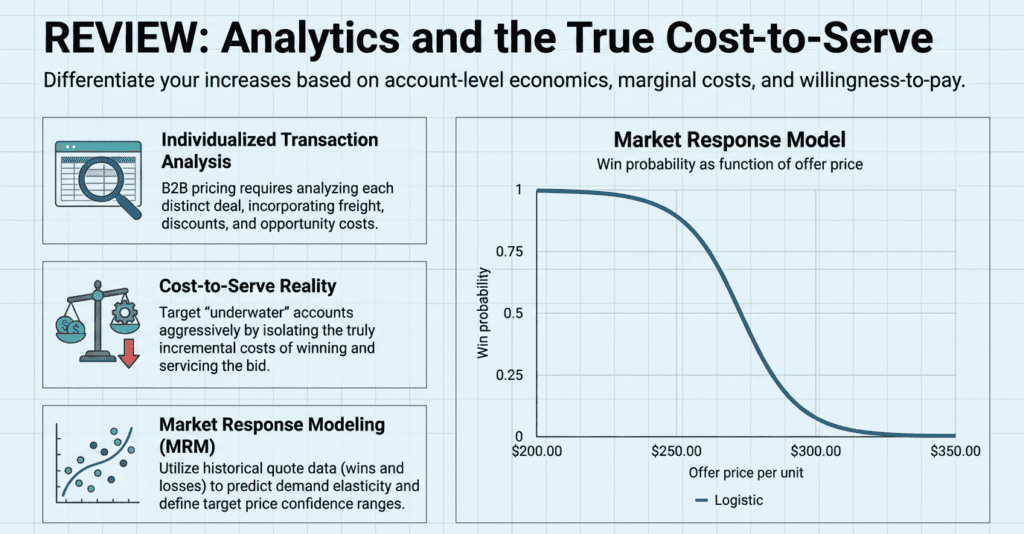
Three numbers per account, at a minimum. Cost-to-serve, so you know which customers are consuming freight, expedites, small orders, and support far beyond what their price covers. Customer-level margin and true net price, so the increase repairs the accounts that need repairing instead of taxing everyone equally. And each account’s realization history from your last increase, so you know who quietly negotiated their way out and needs a different conversation this time.
That data is what kills the peanut-butter increase, the flat 5 percent spread across the whole book. A flat increase overtaxes your best accounts, the ones already paying fairly, and undertaxes the ones eroding your margin. A differentiated approach might hold strategic accounts at 3 percent, move the middle at 5 percent, and take underwater accounts to 9 percent, with a cost-to-serve explanation attached.
How do you prepare your sales team before the announcement?
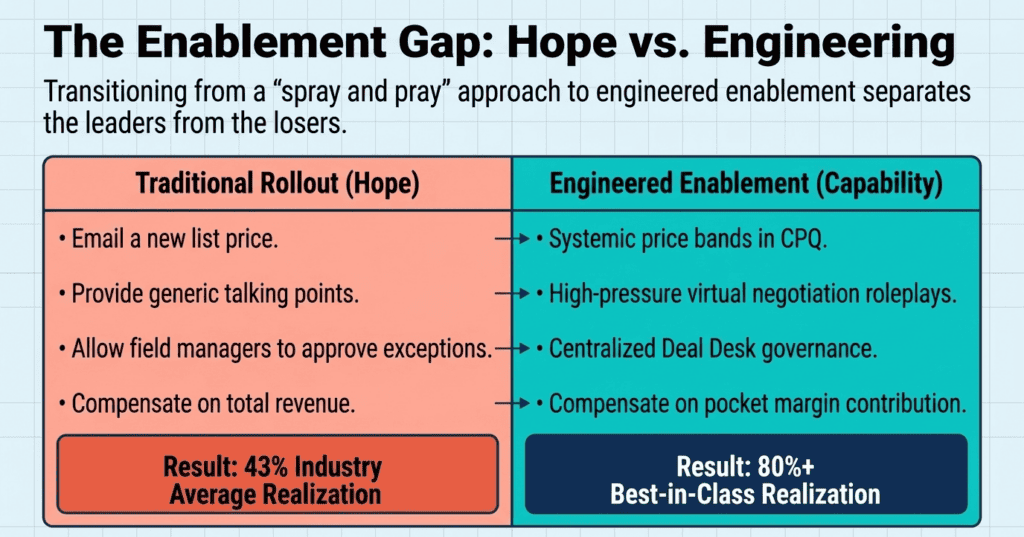
Many sources overlook this critical step, yet it is where price increases are truly defended. Before sending any communication, sellers need five tools: account-specific value recaps to provide evidence during pushback; written floors and guardrails per account to define negotiation limits; a one-page objection FAQ, rehearsed in role play; a clear exception policy detailing approval processes and expiration dates; and awareness that realization will be tracked and published by the seller. Record all customer reactions in the CRM, as these notes inform future segmentation.
Who gets a call, a letter, or a meeting?
Select the communication channel based on the account’s importance and the size of the increase. Strategic accounts should receive a conversation first, followed by a written letter and, if appropriate, an executive review. Mid-tier accounts receive a personalized letter or email from their representative, with an invitation to discuss. Transactional accounts receive a brief notice with updated price files. If an account faces an above-average increase due to cost-to-serve, escalate the communication: a letter becomes a call, and a call becomes a visit. Significant increases should never be communicated via form email.
| Before you send anything: the readiness checklist. Segment customers by margin, cost-to-serve, and strategic value. Decide who gets a conversation instead of an email. Set differentiated increase levels with floors per account. Review open quotations and decide the honor-by date. Build value recaps for the top 20 percent of accounts. Train and role-play the sales team. Write the objection FAQ and exception policy. Set approval rules and stand up the deal desk. Update ERP and portal price files for the effective date. Brief customer service before customers call. Schedule realization reviews at 30, 60, and 90 days. |
Part 2: The letter
What should a price increase letter to customers actually say?
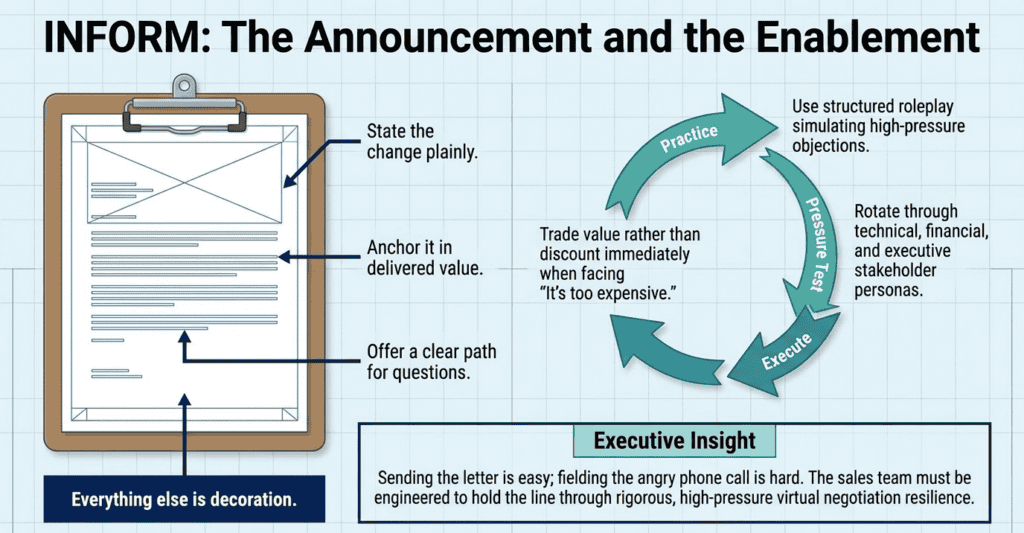
A price increase letter should include five elements, in order: the change itself (percentage or new price, effective date, and specific products or services affected); a concise, respectful explanation; a value anchor highlighting one or two quantified benefits delivered this year; a statement of what remains unchanged, reinforcing retention; and a named contact with a direct phone number to encourage direct communication.
Exclude two things from your letter: apologies, which suggest the price is negotiable, and hidden pricing details. State the increase clearly and early, as buyers often skim and may distrust information that is difficult to find.
1. Price increase letter to customers: the annual review version
| Subject: Annual price review, effective March 1 Dear [Name], As part of the annual price review we hold each year, prices on [product lines] will increase by [X] percent effective [date]. Orders placed before [date] will be honored at current pricing. This year our team [one quantified value line: covered 14 emergency orders, held 98.2 percent fill rate against your 95 percent target, and kept your March changeover on schedule]. We estimate that performance saved your operation roughly [$ amount] in avoided downtime and expedite costs. Your terms, dedicated account team, and service levels are unchanged. If you would like to walk through the numbers or discuss volume commitments for the coming year, call me directly at [phone]. [Name, Title] |
2. The cost-driven letter, for off-cycle increases
| Subject: Price adjustment on [category], effective [date] Dear [Name], Since [month], our input costs on [material or freight lane] have risen [X] percent. We have absorbed that increase for [N] months while renegotiating with suppliers and rerouting freight. We have recovered part of it. The remainder requires a [X] percent adjustment on [specific lines] effective [date]. Pricing on all other lines is unchanged. We will review this adjustment at our regular annual review in [month], and if input costs retreat, the adjustment will be reconsidered. Questions to me directly at [phone]. [Name, Title] |
3. The value-recap email for key accounts
| Subject: Your 2026 results with us, and pricing for next year Hi [Name], Before pricing, the year in review. Together we [three quantified outcomes from the value ledger: cut your order error rate from 2.1 to 0.4 percent, reduced emergency freight spend by $ amount, held OTIF at 97 percent through two supplier disruptions]. To keep investing in that performance, pricing on your program moves [X] percent on [date]. I would rather discuss this in person than in email. Can we take 20 minutes this week? I will bring the account review. [Name] |
4. The short notice for transactional accounts
| Subject: Price update effective [date] Dear Customer, effective [date], list prices on [categories] will increase by [X] percent. Updated price files are attached and available in the portal. Quotes issued before [date] remain valid through their stated expiration. For questions, contact [name] at [phone or email]. |
Subject lines that get opened
Use factual, dated subject lines. Vague subjects are often ignored, while alarming ones may be escalated unnecessarily. Effective examples include: ‘Annual Price Review, Effective March 1’, ‘Upcoming Pricing Update for [Company]’, ‘2027 Pricing Notification’, ‘Annual Contract Price Review’, ‘Price Adjustment on [Category], Effective September 1’, and ‘Your 2026 Results With Us, and Pricing for Next Year’. Avoid generic or apologetic subject lines such as ‘Important Update’.
What not to say (and what to say instead)
| Instead of | Write |
| Unfortunately, we must raise prices… | As part of our annual price review… |
| Due to circumstances beyond our control… | To continue providing [specific service level]… |
| We hope you understand… | This adjustment allows us to keep investing in [what they value]… |
| We regret to inform you… | Effective March 1, pricing on [lines] moves [X] percent. |
| Please don’t hesitate to reach out… | Call me directly at [phone] to walk through the numbers. |
Adapting the wording by industry
The structure holds across sectors; the value anchor changes. Here are some examples by industry:
Industrial distribution: fill rate, emergency coverage, VMI working-capital relief.
Chemicals: feedstock indexation, spec consistency, regulatory documentation handled.
Building products: job-site delivery windows, quote-to-close speed, honoring quotes through a project’s life.
Packaging: changeover support, inventory buffering, scrap rates on their line.
Food manufacturing: audit readiness, traceability, and short-order recovery.
SaaS and services: uptime, adoption gains, hours saved, named-team continuity, with increases usually tied to the renewal date rather than a calendar month.
A note on contracts and legal considerations
None of this is legal advice, but four realities shape what you can send. The contract governs: if pricing is fixed for a term with no escalation clause, you wait for renewal. Required notice periods vary by agreement, jurisdiction, and sector, so confirm before setting the effective date. Government and public-sector contracts follow their own change procedures entirely. Distributor and international agreements often carry their own escalation or notice terms, and cross-border customers may expect longer lead times. When in doubt, have counsel review the notice before it ships.
Part 3: After the letter
How do you negotiate pushback without giving the increase back?
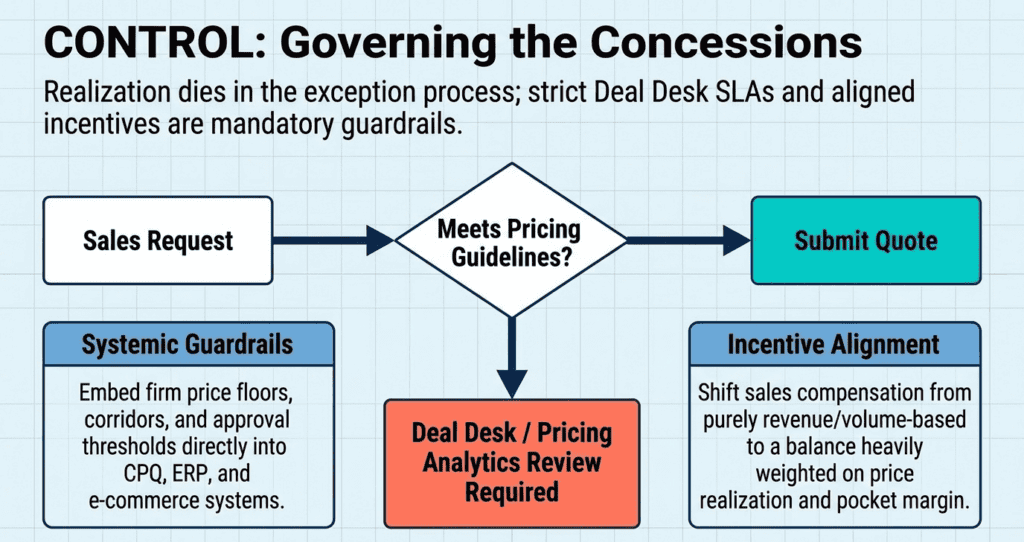
Anticipate pushback from approximately 20 percent of accounts and prepare accordingly, as unplanned concessions often reduce realized increases. When a customer requests a smaller increase, do not respond immediately. First, ask, ‘What concerns you most?’ Their response will guide the negotiation. For budget timing, offer a phased effective date. For cash flow concerns, adjust payment terms in exchange for full pricing. If the issue is the price itself, negotiate commitments such as volume tiers, longer terms, order consolidation, or improved forecast accuracy. If the objection is a disguised service complaint, address the service issue while maintaining the price.
The rules that protect realization: sellers cannot waive the new pricing alone, every exception has an expiration date, and every concession trades for a commitment. A phased effective date is usually the cheapest concession you can give and the easiest for a customer to accept. The rare account that credibly threatens to leave deserves a real decision, not a reflex. Pull its margin and cost-to-serve. Some accounts are worth saving at a smaller increase. Some are churn; you should stop subsidizing. Knowing which is which before the call is the whole game.
5. The key-account conversation script
| Open with the ledger, not the price: ‘Before we get to next year, here is what this year looked like.’ Walk two or three quantified outcomes. Then state the change without a wind-up: ‘Pricing on your program moves 4 percent on March 1.’ Stop talking. Let them respond. If they push, ask what matters most to them, then trade structure rather than points: longer commitment for a phased effective date, volume tier for a smaller move. Never leave the room having given a discount without getting a commitment back. |
6. The objection-handling script for your sellers
| ‘Your competitor is cheaper’: ‘On unit price, possibly. Last year our fill rate and emergency coverage saved you around [$ amount] in downtime. I am happy to compare total cost side by side.’ ‘We did not budget for this’: ‘Which is why we announce in January for March. I can phase it, half on March 1 and half on June 1, in exchange for a 12-month commitment.’ ‘Waive it or we bid it out’: ‘I cannot waive it, and I would rather earn the business than buy it. If we lose on a fair comparison, that is on us. Can we do the comparison first?’ Every concession runs through the deal desk, and every concession trades for something. |
How do you know the increase stuck?
Measure realization, per account and per seller, starting the week the new pricing takes effect. The formula is simple:
| Price realization % = realized net price change ÷ announced price change. Announce 6 percent and land 2.8 net of exceptions, delays, and give-backs, and your realization is 47 percent. |
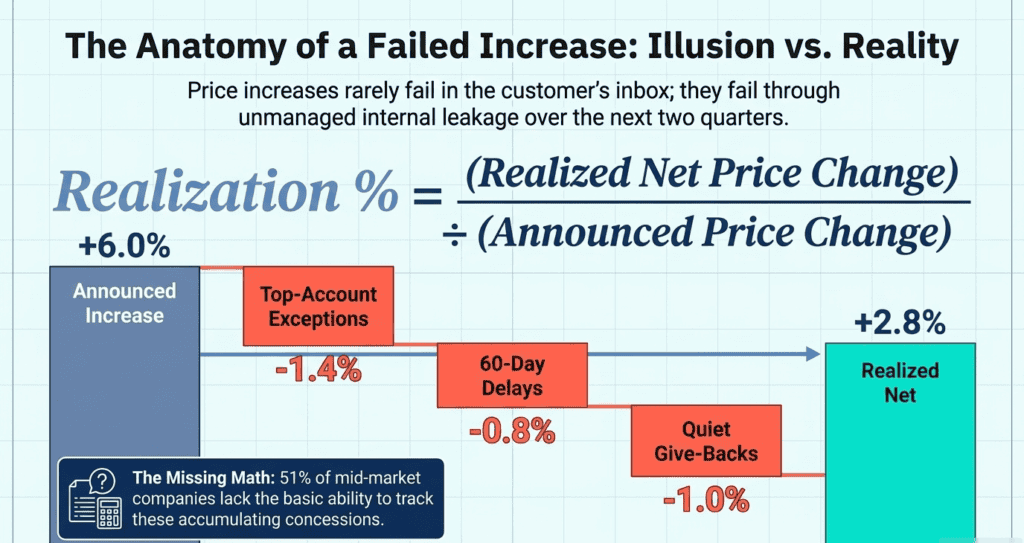
Here is how a typical 6 percent announcement erodes at a distributor without governance:
| Step | Impact |
| Announced increase | +6.0% |
| Exceptions granted to top 20 accounts | -1.4 pts |
| Seller-negotiated 60 to 90 day delays | -0.8 pts |
| Quiet discount give-backs over two quarters | -1.0 pts |
| Realized net price change | +2.8% |
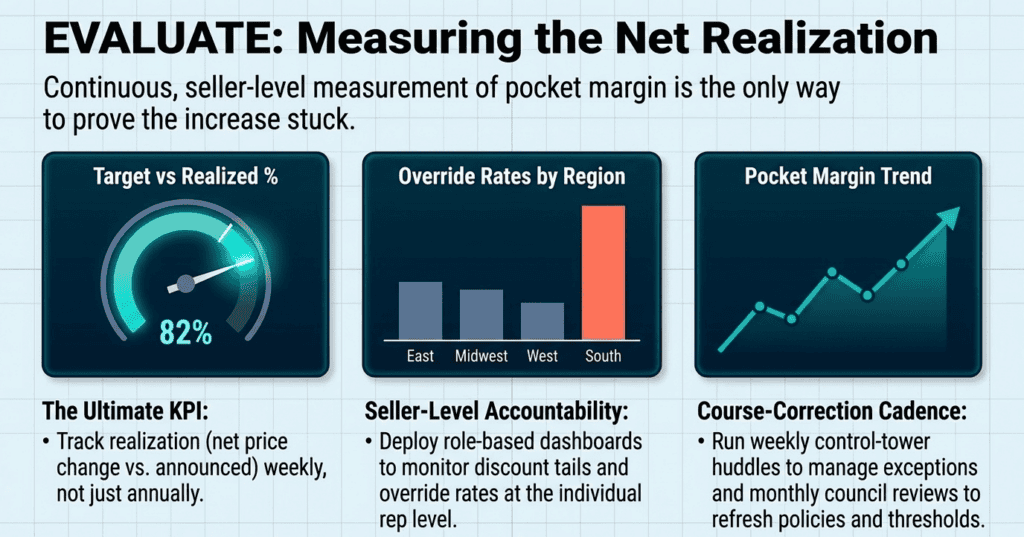
Realization is the primary metric, but a comprehensive dashboard should also track key drivers: acceptance rate (accounts on new pricing without exceptions), exception rate, and average concession size, delays relative to the effective date, average days to acceptance, margin improvement versus plan, customer retention, and revenue retained. Publish seller-level results weekly during the first quarter, as visible measurement drives accountability.
The 30-60-90 day follow-through
Week 1: Confirm that top accounts have received and reviewed the notice; lack of response does not indicate acceptance.
Week 2: Review objections received by sales and customer service, and update the FAQ for recurring questions.
Week 3: Audit exception requests for compliance with policy and address any that bypassed the deal desk.
- Day 30: Compare announced versus realized increases by segment and adjust as needed.
- Day 60: Publish seller scorecards and provide coaching to the lowest performers.
- Day 90: Conduct an executive review of the full price waterfall, retention, and margin improvement, and document lessons learned for future planning.
This disciplined approach distinguishes companies that realize increases from those that only announce them.
Common mistakes, at a glance
| Mistake | Better approach |
| Apologizing in the letter | State the change confidently, anchored in value |
| Long justifications | One honest sentence on the reason |
| Same increase for everyone | Segment by margin and cost-to-serve |
| Negotiating the moment a customer objects | Ask what concerns them most, then trade |
| Announcing with no follow-up | Track realization at 30, 60, and 90 days |
| Exceptions approved by email | One deal desk, expiration dates on every exception |
| Case: a $140MM industrial distributor makes its increase stick. Situation: The distributor had announced 5 percent increases two years running and could not explain why gross margin barely moved. No price waterfall, no seller-level tracking, exceptions approved by email.Actions: Before the next annual letter, we built customer-level cost-to-serve and net price views, replaced the flat 5 percent with tiered increases of 3 to 9 percent, armed sellers with account-specific value recaps and floors, and routed every exception through a weekly deal desk with expiration dates.Result: Realization on the new increase reached 81 percent within 90 days, versus an estimated 45 percent the prior year, worth roughly $2.1MM in annualized gross margin. Customer attrition stayed within its historical range. |
Frequently asked questions
How much notice should you give customers for a B2B price increase?
30 to 60 days is the standard working period for mid-market B2B. Key accounts with budget cycles deserve 60 to 90 days and a conversation before the letter is sent. Shorter notice is defensible for genuine cost shocks if you say so plainly and commit to a review date.
Should you call customers before sending the letter?
For strategic accounts, yes, always. The letter then confirms a conversation that already happened, which removes the surprise that drives most pushback. Transactional accounts can receive the letter directly.
How often should you raise prices?
Annually, on a predictable cadence, even if the move is small in some years. Regular small adjustments are easier to accept and to realize than a large catch-up increase after years of frozen pricing.
How much of a price increase is reasonable?
Whatever your account-level economics justify. In practice, mid-market B2B annual reviews commonly land between 3 and 7 percent, differentiated by segment, with underwater accounts corrected more aggressively, accompanied by a cost-to-serve explanation.
Can you raise prices mid-contract?
Only if the contract allows it, through an escalation clause, a cost pass-through provision, or a scheduled review. If it does not, you wait for renewal, which is exactly why review language belongs in every new agreement from day one.
Should you negotiate after sending the letter?
Be willing to structure, not to retreat. Trade phasing, terms, or volume commitments for acceptance through a deal desk with expiration dates. A quiet, unconditional discount signals to the customer that the letter was an opening bid.
Should strategic customers receive different letters?
Yes. Strategic accounts get a conversation plus a personalized value-recap letter. Mid-tier accounts get a personalized letter from their rep. Transactional accounts get the short standard notice. Same facts, different depth.
What if a customer threatens to leave over the increase?
Check the account’s margin and cost-to-serve before responding. Save the profitable ones with structured trades, a phased date, or a volume commitment. Let the chronically unprofitable ones test the market.
| Start Your Profit Diagnostic.See how much of your last price increase you actually kept, and what a governed one is worth. Revify runs the diagnostic in 2 to 3 weeks, no pricing team required. |
About the author
| Enrico Sieni Co-Founder, Revify Analytics Enrico Sieni has spent more than two decades leading pricing and revenue growth for manufacturers and distributors. He has built and run three pricing teams from the ground up, which is part of why he is convinced most mid-market companies do not need one of their own. At Revify Analytics, he helps these companies install the discipline, governance, and seller-level tracking that turn price realization from a once-a-year surprise into a number they manage every week. He writes about the practical side of pricing: what actually moves margin, and what only sounds good in a deck. |