


By Enrico Sieni·Revify Analytics·June 2026·~14 min read
| SKU rationalization is the disciplined review of every product you sell, judged on margin after cost-to-serve and on the role each item plays, to decide what to keep, reprice, phase out, or delist. Done well, it is one of the fastest ways for a mid-market manufacturer or distributor to recover margin and free up cash, without losing the customers that matter. It is a profit lever, not a tidiness project. |
Table of Contents
Why does SKU rationalization matter more than chasing volume?
At first glance, most mid-market manufacturers and distributors seem free of SKU issues, with rising revenue and expanding catalogs. However, hidden costs and cash tied up in the long tail of SKUs often emerge.
In most portfolios, a small share of SKUs earns the majority of the margin, while a long tail of slow movers earns almost none and still demands shelf space, working capital, purchase orders, and attention. Bain & Company’s research on focused portfolios is direct about the pattern. In many businesses, roughly 20 percent of products generate the bulk of the economic value, and companies with the simplest portfolios tend to grow about three times as fast as those with the most complex portfolios. The reason is not the product count itself, but the work each additional SKU sets in motion across forecasting, purchasing, production, inventory, pricing, and service.
The true cost is often underestimated because standard accounting does not reveal it. McKinsey estimates that product complexity costs US food-and-beverage manufacturers up to $50 billion in gross profit annually, a figure not reflected on any single P&L line. This pattern is also seen in industrial manufacturing and distribution, where catalogs expand incrementally.
For distributors, complexity increases rapidly. Ten thousand active SKUs sold to a thousand customers result in ten million possible price points, each with unique cost-to-serve and margin profiles. SKU rationalization should be a CFO priority, as it is one of the few strategies that can improve margin and free up cash simultaneously.
The hidden cost of SKU complexity
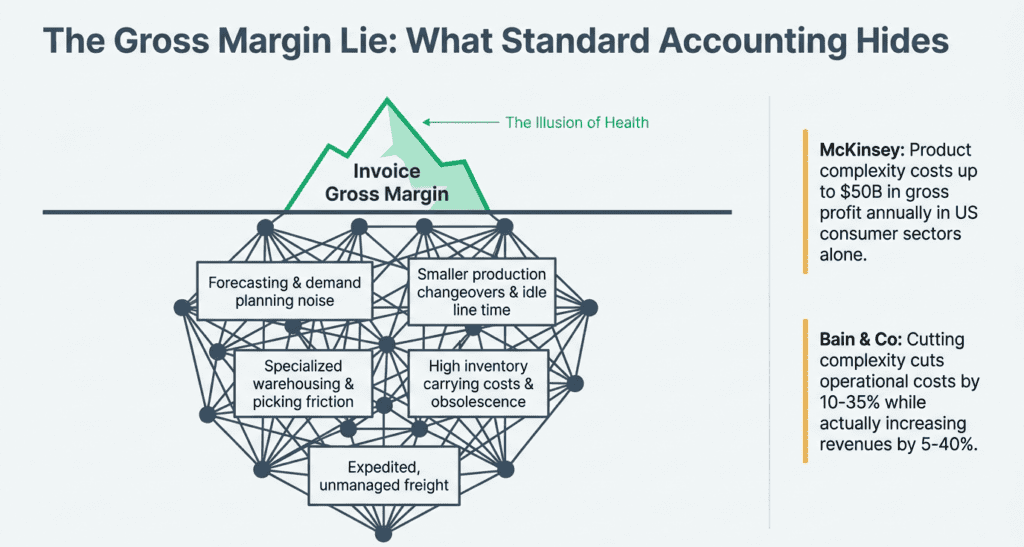
Cost-to-serve shows why a specific SKU may lose money, while complexity cost explains broader portfolio underperformance and highlights the value of SKU rationalization. Most costs triggered by additional SKUs are not directly reflected on the P&L.
McKinsey’s research on portfolio complexity outlines this clearly. A broader catalog complicates demand planning and increases out-of-stock and carrying costs. Smaller, specialized runs lead to more changeovers, idle line time, and lower fill rates. Crowded assortments allow channel partners to negotiate more discounts. These costs do not appear in gross margin, leading leaders to underestimate them.
A single new SKU can touch all of the following:
- Forecasting and demand planning
- Procurement and purchasing, with smaller and more specialized orders
- Production planning, setup, and changeovers
- Warehouse slots, picking, and inventory carrying cost
- Quality, engineering, and specification management
- Customer service and order support
- Pricing administration and quoting
- ERP and master-data maintenance
- Supplier management and minimum order quantities
The evidence is hard to ignore. McKinsey documents a consumer-product company whose SKU count grew by more than half over three years while sales per SKU fell by more than a third and margins dropped by about 10 percent. The reverse works too. Bain describes a business that cut SKUs by 40 percent and saw inventory days fall roughly 60 percent while revenue rose. Less complexity, more profit, usually better service.
What actually drives cost-to-serve
Two SKUs can show the same gross margin and very different real profitability. The gap is cost-to-serve, and rationalization depends on measuring it rather than guessing. For each SKU, look at:
- Order frequency and average order quantity
- Warehouse touches and picks per order.
- Customer support and quoting time
- Returns and restocking
- Expedited and absorbed freight
- Production changeovers and short runs
- Packaging and labeling complexity
- Engineering or specification support
- Minimum order quantity exceptions
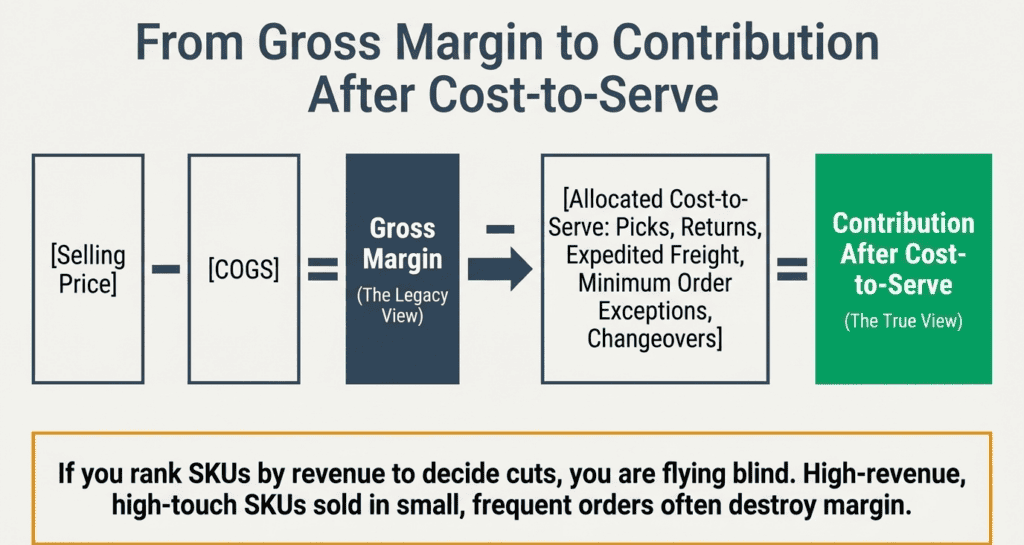
Allocate these costs to each SKU’s volume to quantify the impact of small orders. This approach addresses the main reason revenue-based rankings can be misleading.
Five formulas to put numbers on it
A data science team is not required for core rationalization analysis. Five key formulas provide most of the necessary insight:
- Contribution margin = selling price minus variable cost
- Contribution after cost-to-serve = selling price minus COGS minus cost-to-serve
- Inventory carrying cost = average inventory value times the annual carrying rate
- SKU productivity = revenue divided by active SKU count
- Margin recovery = new contribution minus old contribution.
Apply the first two formulas at the SKU level to identify underperformers. Use the last three at the portfolio level to estimate rationalization benefits before making pricing changes.
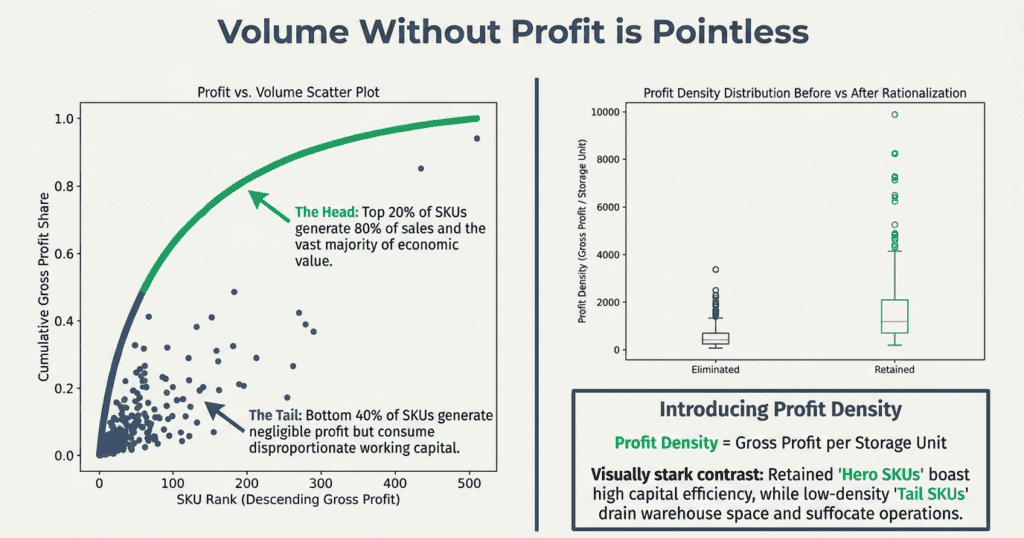
How do you know which SKUs are actually unprofitable?
A common mistake in SKU rationalization is ranking SKUs by revenue and cutting those at the bottom. Revenue can obscure true costs. High-revenue SKUs sold in small, frequent orders to dispersed customers may be unprofitable after accounting for handling, freight, and returns.
The number that matters is contribution margin after cost-to-serve, not the gross margin on the invoice. With the cost drivers above allocated, the real losers surface.
The four signals of a value-destroying SKU
- Thin or negative pocket margin once you net out discounts, rebates, and freight.
- High cost-to-serve: small orders, frequent changeovers, special handling, or high return rates.
- Low strategic role: no anchor customer depends on it, and it does not drive other sales.
- Easy substitution: a similar SKU you already stock can absorb the demand.
If a SKU meets three or four of these criteria, consider repricing, phasing out, or delisting it. If only one applies, a price adjustment or minimum order quantity may be enough. Start rationalization by evaluating these signals, not by targeting a specific number of cuts.
The 7-step SKU rationalization playbook
The following SKU rationalization sequence leverages data already available in your ERP system and can be initiated without a dedicated analytics team.
Step 1. Build the SKU-level P&L
Extract revenue, units, and COGS by SKU for the past twelve months. Most ERP systems can provide this data efficiently. Aim for a dataset with one row per SKU, including gross margin in both dollar and percentage terms. This forms your baseline.
Step 2. Add cost-to-serve
Incorporate the costs not captured by gross margin, such as handling, picking, freight, returns, changeovers, support, and complexity-related overhead. Each SKU will then reflect its contribution margin after cost-to-serve, making underperformers more visible.
Step 3. Score each SKU on the keep-or-cut grid
Plot each SKU on two axes: profitability after cost-to-serve and strategic role. This approach categorizes SKUs into four groups: keep and grow, keep and adjust price, monitor, or exit. The grid simplifies complex data into actionable decisions.
Step 4. Map substitution paths
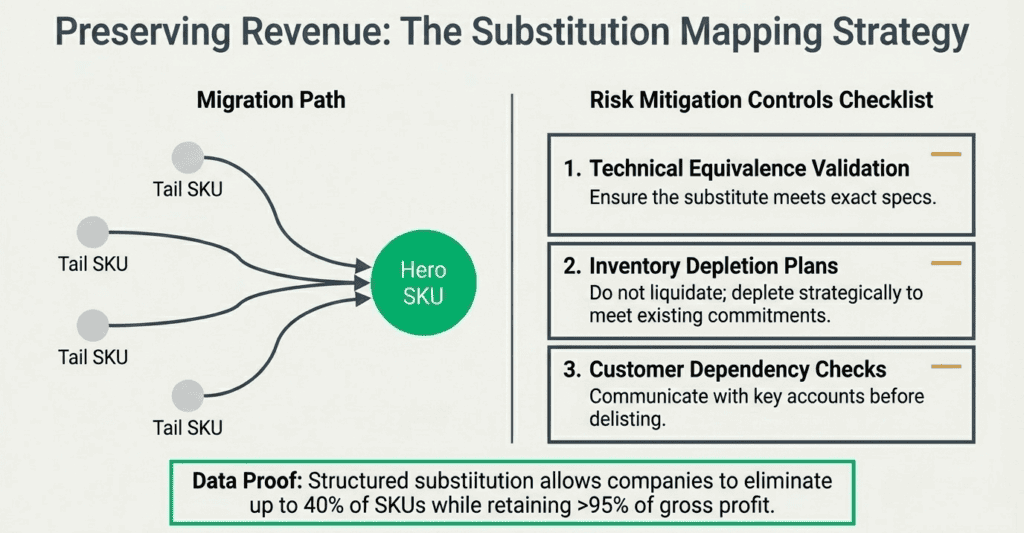
Before removing any SKU, determine where its demand will shift. For most tail SKUs, a similar product can absorb the demand. Mapping this path first helps protect revenue during rationalization and is often overlooked.
Step 5. Decide: keep, reprice, phase out, or delist
Evaluate each SKU individually. Retain high performers, reprice in-demand but unprofitable items, phase out slow movers with substitution options, and delist obsolete stock.
Step 6. Sequence the phase-out and talk to customers
Avoid removing large numbers of SKUs at once. Sequence rationalization based on customer concentration. For accounts dependent on a discontinued SKU, discuss substitution options before changing the catalog.
Step 7. Lock the gate so the tail does not grow back
Rationalization must include controls to remain sustainable. McKinsey recommends a one-in, one-out policy, where each new SKU replaces an existing one. Implement a margin floor, approval threshold, and quarterly review to prevent SKU proliferation.
Classify before you cut: ABC, XYZ, and lifecycle.
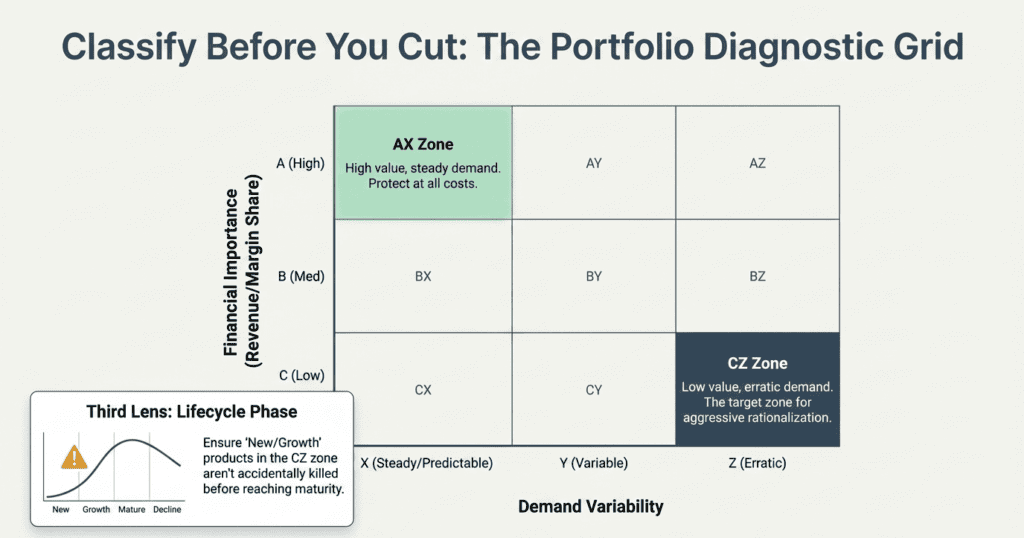
Before SKU rationalization reaches the keep-or-cut grid, classify the catalog. Three main approaches are most effective, and operations teams are already familiar with the first two.
ABC and XYZ analysis
ABC analysis ranks SKUs by financial importance: A items are the vital few that drive the most revenue or margin, C items are the trivial many. XYZ analysis ranks SKUs by demand variability: X items sell steadily and predictably, Z items are erratic and hard to forecast. Put the two together, and the corners tell you what to do.
- AX, high-value and with steady demand, almost never gets cut.
- CZ, low value and erratic demand, deserves the most scrutiny and is where most rationalization happens.
- The large middle needs judgment, which is what the scoring model below is for.
Product lifecycle
Classify each SKU by its lifecycle stage: new, growth, mature, declining, or end-of-life. This prevents discontinuing products that have not reached their potential. A low-volume SKU in growth is an investment, while the same SKU in decline is a liability. Lifecycle classification ensures you do not eliminate future high performers.
The keep-or-cut decision criteria
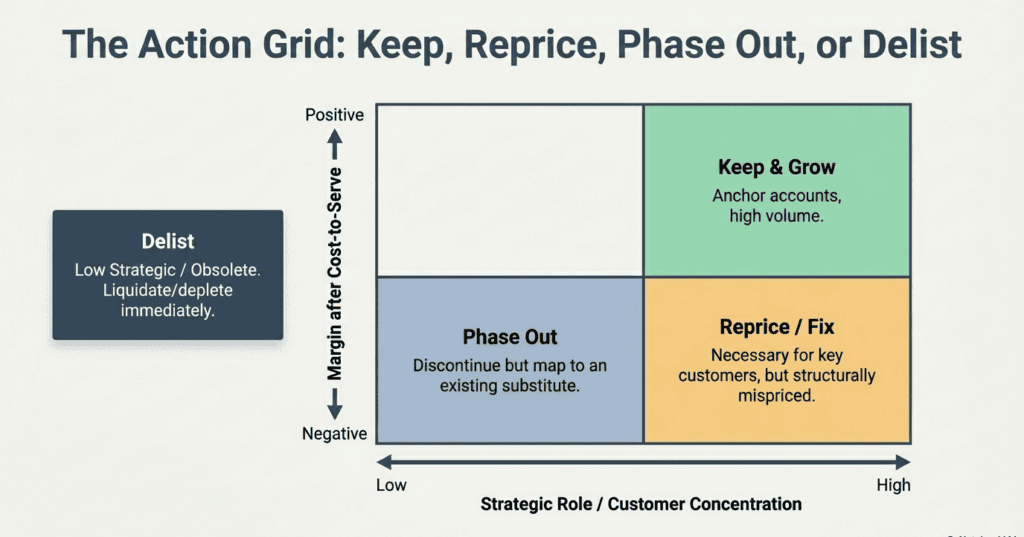
To keep the grid honest, score every SKU on the same factors. This is the rationalization decision tool we hand clients.
| Factor | Keep / grow | Fix or exit |
| Margin after cost-to-serve | At or above target | Thin or negative |
| Cost-to-serve | Normal order size and handling | Small orders, special handling, high returns |
| Strategic role | Anchors an account or pulls other sales | Stands alone, no pull-through |
| Substitutability | Hard for the customer to replace | Adjacent SKU can absorb demand |
| Customer concentration | Broad demand | One or two accounts, easy to manage directly |
Score each SKU on all five. Items landing on the right for three or more factors are your phase-out and delist candidates.
For portfolios where the middle is large, consolidate the factors into a single weighted rationalization score to keep decisions consistent across thousands of SKUs. One workable weighting:
| Factor | Weight |
| Contribution margin after cost-to-serve | 30% |
| Cost-to-serve | 20% |
| Strategic customer importance | 20% |
| Growth potential | 10% |
| Demand stability | 10% |
| Substitute availability | 10% |
Adjust the weighting to fit your business needs. Consistency in rationalization scoring matters more than the exact percentages used.
The SKU rationalization decision in one pass: keep, reprice, phase out, or delist
For a fast first rationalization pass across the whole catalog, walk each SKU through four questions in order:
- Is the contribution after cost-to-serve positive? If yes, go to the next question. If no, skip to question three.
- Does the SKU serve a strategic customer or drive other sales? If yes, keep it. If no, keep it for now but flag it for a price review.
- For a negative-contribution SKU, is there an adjacent product the customer can move to? If yes, phase it out and map the substitution.
- If a negative-contribution SKU has no easy substitute, reprice it. A product customers genuinely need but that loses money is a pricing decision, not a deletion.
These four questions address the majority of SKUs. Those that remain unresolved merit further discussion.
When a weak SKU sits inside a strong account
Some underperforming SKUs are linked to key customers, so the focus should shift from cutting the SKU to transitioning the customer to a better alternative. Before delisting SKUs tied to important accounts, assess the overall profitability of the relationship and plan a migration path. Removing a minor loss-making SKU may be counterproductive if it risks a valuable customer relationship. This is why customer concentration is included in the evaluation.
What not to cut
A credible rationalization is as clear about what stays as about what goes. Some SKUs earn their place for reasons that never show up in a margin column. Protect these unless you have a strong, specific reason not to:
- Regulatory or compliance products you are required to carry.
- Safety-critical items customers expect you to stock.
- Contract-required SKUs tied to existing agreements.
- Strategic loss leaders that anchor a profitable account.
- Emerging products are still early in their lifecycle.
- Items you need to keep a key supplier relationship healthy.
Defining the protected list in advance ensures transparency and prevents essential SKUs from being removed.
What does SKU rationalization actually recover?
SKU rationalization pays off in two places at once: margin on the SKUs you keep and reprice, and cash freed from inventory you no longer carry. Here is how the math typically runs for a mid-market distributor. The figures below are illustrative, not a specific client result.
| Metric | Before | After |
| Active SKUs | 4,200 | 2,750 |
| Long tail as a share of SKUs | 55% | n/a |
| Long tail as a share of revenue | 8% | n/a |
| Long tail as a share of handling cost | 31% | n/a |
| Annual margin recovered | n/a | +$1.6M |
| Working capital freed from inventory | n/a | +$2.3M |
Much of the margin improvement comes from repricing mid-tier SKUs that customers value but were previously unprofitable. A pure cut-the-tail approach misses this opportunity, while a comprehensive rationalization captures it.
The service-level upside: OTIF and fill rate
While margin and cash are primary outcomes, operations leaders also prioritize service. A streamlined catalog simplifies forecasting, stocking, and shipping. Fewer SKUs competing for warehouse space typically lead to higher fill rates, better on-time-in-full performance, and fewer stockouts for key products. Programs that improve both OTIF and margin are rare, making SKU rationalization especially valuable.
Why price beats pruning: fix realization before you cut
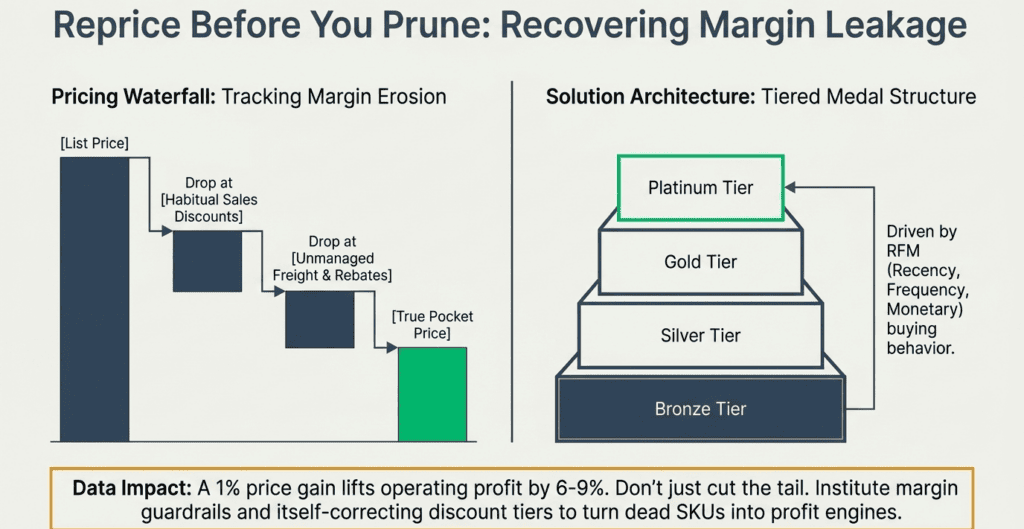
Before making rationalization cuts, review pricing. In most mid-market portfolios, the greater opportunity lies in improving price realization across the SKUs you keep, not just in removing the tail.
A common pitfall is misidentifying healthy SKUs as unprofitable due to weak pricing. Poor pricing causes margin leakage, making SKUs appear unviable and leading to unnecessary cuts, while the underlying issue persists. Removing the SKU addresses the symptom, not the root cause of undisciplined pricing.
Our research highlights how common this issue is. About half of organizations do not use a price waterfall, and roughly one in five rarely measure realized price. You cannot fix what you do not see. Most lost profit is hidden in margin leakage: unmanaged discounts, absorbed freight, and small-order costs that turn a healthy-looking SKU into a marginal one.
Price is the most effective lever for profit improvement. A modest increase in realized price has a greater impact on profit than similar gains in volume or cost reduction. Remove obsolete stock, but prioritize repricing. A delisted SKU generates no revenue, while a repriced one can remain profitable.
Net price vs mix
Monitor both mix and price realization effects. Removing low-priced tail SKUs may increase the average selling price due to mix, not actual price improvement. True gains are reflected in the net price for comparable SKUs. Track both metrics to distinguish between superficial and real improvements.
Doing SKU rationalization without a pricing or analytics team
Most mid-market manufacturers and distributors do not have a head of pricing or a data team. This should not prevent action. The complexity they face gradually erodes the margin while teams are focused elsewhere.
SKU rationalization analysis is repeatable. The SKU-level P&L, cost-to-serve overlay, classification, and keep-or-cut grid can be updated quarterly. These processes are well-suited to managed services, allowing your team to focus on decisions rather than data management.
Governance: what keeps the tail from growing back
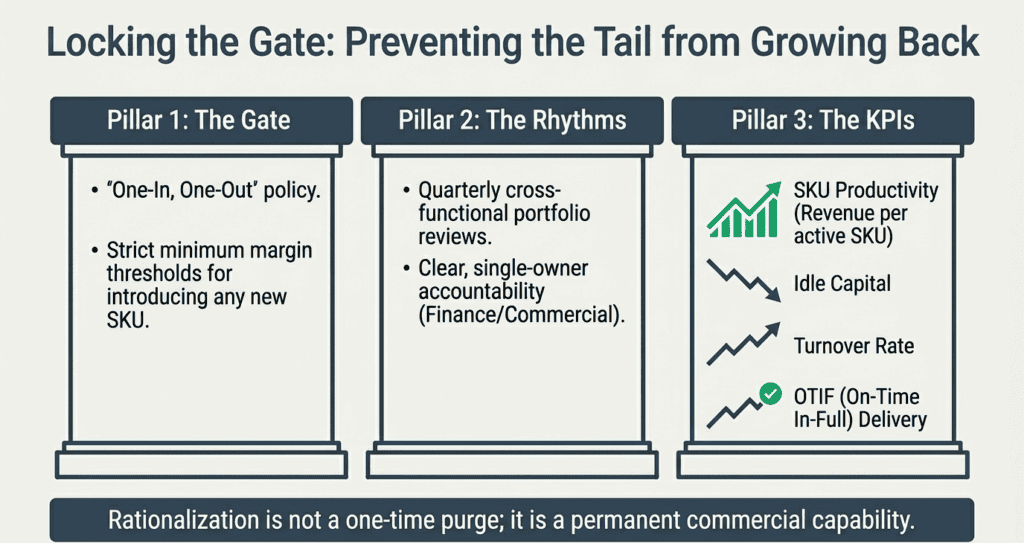
External support primarily provides governance and consistency. Regular reviews keep the SKU rationalization grid current, maintain margin thresholds, and identify complexity before it escalates. The process can remain straightforward, guided by four key questions:
- Who owns the portfolio? Name a single accountable owner, usually in finance or commercial, not a committee.
- Who approves new SKUs? Put a gate in front of additions, with a minimum margin and a cost-to-serve check before anything is added to the catalog.
- How often is the portfolio reviewed? Quarterly for most mid-market businesses, semi-annually at the slowest.
- What triggers an off-cycle review? Set thresholds, such as a rising share of slow-moving inventory, increasing obsolescence, or declining SKU productivity, that prompt a review of a SKU or category. An external partner adds value by maintaining review cadence and enforcing controls when internal pressures arise to add more SKUs.
The metrics that keep a portfolio honest
Rationalization governance requires actionable metrics. A concise dashboard, reviewed quarterly, shows whether the portfolio is improving or quietly expanding:
| Metric | Why it matters |
| Active SKU count | Portfolio size and complexity |
| SKU productivity (revenue per SKU) | Whether each SKU pulls its weight |
| Contribution margin after cost-to-serve | True profitability, not invoice margin |
| Inventory turns | How efficiently cash is working |
| Days inventory outstanding | Working capital tied up in stock |
| Slow-moving inventory share | Early warning of complexity creep |
| Obsolescence write-offs | The cost of carrying excess assortment |
| Pocket margin | Pricing effectiveness after all leakage |
| Price realization | Pricing discipline on the SKUs you keep |
| Revenue concentration | How dependent are you on a few SKUs or accounts |
Monitor these metrics together. A declining SKU count, rising SKU productivity, and stable service levels indicate successful rationalization.
The phased journey: Diagnose, Stabilize, Optimize, Scale
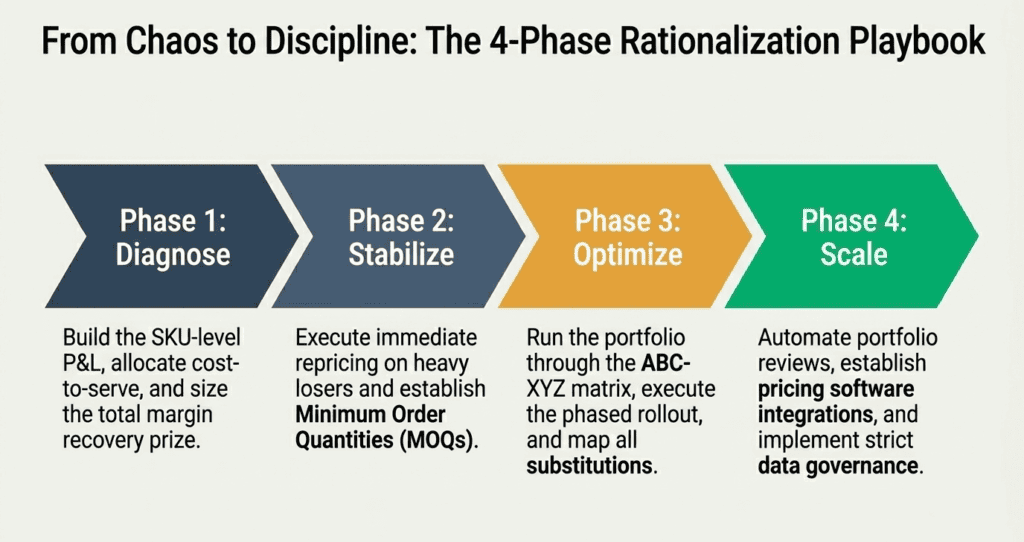
Rationalization is an ongoing process best approached in phases. Early successes can fund later improvements.
- Diagnose: build the SKU-level P&L with cost-to-serve, classify the catalog, and size the prize.
- Stabilize: reprice the obvious losers, set a margin floor, and add a new-SKU threshold.
- Optimize: work the keep-or-cut grid, phase out the tail, and map substitutions.
- Scale: lock the gate, automate the quarterly review, and keep complexity from creeping back.
Initial repricing and targeted reductions generate immediate returns and support longer-term efforts. The process does not require a year-long project to deliver results.
Common mistakes that send the tail growing back
Most failed SKU rationalization efforts share the same handful of mistakes.
- Cutting on revenue instead of contribution margin after cost-to-serve.
- Whacking the tail without mapping substitution paths, then losing the revenue you meant to keep.
- Treating rationalization as a one-time purge with no gate to hold it.
- Eliminating a low-volume SKU that quietly anchored a key account, a risk McKinsey flags directly.
- Killing a product that was simply early in its lifecycle, not in decline.
- Cutting before repricing, and giving away margin you could have kept.
The objection you will hear: won’t we lose customers?
Rationalization efforts often encounter concerns about customer loss. While this is a valid consideration, mapping substitution paths and sequencing phase-outs by account typically ensures most demand transitions to existing SKUs. Customers with unique needs can be managed individually, often through direct communication or last-time buy offers. Disciplined rationalization preserves revenue, whereas indiscriminate cuts without planning risk customer attrition.
| Situation. A mid-market industrial distributor, roughly $300M in revenue across four regional warehouses, carried about 4,000 active SKUs. Revenue was growing while gross margin slipped about two points over three years. Pricing was inconsistent from region to region, and the catalog had not had a real review in years. Actions. Over a single quarter: build a SKU-level P&L, layer in cost-to-serve, and classify the catalog with ABC, XYZ, and lifecycle before scoring it on the keep-or-cut grid. Reprice the loss-making middle, map substitutions for the long tail, and protect the regulatory and strategic-account SKUs. Phase out the dead stock in sequence, account by account.Governance. Name a single portfolio owner in finance, add a margin-floor gate for new SKUs with a one in, one out rule, and put a quarterly review on the calendar with slow-moving inventory and SKU productivity as triggers. Result. A cleaner catalog of well under 3,000 SKUs. Margin recovered mostly from repricing the items customers actually wanted, working capital freed from inventory the business no longer needed, and fill rates that improved as planning got simpler. The gate kept the tail from coming back. |
Representative pattern drawn from common diagnostic findings, not a single named engagement. Figures are illustrative.
Frequently asked questions
What is SKU rationalization?
It is the disciplined review of every SKU on margin after cost-to-serve and on strategic role, to decide what to keep, reprice, phase out, or delist. The goal is more margin and less tied-up cash, not a shorter list for its own sake.
How do we identify unprofitable SKUs?
Rank on contribution margin after cost-to-serve, not revenue. Flag the SKUs with thin or negative pocket margin, high handling cost, low strategic role, and an easy substitute. Those are your candidates.
How many SKUs should we cut?
Good rationalization targets value, not a cut count. In most portfolios, the tail is large in count but small in margin, so the list is longer than leaders expect, while the revenue at risk is smaller.
Should we cut first or reprice first?
Reprice first. A delisted SKU earns nothing, while a repriced one can earn for years. Focus on the items customers want, then prune the dead stock.
Can we do this without a pricing team?
Yes. The rationalization analysis is repeatable and can run as a managed service. What you need is discipline and a gate, not a new department.
A key principle remains: leading companies do not maintain the largest catalogs, but the most disciplined ones. SKU rationalization ensures that every product contributes to profitable growth, rather than simply reducing the number of offerings.
| Start Your Profit Diagnostic. See where margin is leaking across your SKUs and how much you can recover, often within days, and without a pricing team. |
About the author
| Enrico Sieni, Pricing & Revenue Growth Leader, Revify Analytics. Enrico Sieni has spent more than two decades leading pricing and revenue growth for manufacturers and distributors. He has built and run three pricing teams from the ground up, which is part of why he is convinced most mid-market companies do not need one of their own. At Revify Analytics, he helps these companies install the discipline, governance, and seller-level tracking that turn price realization from a once-a-year surprise into a number they manage every week. He writes about the practical side of pricing: what actually moves margin, and what only sounds good in a deck. |