Insights

Explore the Revify Analytics Insights hub for expert articles and blogs on Revenue Growth Management (RGM), strategic pricing, and AI-driven profitability for mid-market companies. Learn how to stop margin leakage and accelerate growth.

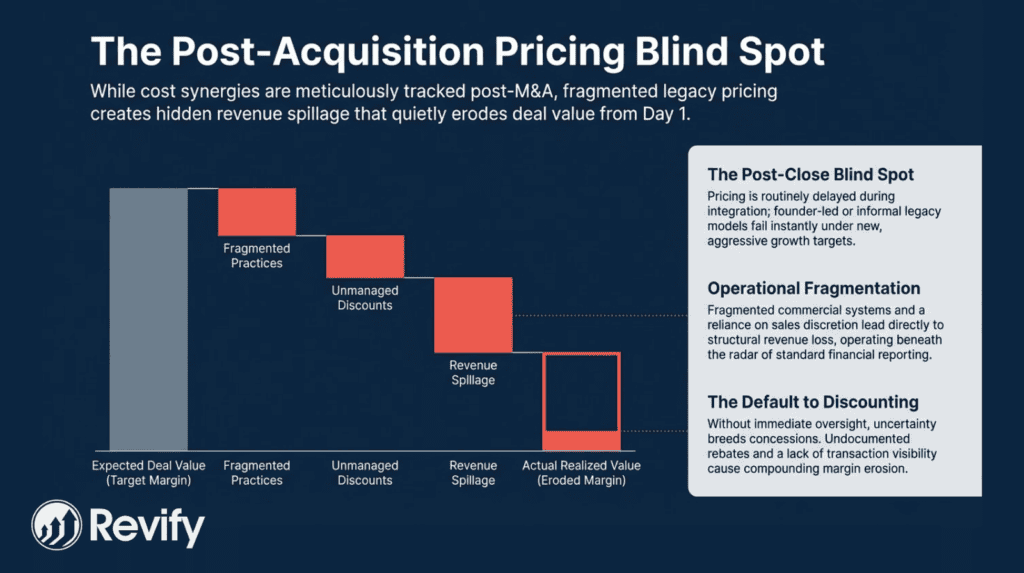
Visual of post-M&A pricing analysis with fragmented practices and revenue spillover.

How Do You Build Post-Acquisition Pricing Capability in the Mid-Market?

Post-acquisition pricing capability is the rapid stabilization of commercial processes after ownership change—setting guardrails before sophistication, accepting imperfect data, and assigning immediate accountability. Mid-market acquirers who delay pricing until after integration erode synergy value; a phased playbook delivers fast wins on inconsistent customer pricing, undocumented rebates, and informal discount approvals.

Read More »
Pricing transformation and analytics for strategic revenue growth.

How Do You Build Pricing Transformation Capability (Not Just Better Prices)?

Pricing transformation capability is the structured, governed, repeatable ability to make consistently better pricing decisions—not the one-time output of a consulting engagement or software rollout. Mid-market manufacturers that build capability before optimization sustain 200-400 bps of EBITDA gain; those that chase analytics first see results fade within two quarters.

Read More »
Digital tablet and report on building pricing capability without hiring a full team.

How Do You Build Pricing Capability Without a Full Team?

Building pricing capability without a full team requires mastering five disciplines—price setting, discount management, exception approval, profitability measurement, and cross-functional review—rather than buying software. Simon-Kucher’s 2025 study found price realization averaged 43%; BCG attributes 90% of RGM success to internal capability and only 10% to tools.

Read More »
How Do You Build Pricing Policy Strategies That Stick Without a Pricing Team? — Build Pricing Policy Strategies that Stick…

How Do You Build Pricing Policy Strategies That Stick Without a Pricing Team?

Pricing policy strategies establish enforceable guardrails—who can change prices, by how much, and through which approval workflow—turning pricing strategy from intent into consistent daily execution. Without policy, strategy collapses into negotiation variability. Mid-market manufacturers and distributors can embed durable policies without a pricing team by combining governance rules with cross-functional ownership.

Read More »
Pricing Roadmap Excellence

How to Build a Proven Pricing Roadmap That Delivers Margin, Not Just Metrics

Building a pricing roadmap that delivers margin requires sequencing diagnosis, governance, and optimization across 8-12 weeks, not endless dashboards. The 2025 Revenue Growth Analytics Maturity Report shows 50%+ of mid-market firms lack a price waterfall and 75%+ still use cost-plus methods—gaps a sequenced roadmap closes with weekly cadence and executive accountability.

Read More »
Pricing Outsourcing

What Is Pricing Outsourcing and How Do Managed Pricing Services Work?

Pricing outsourcing—also called managed pricing services—engages an external team to handle pricing analysis, governance, and execution without building a full internal department. Backed by Nagle, McKinsey, Bain, and BCG research, it delivers measurable EBITDA improvement by embedding pricing discipline as a repeatable service rather than a one-time pricing study.

Read More »
What Is Interim Pricing Leadership and When Should You Use It? — Build Interim Pricing Leadership Capabilities (image 9 of…

What Is Interim Pricing Leadership and When Should You Use It?

Interim pricing leadership capability provides experienced practitioners on a defined, time-bound basis to quantify the pricing opportunity, identify gaps in people, process, and technology, and accelerate the shift to effective price management. Over 75% of industrial mid-market firms lack the pricing infrastructure interim leaders install: governance, waterfall visibility, and systematic price management.

Read More »
What Are Pricing Quick Wins and How Do You Capture Them in Weeks? — pricing analytics chart: Pricing Quick Wins Strategy…

What Are Pricing Quick Wins and How Do You Capture Them in Weeks?

Pricing quick wins are targeted actions deployable in days or weeks—using existing data and lightweight governance—to stop margin leakage without a full transformation. They focus on tightening discounting, plugging price-waterfall leaks, and enforcing pricing discipline on high-impact customers, SKUs, and quotes. Over 60% of mid-market firms still discount manually, leaving leakage everywhere.

Read More »
Why Should You Treat Price Elasticity as a Competitive Advantage? — Price Elasticity Insights (image 2 of 2) | Revify…

Why Should You Treat Price Elasticity as a Competitive Advantage?

Price elasticity is the discipline of measuring how customer demand responds to price changes, replacing instinct with evidence from real buying behavior. Treating elasticity as a strategic capability (not just a metric) reveals where the business has true pricing power, which products can absorb increases, and where promotions deliver real incrementality versus subsidizing existing demand.

Read More »
Competitive Intelligence Analytics: Practical Ways to Make Better Pricing Decisions with Imperfect Data

How Do You Make Better Pricing Decisions With Imperfect Competitive Data?

Competitive intelligence analytics is the practice of making confident pricing decisions when external market data is incomplete, fragmented across ERPs and CRMs, and budgets for full systems are unavailable. The pragmatic approach combines partial competitive signals with internal elasticity and win/loss evidence, delivering better pricing decisions without waiting for a perfect dataset.

Read More »
Analytics Gap in Monitoring Profit Drivers

What Are Revenue and Profit Growth Drivers? PCVM Analysis Explained

Revenue and profit growth drivers are isolated through Price-Cost-Volume-Mix (PCVM) analysis, which decomposes financial performance into the individual contributions of pricing actions, cost changes, sales volume, and product-mix shifts. Only 50% of companies systematically monitor these drivers—a gap that prevents mid-market firms from translating insight into the specific actions that compound margin growth.

Read More »

Browse Top Contents

Get in Touch With Us!

Let’s Unlock Your Profitable Growth Potential

You are on the right spot!

We are still working on this to give the best insights. 

We will inform you once this is done.