
This guide enables commercial leaders at mid-market manufacturers and distributors to develop a pricing roadmap from diagnostic to optimization, establish governance, and achieve measurable margin improvement within weeks.
Most mid-market manufacturers and distributors maintain a pricing strategy on paper, including list prices in the ERP, periodic discount approvals, and annual or semi-annual cost-plus updates. However, when leadership inquires about quarterly margin left on the table, clear answers are often lacking.
This lack of clarity is costly. In early 2026, tariff volatility, persistent input-cost inflation, and evolving customer buying patterns are compressing margins. Companies using reactive, spreadsheet-based pricing cannot identify or recover these losses. The 2025 Revenue Growth Analytics Maturity Report notes that over half of mid-market organizations lack a price waterfall, and more than 75% still use cost-plus or basic competitive methods focused on list price rather than realized price.
A pricing roadmap addresses this gap by providing a sequenced plan to build pricing capability from visibility to control to optimization, with defined ownership, governance, and regular execution. Leading firms such as McKinsey, Bain, and Simon-Kucher describe this as a maturity journey, progressing from ad hoc and fragmented practices to foundations, governance, and ultimately a pricing center of excellence. This guide explains why a roadmap is essential, outlines each phase, and demonstrates how to achieve quick wins while building lasting capability.
The Problem a Pricing Roadmap Solves in Mid-Market Pricing
Before taking action, it is important to define the problem. Most mid-market companies face a pricing capability gap rather than a traditional pricing problem. While the symptoms are familiar, they are often addressed in isolation instead of as part of a system.
Common Symptoms: Reactive Pricing and Spreadsheet Decisions
Sales representatives negotiate discounts without visibility into customer profitability. When costs rise, companies often apply blanket price adjustments that ignore segment differences. Exception requests accumulate without a standard approval workflow, causing delays.
These issues are systemic and reflect what practitioners call “Stage 0” maturity: an ad hoc, fragmented model where pricing decisions depend on individuals, spreadsheets, and informal knowledge. There is no single source of truth for net price, no governance cadence, and no feedback loop connecting price actions to margin outcomes. Companies may assume they have a pricing strategy due to a price list and annual increases, but without proper execution, value is lost throughout the process.
A common misconception is that more analytics alone will resolve these issues. Without defined workflows, accountability, and decision rights, insights do not lead to action. Tools without an operating model remain unused.
What It Costs You: Margin Leakage and Slow Decisions
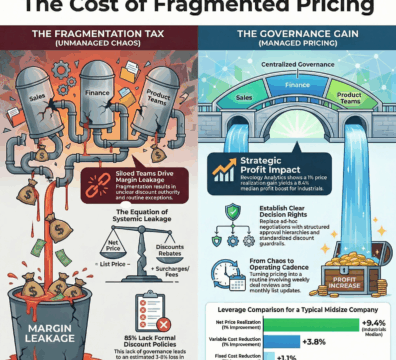
The cost is not hypothetical. Margin leakage—the difference between your intended price and the pocket price a customer actually pays—compounds silently across thousands of transactions. McKinsey’s pocket price waterfall framework, one of the most widely used diagnostic tools in transaction pricing, exists precisely because this leakage is invisible without instrumentation: the gap between list price, invoice price, and pocket price reveals where margin disappears. For a detailed framework on diagnosing where this leakage occurs in your business, see our strategic guide to eliminating margin leakage. Discount exceptions that seem small individually can erode 200–400 basis points of gross margin annually when aggregated across the customer base.
Slow decisions have significant costs. When cost pass-through updates take weeks instead of days, margins are eroded on every transaction in the interim. When pricing approvals stall, sales teams often default to the largest discount they believe will close the deal. The result is revenue growth without corresponding gross profit—a pattern that is especially risky for PE-backed companies under EBITDA scrutiny.
What Changes When You Build Pricing Capability
A pricing roadmap is the execution plan that transitions your organization from scattered, reactive pricing to a disciplined operating model. This shift is structural, not cosmetic. It addresses people, process, and platform in a deliberate sequence, which is critical. High-performing organizations begin by naming accountable owners and establishing governance. Tools are introduced later, once the operating model is in place to support them.
Mandate, Owners, and Operating Model First
The most important insight from pricing transformation research, confirmed by McKinsey, Bain, and the Pricing Society, is that capability building begins with people and governance, not technology. Before selecting any platform, high performers secure three elements:
- A C-suite mandate. Pricing improvement requires cross-functional change. Without an executive sponsor who can resolve organizational friction, initiatives stall at the first budget review or sales pushback.
- A pricing council charter with clear decision rights. Who approves discounts above a threshold? Who owns the cost pass-through cadence? Who resolves exceptions when sales and finance disagree? Ambiguity here is the root cause of inconsistent pricing.
- Five core KPI definitions. Before you build a single dashboard, align on how you will measure progress: price realization, discount spend as a percentage of revenue, waterfall leakage, pocket margin, and (eventually) promotional ROI. These definitions become the shared language of accountability.
Bain frames this as building a coherent capability system spanning incentives, processes, and tools—not isolated point solutions. The Pricing Society similarly emphasizes control as a structural pillar: measurement and enforcement so that pricing policy is actually executed, not just published.
Governance, Guardrails, and Decision Rights
With the mandate and owners in place, the next structural change is governance. This means defining who can approve what level of discount, under what conditions, with what data. It means establishing price floors by customer segment or SKU category so that every deal operates within boundaries that protect margin.
In many mid-market organizations, pricing authority is ambiguous. Sales, finance, and product teams all contribute, but no one owns the outcome. A well-designed pricing roadmap clarifies these roles, even if the team is virtual rather than a dedicated pricing department. It is a misconception that only a dedicated pricing department can drive this change. Mid-market firms often build effective pricing capability with a cross-functional governance team and clear accountability. What matters is not the organizational structure, but the decision rights and cadence.
Governance also includes discount discipline, such as corridors, floors, approval workflows, and reason codes, as well as the critical step of embedding guardrails into quoting and CRM workflows to ensure policy is enforced where deals occur, not just documented. Linking one or two pricing KPIs to quarterly business reviews and, eventually, compensation helps reinforce behavioral change.
From Insights to Execution: The Weekly Operating Rhythm
Data without a regular cadence is often ignored. The third structural change a pricing roadmap introduces is an operating rhythm—a weekly or biweekly cycle where the pricing team reviews performance data, identifies required actions, assigns owners, and tracks execution. Cadence is a profit driver, enabling action while data remains relevant.
This cadence transforms pricing from a periodic project into a continuous function. Cost pass-throughs occur within days of changes in raw materials. Discount exceptions are reviewed against margin thresholds before approval. Customer profitability data informs renewal and renegotiation conversations in real time. A well-designed operating model specifies its cadences: weekly exception reviews, monthly PCVM (Price-Cost-Volume-Mix) decomposition, and quarterly strategic recalibration.
PCVM Decomposition: Separating What You Can Control
One analytical tool that deserves special attention on any pricing roadmap is PCVM decomposition—Price, Cost, Volume, Mix. PCVM breaks down margin changes into their component drivers so that leadership can separate price-driven performance from cost changes, volume shifts, and product or customer mix effects. Without it, a quarter in which the margin improved could mask deteriorating price realization, offset by a favorable mix—a dangerous blind spot.
PCVM reporting should begin quarterly and transition to monthly as data infrastructure matures. This provides the pricing council with the granularity to act earlier and more precisely. If margin compression is cost-driven, the response is cost pass-through acceleration; if price-driven, the response is guardrail enforcement and discount cleanup. This decomposition shifts margin conversations from reactive to diagnostic.
How Revify’s Pricing Roadmap Maturity Journey Works
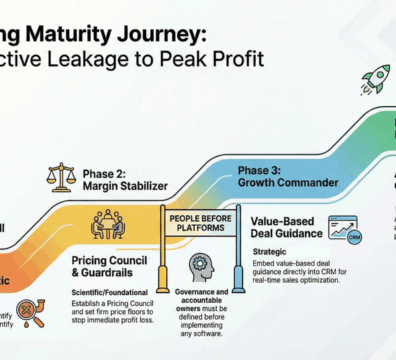
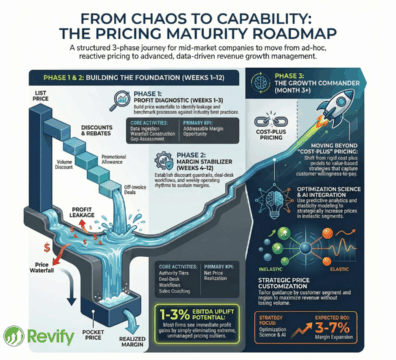
Revify structures the pricing roadmap as a maturity journey with distinct phases, aligned with the stage-based progression described by leading practitioners: from ad hoc (Stage 0), to foundations and transparency (Stage 1), governance and control (Stage 2), optimization and cross-functional integration (Stage 3), and finally a closed-loop pricing center of excellence (Stage 4). Each phase has defined deliverables, KPIs, and a clear handoff to the next. The design principle is straightforward: early phases generate cash and credibility to fund later optimization. Phase 1 — Profit Diagnostic and Blueprint (Foundations and Transparency)
Every engagement begins with the Profit Diagnostic, a rapid, data-driven assessment that typically takes 10 business days to complete. It quantifies margin leakage and identifies the highest-ROI price actions, serving as a diagnostic X-ray for your business’s profitability. This phase aligns with Stage 1 of the pricing excellence maturity model: creating a single source of truth and initial instrumentation.
What it covers:
- Transaction-level net price visibility using pocket price and price waterfall logic (list → invoice → pocket)
- Price realization scorecard, basic margin, and pocket-margin views
- Discount distribution and variance by customer segment, product category, and channel
- Cost-to-serve and customer profitability ranking
- Documented pricing principles, core definitions, and data requirements
- A prioritized action plan with estimated margin impact and a phased Blueprint
The Blueprint accompanying the diagnostic outlines the recommended pricing roadmap, specifying which initiatives to pursue, their sequence, required resources, and timeline. It serves as a shared reference for leadership alignment. Budgeting for a high-impact pricing initiative is often one of the first discussions the Blueprint enables, as it quantifies the investment relative to the identified opportunity.
Phase 2 — Margin Stabilizer (Governance and Control)
Phase 2 installs the structural elements that stop margin leakage and create pricing discipline. This is where governance becomes operational—corresponding to Stage 2 of the maturity model, where the goal is to make pricing repeatable and enforceable.
Key deliverables:
- Pricing council charter with explicit decision rights and authority levels
- Price floors and guardrails by customer tier and product category
- Deal governance workflow: exception request → data review → approval/denial with documented rationale and reason codes
- Cost pass-through cadence tied to commodity or supplier cost movements
- A weekly pricing action meeting with a defined agenda, participants, and action-item tracking
- PCVM reporting (initially quarterly, moving to monthly) so leadership can separate price, cost, volume, and mix effects
- Dashboards showing net price realization, discount variance, and compliance with guidance
- One or two KPIs linked to QBRs (and eventually to compensation, even lightly) to anchor behavioral change
For most mid-market organizations, Phase 2 is where the largest margin gains occur. Advanced analytics are not required to prevent margin loss from inconsistent discounting; visibility, rules, and enforcement cadence are essential. Without approval thresholds, reason codes, and deal desk processes embedded in workflows, governance can degrade within a quarter.
Phase 3 — Growth Commander (Optimization and Cross-Functional Integration)
With governance in place and margin stabilized, Phase 3 layers in active optimization—moving beyond visibility and control to pricing as an engine for profitable growth. This corresponds to Stage 3 of the maturity model.
What this phase adds:
- Segmented, value-based pricing that moves beyond pilots to standard operating practice
- Deal guidance embedded directly in quoting and CRM systems—proactive guardrails and analytics at the point of decision
- Promotion effectiveness measurement: baseline vs. lift, incremental ROI, and spend reallocation toward higher-return tactics
- Sales and marketing enablement beyond basic CRM hygiene: RFM (Recency, Frequency, Monetary) scoring, churn risk prediction, and next-best-action signals
- Customer value and elasticity modeling, scenario analysis for competitive moves, and cross-sell and upsell identification
Pricing optimization is most effective when it builds on the discipline and data infrastructure established in earlier phases. Skipping optimization without governance is one of the most common and costly mistakes companies make. Simon-Kucher emphasizes that pricing is a continuous process requiring leadership and enforcement, not a one-time project.
Phase 3 is also where AI and machine learning become valuable. Mid-market AI pricing delivers results when data is clean, processes are defined, and the team has a cadence for acting on model outputs. Without these foundations, even the best models remain unused.
Quick Wins and a Realistic Timeline to Impact
What You Can Improve in Weeks, Not Months
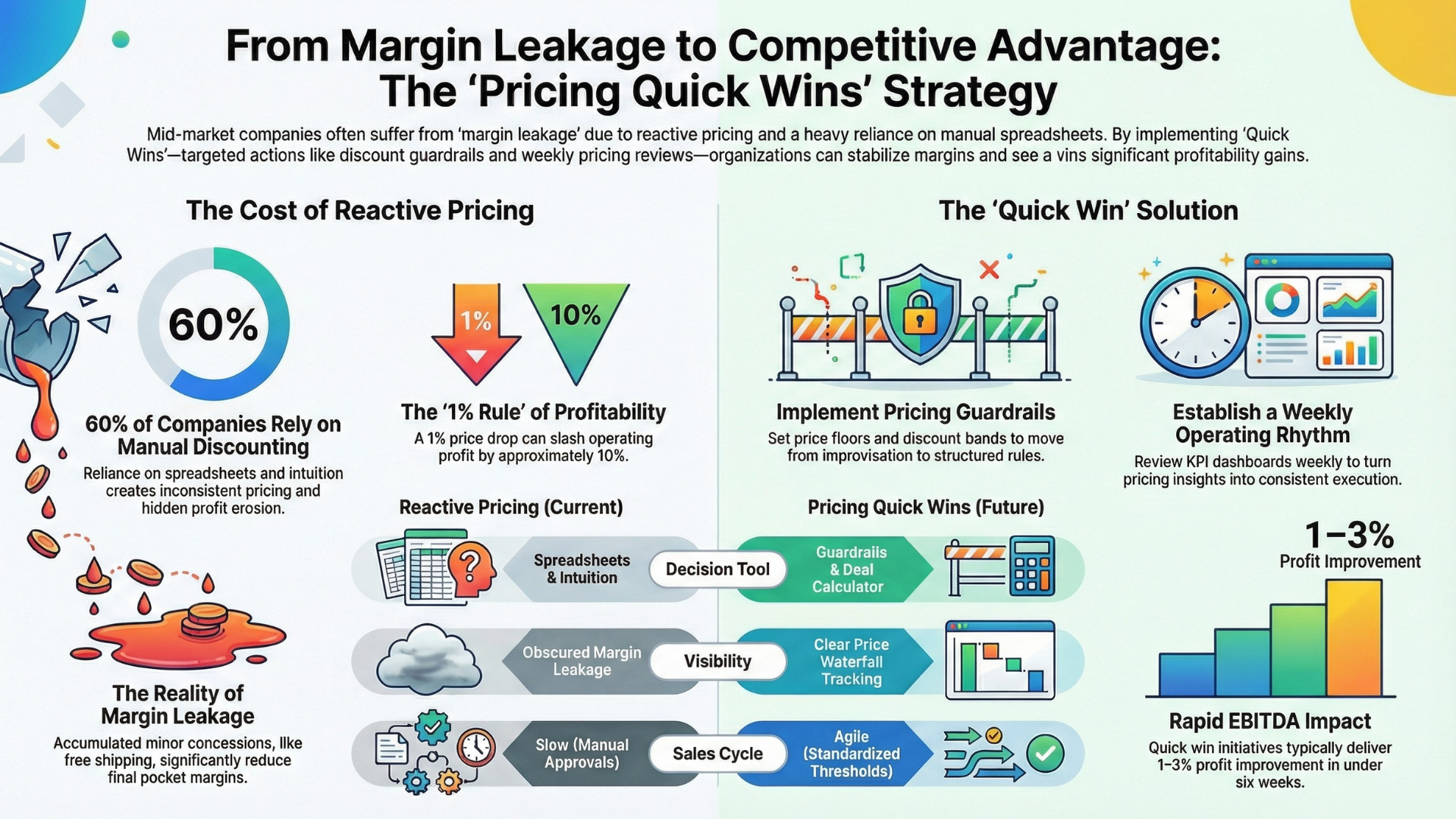
A well-sequenced pricing roadmap deliberately targets early wins. Within the first few weeks of a Profit Diagnostic, companies typically identify actionable opportunities in three areas:
Step 1: Cost pass-through updates. Identify products where input costs have increased, but selling prices remain unchanged. Typically, 15–25% of the SKU base has outdated pricing relative to current costs. Addressing these gaps can recover margin within a single billing cycle.
Step 2: Discount cleanup on low-margin accounts. Rank customers by net margin contribution. The bottom decile often includes accounts receiving discounts that were never formally approved or no longer reflect the relationship’s value. Simultaneously, freeze the deepest discretionary discounts pending economic justification to create immediate margin improvement while governance is established. Set minimum net prices by product category or customer segment. Even a simple rule—no deal below X% gross margin without VP approval—can arrest the worst margin erosion while the full governance model is being built.
A Practical Implementation Timeline Most Companies Can Actually Execute
Based on the execution patterns observed across pricing maturity research and Revify’s own engagement data, here is the default timeline that most mid-market organizations can realistically follow:
Days 0–30 (Manual Alignment). Confirm definitions and data requirements for waterfall, realization, and cost-to-serve. Identify the top three to five margin-leakage drivers. Freeze the deepest discretionary discounts pending economic justification. Secure an executive mandate and appoint pricing council members.
Days 31–90 (Build and Launch the Core System). Launch waterfall visibility, weekly realization reporting, initial PCVM decomposition, and a minimum viable promotional ROI view. Train teams on new workflows, establish weekly and monthly cadences, and embed guardrails into deal approval processes.
Months 3–12 (Scale and Integrate). Standardize segmentation and price architecture. Integrate cost-to-serve where most impactful. Expand CRM-based enablement, including RFM scoring, churn risk, and next-best-action. Add promotion optimization gates and reallocate spend toward higher-return tactics.
Months 12–24 (Knowledge Center Maturity). Implement closed-loop performance management, including elasticity refresh cadence, scenario simulators, systematic post-mortems, controlled experimentation, and selective dynamic pricing or deal guidance automation where supported by data and processes.
Typical KPIs: Price Realization, Discount Variance, and EBITDA Lift
A pricing roadmap should track metrics that connect pricing actions to financial outcomes. The following KPIs form the core measurement framework:
- Net price realization (%): Actual net price ÷ target (or list-derived) net price. Measures how effectively list prices convert to realized revenue.
- Gross margin $ and %: (Net revenue − COGS) ÷ Net revenue. The fundamental profitability metric.
- Discount leakage (discount spend as % of revenue): (List price − Net price) ÷ List price. Tracks the cumulative erosion from all price concessions.
- Pocket margin: Margin calculated at the true pocket price after all on- and off-invoice deductions. The metric that reveals what you actually keep.
- Waterfall step impact: Value at step n − value at step n+1 (e.g., list-to-invoice, invoice-to-pocket). Pinpoints where margin is lost.
- PCVM contribution: Isolates price-driven margin changes from cost, volume, and mix effects—ensuring you measure pricing performance, not just margin outcomes.
- Promotional ROI: Baseline vs. lift measurement for promotions, enabling spend reallocation toward higher-return tactics.
- Price action frequency and impact: Number of executed price changes per period and their dollar contribution to margin.
- Compliance with price guidance: Percentage of deals approved within established guardrails.
- Win rate vs. margin: Ensures that pricing discipline does not come at the cost of competitive win rates.
For current industry benchmarks on pricing maturity and metric tracking, refer to the Taking Pricing to the Next Level webinar, which presents key findings and practical recommendations.
A Worked Example: Mid-Market Distributor Pricing Roadmap
To make this concrete, consider how the roadmap plays out for a mid-market distributor with $150M in revenue, 12,000 active SKUs, and margin pressure concentrated in their top 50 accounts and long-tail product categories.
Step 1: Profit Diagnostic (Weeks 1–2). The diagnostic reveals margin leakage in two areas: inconsistent discounting on the top 50 accounts (which generate 40% of revenue and have the widest discount variance) and outdated cost markups on long-tail SKUs that have not been repriced in over 12 months. Net price realization across the portfolio is 87%, indicating that 13 cents of every intended dollar is lost in the waterfall. PCVM decomposition shows that 60% of the margin shortfall is price-driven (discretionary discounts and stale pricing), not cost- or mix-driven, making it directly actionable.
Step 2: Margin Stabilizer (Weeks 3–10). The team implements net price visibility dashboards, sets customer- and SKU-level price floors, builds a deal desk workflow for exception requests with reason codes, and establishes a weekly pricing action cadence. The pricing council meets weekly to review exceptions and monthly for PCVM reporting. Initial actions include cost pass-through updates on 2,200 SKUs with outdated pricing and targeted discount cleanup on the 15 lowest-margin accounts in the top 50. Two KPIs—price realization and discount spend as a percentage of revenue—are added to the quarterly business review. Within eight weeks, gross margin improves by 120 basis points.
Step 3: Growth Commander (Months 3–6). With governance established and data available, the team adds segmentation-based price architecture, grouping customers by value tier and setting differentiated target margins. Price guidance is embedded in the quoting system, so representatives see guardrails at the point of decision. Promotion effectiveness measurement begins with a baseline-versus-lift analysis, identifying two promotional programs with negative incremental ROI, prompting a spend reallocation. Price guidance incorporates elasticity proxies and scenario modeling for competitive responses. The team conducts quarterly pricing reviews with full waterfall visibility.
Getting Started: Start Your Profit Diagnostic
Building pricing capability does not require a multi-year transformation or a significant technology investment. It begins with understanding your current position and assigning ownership for follow-up actions.
Revify’s Profit Diagnostic provides this clarity in 10 business days. It delivers a quantified view of margin leakage, a PCVM breakdown isolating price-driven losses, a prioritized action plan, and a phased pricing roadmap tailored to your organization’s size, data maturity, and commercial goals. Early actions often generate margin improvement before the full roadmap is finalized.
The diagnostic includes transaction-level net price visibility, waterfall analysis, discount distribution, customer profitability ranking, and the five core KPI definitions your pricing council will use to measure progress, as described in this guide. From there, you determine the pace: some companies proceed directly to the Margin Stabilizer phase, while others use the Blueprint to secure internal alignment and budget first.
To understand where your margin is going, begin your Profit Diagnostic today and take the first step toward building sustainable pricing capability.
Frequently Asked Questions About Pricing Roadmaps
What is a pricing roadmap?
A pricing roadmap is a sequenced plan that outlines the initiatives, owners, timelines, and governance needed to improve pricing performance and build sustainable pricing capability. It defines the pricing operating model—people, processes, and platform—and the specific actions required to improve net price realization and margin across products, customers, and channels. Leading practitioners describe the progression as a maturity journey: from ad hoc and fragmented, through foundations and governance, to a closed-loop pricing center of excellence.
Who should own a pricing roadmap in a mid-market B2B company?
A commercial leader—often in Sales, Finance, or a General Manager role—should own it, with clear decision rights and a cross-functional pricing governance team (or pricing council). Execution can be supported by an internal team or a virtual pricing function; what matters is that one person is accountable for driving the cadence and holding the organization to its pricing commitments. The executive sponsor role is critical for resolving cross-functional friction.
What are the phases of a practical pricing transformation roadmap?
A proven sequence is: Profit Diagnostic (visibility into margin leakage and PCVM decomposition) → Margin Stabilizer (governance, guardrails, deal discipline, and operating cadence) → Growth Commander (optimization through segmentation, embedded deal guidance, promotion ROI, and analytics) → Managed Services / Knowledge Center (closed-loop performance management, elasticity refresh, experimentation, and continuous improvement). Each phase builds on the prior one, and early phases are designed to generate ROI that funds subsequent work.
How long does a pricing roadmap take to show results?
A well-sequenced roadmap prioritizes early margin-stabilization actions, enabling measurable results in weeks. Cost pass-through corrections and discount cleanup are common quick wins. The core system (waterfall, realization reporting, governance, guardrails) can typically be launched within 90 days. Deeper optimization—segmentation-based pricing, elasticity modeling, and advanced governance—typically takes 3–12 months to mature, with knowledge center maturity reached at 12–24 months.
What should be included in a pricing roadmap deliverable?
A complete pricing roadmap includes: initiatives organized by phase, a timeline with milestones, owners and decision rights for each initiative, governance cadence (meeting frequency, agenda, escalation paths), required data and systems, KPIs to track progress (including PCVM decomposition), and a change-management plan addressing sales enablement and customer communication.
What KPIs should a pricing roadmap track?
Core KPIs include net price realization, pocket margin, gross margin percentage and dollars by segment, discount spend as a percentage of revenue, waterfall step impacts, PCVM contribution (isolating price-driven performance from cost, volume, and mix effects), promotional ROI, win rate vs. margin, compliance to price guidance, and the frequency and dollar impact of executed price actions.
How do you prioritize pricing initiatives on the roadmap?
Prioritize by margin impact, speed to implement, data readiness, and organizational friction. Start with actions that reduce leakage and improve deal discipline—these tend to be high-impact and low-friction. Advanced optimization initiatives (segmentation, pricing architecture, ML models) should be implemented later, once governance and data foundations are in place. The guiding principle: fund later phases with the ROI from early phases.
Do we need pricing software to execute a pricing roadmap?
Not initially. Many mid-market teams can stabilize margins with better governance, data hygiene, and workflows before investing in dedicated tools. Software becomes valuable once processes and adoption are established—it accelerates execution, but it cannot substitute for the discipline, decision rights, and cadence that make pricing actions stick. Bain and Simon-Kucher both emphasize durability through capability building (organization, operating model, adoption), not isolated tool deployment.
What’s the difference between a pricing strategy and a pricing roadmap?
Strategy defines where you intend to compete and how you plan to price—value-based, cost-plus, competitive, or a hybrid. The roadmap defines the step-by-step execution plan, operating model, and governance required to operationalize that strategy. Many companies have a pricing strategy; far fewer have a roadmap to execute it. The common failure mode: a price list and annual increase exist, creating the illusion of strategy, but execution is uninstrumented.