



By Enrico Sieni · Revify Analytics · June 10, 2026 · ~12 min read
You can improve price realization without hiring a dedicated pricing team. Results come from disciplined processes: tighter discount control, clear approval thresholds, a straightforward deal desk routine, seller-level tracking, and a focused set of KPIs. This guide helps mid-market manufacturers and distributors identify where price realization declines, address the gaps, and sustain improvements through a phased, self-funding approach.
Why does price realization matter more than chasing volume?
Most companies focus on volume because revenue is highly visible. However, pricing has a greater impact on profit, and the difference is significant.
Across a database of roughly 130 publicly traded distributors, McKinsey estimated that a 1 percent price increase would lift EBITDA margins by about 22 percent. To match that with volume, the average distributor would need to grow units by nearly 6 percent while holding costs flat. One point of price did the work of six points of volume. For a mid-market manufacturer or distributor, that is the difference between a hiring plan and a pricing routine.

A key point is often overlooked: you improve price realization by capturing more of what you already charge, not only by raising list prices. The gap between intended and invoiced price is typically the most accessible source of margin, as it often goes unaddressed.
Why does price realization break down in mid-market manufacturers and distributors?
Consider a distributor whose revenue increases each quarter while gross margin declines. Sales may be satisfied with the results, but the P&L reveals underlying issues. A price waterfall analysis often uncovers the cause: one sales territory consistently offers 5 to 7 percent more in off-invoice discounts than others, without corresponding volume gains. These concessions accumulate gradually, often without deliberate intent.
Where margin leaks: quotes, discounts, rebates, and exceptions
Price realization typically erodes through multiple small decisions rather than a single major one. The gap between list price and pocket price—the amount retained after all discounts, rebates, freight allowances, and payment terms—often contains the most significant leaks, which are frequently overlooked by management. McKinsey’s power of pricing study found that one company’s off-invoice reductions totaled 16.3 percentage points, resulting in an average pocket price nearly half of the list price. Bain has reported B2B cases where sales believed they offered a 10 percent discount, but finance observed pocket prices 25 percent below the list. Leakage of ten to twenty points, or more, is common and often unnoticed.
Small actions, such as a goodwill discount, an absorbed freight charge for a long-standing account, or an outdated rebate program, may seem minor individually. Collectively, they create the gap between the intended and realized price. For a comprehensive overview, refer to our guide on eliminating margin leakage.
Why ad hoc pricing decisions create inconsistent outcomes
The underlying issue is organizational structure. Most mid-market companies are too small for a dedicated pricing department but too complex for the owner to manage pricing informally. As a result, pricing decisions often fall to whoever is most persuasive in negotiations. Sales advocate for the customer, while finance responds with incomplete data. This can lead to the same customer receiving different prices in separate quarters, with no clear rationale. Inconsistent processes lead to inconsistent price realization.
What does price realization actually mean?
Price realization measures how closely the prices you invoice match the prices you meant to charge. In plain terms, it is the share of your list or target price that survives all the way to the invoice and into the bank.
The price realization formula
The formula is simple enough to run on a napkin:
Price realization (%) = Realized pocket price ÷ Target (or list) price × 100
Where the realized pocket price is the list price minus all on-invoice discounts, off-invoice rebates, allowances, freight concessions, and payment-term costs.
A worked price realization example
Take a single order with a list price of $100. The waterfall below shows what actually happens to it:
| Step | Per unit |
| List price | $100.00 |
| Customer discount (on invoice) | -$8.00 |
| Promotional rebate (off invoice) | -$5.00 |
| Freight absorption | -$1.00 |
| Extended payment terms | -$1.00 |
| Pocket price (realized) | $85.00 |
The pocket price is $85, resulting in a price realization of 85 percent for this order. The remaining 15 percent is distributed across various decisions that may have seemed reasonable individually, making them difficult to identify without a waterfall analysis.

Common causes of poor price realization
Three patterns keep appearing. Three recurring issues contribute to poor price realization: discounting not linked to volume or strategic value, approval rules that are bypassed under time pressure, and the absence of a single source of truth, leading to disputes between sales and finance. During periods of inflation, a fourth issue arises: list price increases that are not fully implemented due to a lack of compliance tracking.
Raising prices
When margins tighten, the typical response is to raise prices. While this action is visible and appears decisive, greater and faster gains often come from retaining more of the prices already in place.
These are distinct initiatives. A list price increase must withstand the entire pricing waterfall before impacting revenue. Simon-Kucher notes that if sales teams routinely discount to secure deals, price increases are often offset by further discounts. McKinsey similarly observes that disciplined transaction pricing management often delivers more value than broad list price adjustments. Raise list prices only when justified, but address price realization first to prevent new increases from eroding through existing gaps.
What changes when you install pricing discipline without a team?
Companies that improve price realization most rapidly are typically those that implement effective processes, not those that increase headcount. A dedicated department is not required to enforce discount thresholds or manage exceptions. What is needed are clear rules, consistent routines, and accountability for monitoring results.
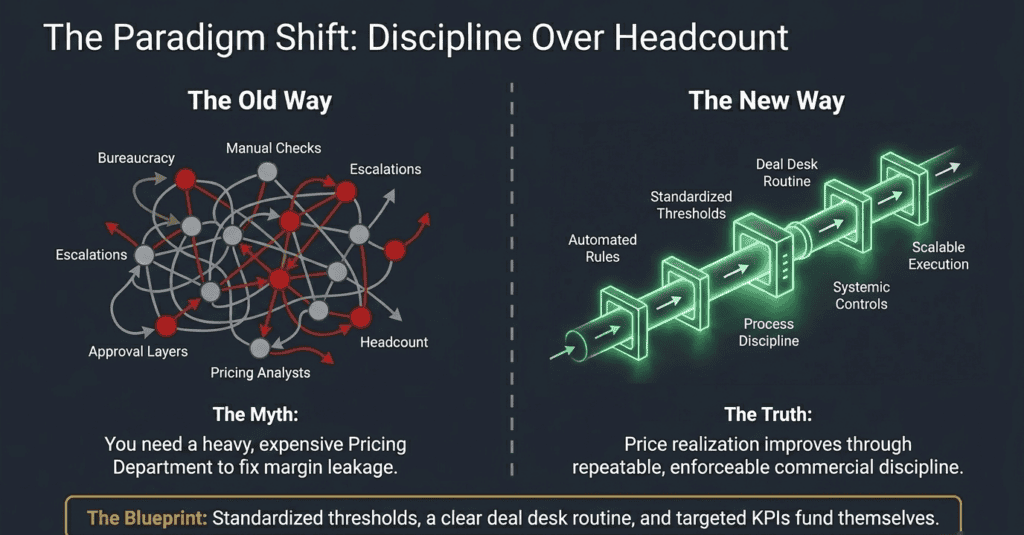
Governance and control: approval through effective pricing governance relies on a few clear boundaries. Each customer tier is assigned a price range, and any pricing outside this range requires approval from a designated individual. All exceptions are logged for future analysis. This approach replaces informal approvals with documented decisions. Bain’s research cautions that when approval requests become excessive, managers may approve nearly all requests, undermining net price. Controls are only effective if exceptions remain infrequent. tays low enough to mean something.
Roles, routines, and deal desk workflows
A deal desk in a mid-market company is a structured routine rather than a dedicated team or software solution. An effective deal desk includes the following elements:
- Who participates: a commercial lead who owns the customer relationship, someone who owns margin (often finance or the GM), and a decision-maker with the authority to say yes or no in the room.
- What it reviews: only the deals that fall outside the agreed price range. Everything inside the range goes out without ceremony, so the desk stays fast.
- Thresholds: a clear discount or margin floor that triggers review, plus a higher tier that escalates to the GM or owner.
- Cadence: a standing 30-minute weekly slot, with a same-day path for urgent quotes so the desk never becomes the reason you lose a deal.
Establishing a consistent schedule for exception decisions improves pricing outcomes by making decisions proactively rather than under last-minute pressure.
Why sales compensation often drives price leakage. If you address only one area, review your compensation structure. Bain surveyed over 1,700 B2B companies and found that approximately 85 percent saw room for improvement in pricing decisions, with the largest gaps in sales incentives. When representatives are compensated solely on revenue, they are incentivized to concede on price, resulting in deals closing at the lowest permissible margin allowed by the rules.
Bain’s research highlights an industrial manufacturer that attributed years of weak margins to misaligned incentives. By linking compensation to margin-based metrics and assigning a single executive accountability for price realization, the company improved EBITDA by 7 percentage points. The solution was not a new product or price increase, but rather clear ownership and aligned incentives. As Bain notes, realized price depends on sales and pricing working toward the same goal.
The Revify maturity journey for stronger price realization.The roadmap includes Diagnose, Stabilize, Optimize, and Scale, with each stage designed to fund the next. Early successes finance subsequent improvements, eliminating the need for upfront risk. There is no leap of faith.

Diagnose: The Profit Diagnostic
The initial step is to identify and quantify margin leakage. A Profit Diagnostic assesses the opportunity, identifies the primary drivers of leakage, and outlines a phased improvement plan. Most engagements reveal a 1 to 3 percent margin improvement in the first phase, typically originating from four main sources:
- Discount leakage: off-invoice concessions that drifted past policy and never came back.
- Inconsistent approvals: similar deals were priced differently depending on who handled them and how busy the week was.
- Customer outliers: small or low-effort accounts somehow receiving the deepest discounts.
- Product outliers: commodity and premium items discounted at the same rate, giving away the margin the premium line earned.
These issues can be identified using existing transaction data. The diagnostic process is efficient and typically enables companies to begin realizing value within weeks, rather than requiring a lengthy analysis.
Stabilize: The Margin Stabilizer
The next step is to stabilize margins by implementing approval thresholds, exception logging, and a deal desk routine, supported by real-time dashboards that track price realization. The objective is to maintain recent gains and prevent recurring margin leakage.
Optimize: Growth Commander
Once price realization is stable, the focus shifts to proactive strategies such as customer and product segmentation, value-based pricing, and targeted price increases. At this stage, it is important to distinguish between price, mix, and volume effects to determine whether margin improvements result from pricing actions or changes in sales composition.
Net price realization and mix: was it price, or was it mix?
A common pitfall is celebrating gross margin improvements without understanding their source. Margin can increase for three distinct reasons, but only one reflects sustainable pricing improvements.
- Price effect: you sold the same things at better realized prices. This is the gain you want, and the one realization work creates.
- Mix effect: you sold more of the high-margin products and fewer of the low-margin ones. Margin rises without any pricing improvement.
- Volume effect: you simply sold more units, which moves profit but tells you nothing about pricing health.
If these effects are not separated, it is easy to reward the wrong behaviors and overlook margin leakage masked by a favorable mix. Price-Cost-Volume-Mix analysis distinguishes these factors, so a statement like “margin improved 2 percent” becomes “price contributed 1.2 points, mix added 1.1, and volume reduced margin by 0.3.” This distinction enables effective management rather than relying on chance.
Quick wins and a realistic timeline to improve price realization
First 30 days: find the leakage and tighten discount control
Construct a price waterfall and rank customers and products by realized price rather than list price. Identify the territories, accounts, or SKUs with the highest margin leakage and implement temporary caps on these outliers while developing a permanent policy.
Next 60 to 90 days: standardize approvals and pricing discipline
Convert temporary caps into formal policy. Establish approval thresholds, begin logging exceptions, implement a weekly deal desk, and start reporting price realization by seller. By quarter-end, pricing decisions should follow a defined process, resulting in sustained improvements.
KPIs that show whether price realization is improving
You only need a few numbers, watched consistently:
- Realized price by customer, product, and channel, tracked over time, so you catch drift early instead of at year-end.

- Discount waterfall and exception rate: how often deals fall outside policy, and whether that count is shrinking month over month.
- Net price realization variance: how far invoiced prices sit from intended prices, and where the gap concentrates.
- Margin improvement in points, split into price, mix, and volume, so you know what actually drove it.
Three seller-level metrics are worth standing up early:
- Price realization by salesperson, so discounting discipline becomes visible per rep instead of being buried in the average.
- Margin leakage by salesperson, to separate the reps defending price from the ones buying every deal.
- Approval exceptions by salesperson, which usually flag the same names long before the margin does.
A closer look: five points of net price realization at a med-tech manufacturer
Situation
A mid-market med-tech manufacturer experienced growth but suffered margin leakage due to inconsistent discounting across representatives and accounts. Although ERP data was available, the absence of a dedicated pricing team meant no one was accountable for price realization.
Actions
A waterfall analysis identified where the pocket price diverged from the list price. The company established approval thresholds, implemented a streamlined deal desk and exception logging, and began tracking price realization by account and by seller.
Result
Net price realization improved by approximately 5 percentage points, and margin retention remained stable due to the continued application of controls after project completion. Read the full case study.
Common implementation mistakes to avoid. Two common mistakes can undermine these efforts. The first is treating pricing as a one-time project; after initial improvements, attention shifts, and margin leakage returns. Price realization is an ongoing capability, similar to cash collection. The second mistake is stopping at analysis. Without action, insights from a waterfall analysis have no impact. Successful companies combine analysis with execution, aligned incentives, and clear ownership.
FAQ about price realization
How much price leakage is normal?
Most B2B companies leak somewhere between 10 and 20 points off the invoice line, and documented cases run higher. McKinsey has shown pocket prices landing near half of the list once every off-invoice concession is counted. If you have never built a waterfall, assume your leakage is larger than it feels.
How do you measure price realization?
Divide the realized pocket price by your target or list price. Track it by customer, product, channel, and salesperson rather than as a single-company average, because the average hides the outliers where the real money lies.
What is a good price realization percentage?
There is no universal benchmark, since it varies by industry and discounting norms. The number that matters is your own trend: whether the gap between intended and invoiced price is closing over time, and whether your worst accounts and reps are moving toward the rest.
Can you improve price realization without raising prices?
Yes, and it is usually the faster path. Tightening discount control, enforcing approval thresholds, and tracking realization by seller recover margin from prices you have already set, without asking customers to absorb an increase.
What KPIs should distributors track?
Realized price by customer and product, exception rate against policy, net price realization variance, and margin split into price, mix, and volume. Add the salesperson’s realization and leakage to see discipline at the level where deals are actually made.
Getting started with a Profit Diagnostic
If pricing remains a passive process in your company, the potential for improvement is likely greater than it appears, as it has not yet been measured. The initial step is not to hire, but to make margin leakage visible. A Profit Diagnostic identifies where price realization is declining and quantifies the recovery opportunity. Since each phase funds the next, there is no need for upfront risk. Let the first improvement finance subsequent gains.
See exactly where your pricing is leaking, and how much you can get back.
About the author
Enrico Sieni
Pricing & Revenue Growth Leader, Revify Analytics
Enrico Sieni has spent more than two decades leading pricing and revenue growth for manufacturers and distributors. He has built and run three pricing teams from the ground up, which is part of why he is convinced most mid-market companies do not need one of their own. At Revify Analytics, he helps these companies install the discipline, governance, and seller-level tracking that turn price realization from a once-a-year surprise into a number they manage every week. He writes about the practical side of pricing: what actually moves margin, and what only sounds good in a deck.