

By Enrico Sieni ·Revify Analytics ·2026-06-17 ·~13 min read
| Channel pricing is the discipline of setting, governing, and tracking what each route to market actually pays you, from list price down to pocket margin. Most mid-market manufacturers and distributors run it in spreadsheets, channel by channel, deal by deal, and the cost shows up as margin leakage nobody owns. Building channel pricing capability means combining two things most companies treat separately: the segmentation to charge different channels differently on purpose, and the guardrails, governance, and weekly rhythm to keep those differences under control. You can build both without hiring a pricing team or buying enterprise software. |
Table of Contents
What problem does channel pricing solve in mid-market companies?
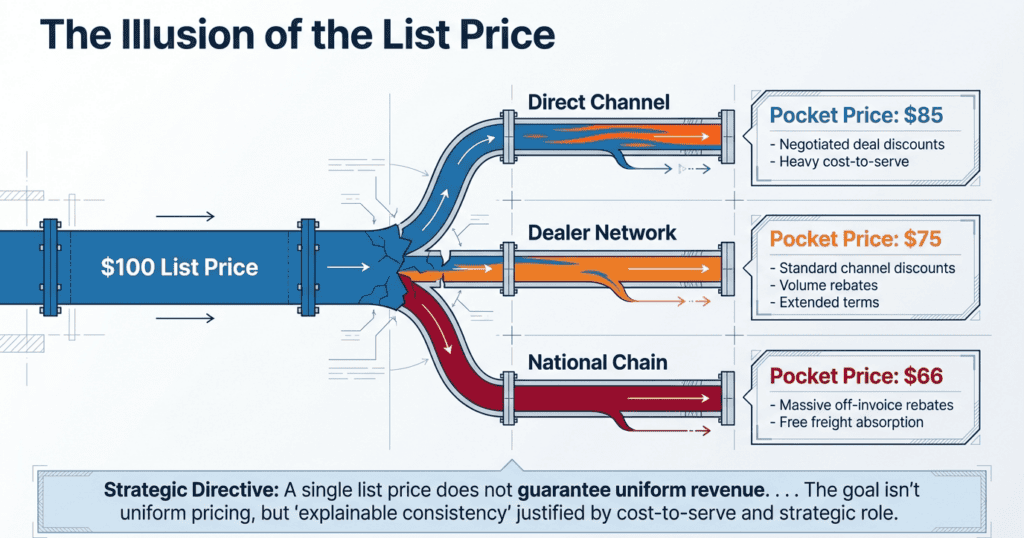
A distributor we supported sold the same SKU through three channels: direct accounts, a dealer network, and a national chain. While the list price was the same, pocket prices differed by 19 points across channels, with no clear explanation internally. Channel pricing addresses this issue and should be part of ongoing operations, not reserved for year-end projects. The goal is not to set three list prices, but to manage how a single list price is affected by varying discounts, rebates, freight terms, and exceptions, and to intentionally determine where these differences should occur.
Common symptoms: reactive pricing and spreadsheet decisions

This scenario is common. A channel partner requests an additional two points and receives it, as the representative seeks volume and lacks clear guidelines. Price files are often managed in spreadsheets and updated infrequently. When competitors adjust pricing, it can take weeks to respond due to limited visibility into affected accounts. Channel pricing decisions are made reactively, deal by deal, without reference to past agreements.
These issues rarely appear urgent in isolation. Each concession seems minor and justifiable, which is precisely why its impact accumulates over time.
What it costs you: margin leakage and slow decisions
In distribution and manufacturing, the difference between list price and realized price often ranges from 15 to 30 percentage points after accounting for on-invoice discounts, rebates, freight absorption, payment terms, and exceptions. Much of this gap is not visible on invoices; it exists off-invoice, varying by channel, and is rarely reviewed in totality.
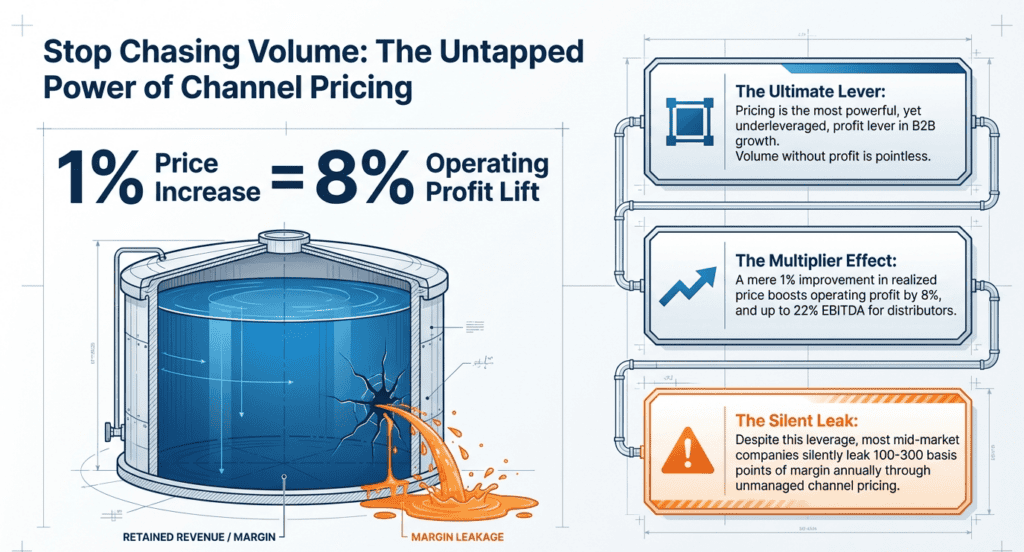
The payoff for fixing it is unusually high, and the research record here is long. McKinsey’s classic analysis of S&P 1500 income statements, “The Power of Pricing”, found that a 1% price improvement, with volume held stable, raises operating profit by roughly 8%, an effect about three times larger than a 1% volume gain. For distributors, the arithmetic is even steeper: McKinsey’s 2019 study of 130 publicly traded distributors estimated that a 1% price increase lifts EBITDA margins by about 22%, because thin-margin business models magnify every point of price. Revology Analytics revisited the question in June 2025 across roughly 2,000 public companies in “Pricing Still Packs a Punch” and found the median lift now sits near 6.4%, with industrials around 9.4%. The lever has not weakened where it matters for this audience. Weak channel pricing is how companies hand that 1% back without noticing, one channel at a time.
What does channel price realization actually mean?

Price realization measures how much of your list price survives the journey to your bank account. Sophisticated pricing teams track four levels: list price, invoice price (after on-invoice discounts), pocket price (after every off-invoice concession), and pocket margin (after cost-to-serve). The price realization formula covers the first three:
| Pocket Price = List Price minus on-invoice discounts minus off-invoice concessions (rebates, freight absorption, payment terms, returns allowances).Price Realization % = Pocket Price divided by List Price. |
Here is what that looks like for one product through a dealer channel, per unit:
| Waterfall step | Per unit | % of list |
| List price | $100.00 | 100% |
| Standard channel discount | -$12.00 | 88% |
| Negotiated deal discount | -$5.00 | 83% |
| Volume rebate (accrued) | -$4.00 | 79% |
| Freight absorbed | -$2.50 | 76.5% |
| Early-payment terms | -$1.50 | 75% |
| Pocket price | $75.00 | 75% |
When the same product is sold through a direct account, the price waterfall changes: the channel discount is removed, the negotiated discount increases, and a service concession is added. Although the list price remains the same, pocket prices differ. Without analyzing each channel’s price waterfall, future pricing decisions lack context. This channel-by-channel decomposition is the foundation of effective channel pricing and the first step in any robust strategy.
Pocket price is only half the story: pocket margin and cost-to-serve
The waterfall stops at the pocket price. Your P&L does not. Two customers can pay you identical pocket prices and produce very different profits once you count the cost of serving them: order frequency, line-item complexity, expedited freight, returns handling, technical support, and inventory carried on their behalf. Consider two accounts buying the same product:
| Customer | Pocket price | Cost-to-serve | Pocket margin |
| Customer A | $80 | $5 | $75 |
| Customer B | $85 | $20 | $65 |
Customer B may appear more profitable in pricing reports until cost-to-serve is considered. Distributors frequently encounter situations where high-revenue or high pocket price accounts are unprofitable due to small order sizes, expedited delivery demands, and high return rates. Relying solely on pocket price in channel pricing decisions often favors these accounts. A basic allocation of freight, handling, returns, and support costs across customers provides most of the necessary insight without requiring complex costing models.
Net price versus mix: read the right number
Another common pitfall is misinterpreting average realized price increases. Performance may appear to improve if the sales mix shifts toward higher-priced channels or products, even if underlying pricing discipline weakens. Always separate true net price changes within each channel from mix effects. A 2% average price gain driven solely by mix does not indicate improved discipline, while a 0.5% net price gain within a weaker channel demonstrates effective controls.
Why should different channels have different economics?

Many channel pricing programs falter at the outset by assuming fairness requires similar pricing across all channels, minimizing differences. In reality, channels have distinct economics, and pricing should intentionally reflect these variations:
- National accounts take larger discounts but cost far less to sell to: one negotiation covers thousands of orders.
- Dealers need rebates, co-op funds, and channel support, but they carry your inventory risk and reach customers you cannot serve directly.
- Direct customers often show the highest gross margin and the highest service cost, because every order touches your people.
- E-commerce carries low transaction costs and brutal price transparency, so a discount there reprices your whole market.
The goal of channel pricing is not price consistency. The goal is consistent profitability after cost-to-serve and strategic role, with differences you can explain. That requires segmentation: grouping customers within each channel by size, willingness to pay, and service demands, and building a price architecture where list prices, standard discounts, and rebate programs differ by segment for stated reasons. Pure discount control eventually hits a ceiling. You can only stop so much leakage. Sustained gains come from knowing where prices should differ and charging accordingly, which is the same logic we applied to account-level moves in our guide to strategic price customization. Capability means making different channel pricing decisions for different customers, products, and situations while keeping control. Control without differentiation leaves money on the table. Differentiation without control is how you got here.
What does a complete channel pricing capability include?
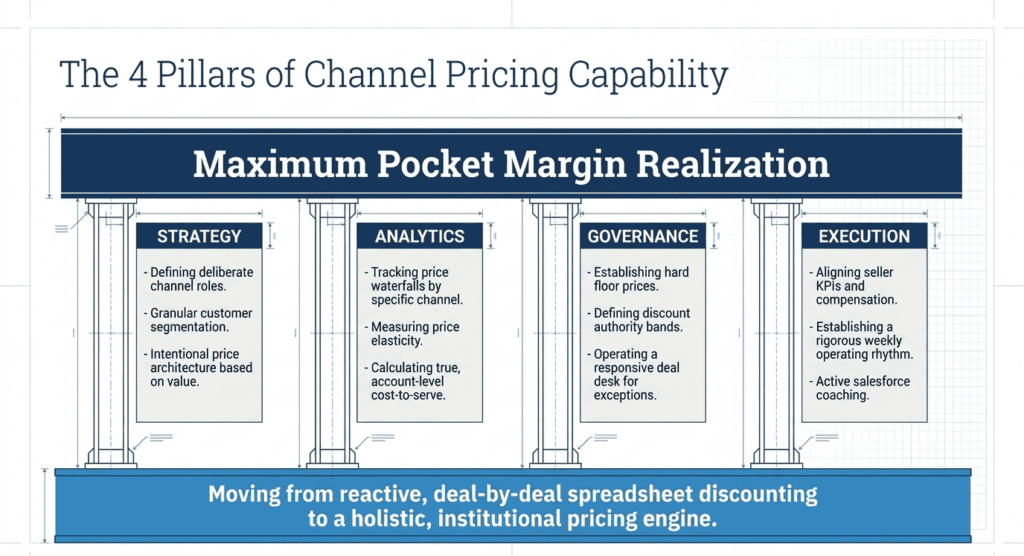
Pricing leaders tend to structure full channel pricing capability around four pillars. Most mid-market companies have fragments of each and a complete version of none.
| Pillar | What it covers | Where mid-market companies usually stand |
| Strategy | Channel role definition, customer segmentation, value proposition, price architecture | Implicit, inherited, undocumented |
| Analytics | Price waterfalls by channel, realization tracking, elasticity, cost-to-serve | Annual spreadsheet exercise, if any |
| Governance | Floors and authority bands, deal desk, approval workflows, exception management | Informal; the loudest rep wins |
| Execution | Seller coaching, seller-level KPIs, compensation alignment, weekly rhythm | Comp plan actively rewards leakage |
The sequence of implementation is less important than achieving completeness. Strong governance without segmentation leads to average pricing outcomes, while advanced analytics without disciplined execution results in insights that are not applied.
What changes when you build channel pricing capability?

Discipline, governance, and guardrails
Channel pricing capability begins with pre-established rules. Set floor prices by channel and segment. Define discount authority bands, allowing representatives limited flexibility, with higher approvals required for larger concessions. Implement rebate programs with tracked thresholds and maintain exception logs to prevent one-off deals from becoming standard practice. These measures do not require software initially, but do require clear documentation and leadership commitment to enforcement.
From insights to execution: the weekly operating rhythm
The next critical element is establishing a regular review cadence. Annual channel pricing projects are ineffective because margin leakage occurs weekly. An effective process includes weekly reviews of realized price by channel, discount variance by seller, and exception logs; monthly reviews of rebate accruals and win-loss patterns; and quarterly adjustments to floors and bands based on data. Companies that follow this rhythm identify issues quickly, while those that do not often discover problems only during year-end audits, after significant margin loss.
The honest part: your sales incentives are working against you

Most channel pricing problems are compensation problems wearing a disguise, and no channel pricing program survives a comp plan that rewards the opposite behavior. The structural reason is simple: in mid-market distribution and manufacturing, most pricing decisions are made in the field, deal by deal, not at headquarters. Whoever designs the list price controls far less of the realized price than whoever designs the commission plan, the approval workflow, and the deal desk. If reps are paid on revenue or volume, every discount is free to them and expensive to you. The rep who gives away four points to close a quarter-end deal is responding rationally to the plan you wrote. Capability means facing this directly: shift at least part of variable compensation to pocket margin or realization against target, publish seller-level realization so the numbers are visible, and stop celebrating revenue that arrives without margin. This is the least popular step and the one with the longest payback. Skip it, and the guardrails will erode within a year.
How does Revify’s maturity journey work?
Pricing capability tends to mature in a recognizable progression: from spreadsheet pricing to governance pricing, to analytics pricing, to optimization pricing. Companies that try to skip a stage usually slide back. Revify packages the channel pricing capability into a phased journey that follows that progression, designed for companies without a pricing team. The phases are sequential because each one creates the conditions for the next.
Phase 1: Profit Diagnostic and Blueprint (mandatory)
Every engagement begins with this phase. We analyze your transaction history, construct the price waterfall by channel, customer segment, and SKU, incorporate cost-to-serve, and precisely identify where realization and pocket margin are lost. The result is a tailored blueprint outlining specific channel pricing guardrails, segmentation logic, governance forums, and KPIs, all aligned with your business’s margin opportunities. This approach is customized to your data and channels.
Phase 2: Margin Stabilizer (guardrails plus governance)
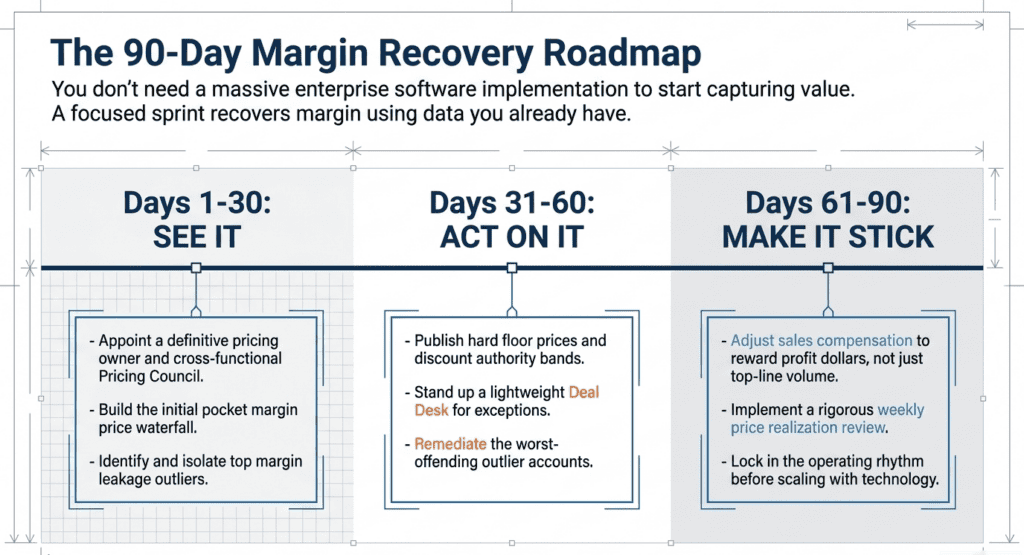
Next, we implement controls. Floor prices and authority bands are established by channel and segment, the deal desk is activated, exception logs are initiated, and a weekly review process begins. This phase focuses on discipline and often delivers rapid returns, as eliminating unnecessary discounts quickly improves margins.
Phase 3: Growth Commander (optimization science)
With discipline in place, the analytics get sharper and the program shifts from defense to offense: where should prices differ, and by how much. Elasticity modeling by channel and segment, discount curves, price-point profitability, and recommendations that a seller can act on inside the quote. Optimization only works on top of governance. Run the science before the discipline and the model’s recommendations die in the field.
Where analytics and AI take channel pricing next
Once the governance foundation is in place, machine learning earns its place in channel pricing. The useful applications are specific: price elasticity by customer segment and channel, so it increases the land where demand can bear them. Rebate effectiveness, separating programs that drive incremental volume from programs that pay customers for what they would have bought anyway. Discount-pattern detection, flagging the seller and account combinations whose concessions predict margin erosion. Willingness-to-pay scoring, identifying accounts likely to accept higher prices based on how similar accounts behaved. And early-warning signals on channel leakage, catching a drifting waterfall in weeks instead of quarters. The sequencing rule is firm, though. Machine learning is most valuable once a pricing discipline is in place. Applied before it, the models simply learn your bad habits and automate them faster.
The full approach, including the analytics and advisory model behind each phase, is laid out on our pricing and details page.
Quick wins and timeline to impact
What you can improve in weeks, not months
You do not wait a year for results. The early moves are mechanical: cap the bottom decile of discounts, enforce rebate thresholds that customers are missing anyway, stop absorbing freight below a defined order size, and re-anchor the ten largest off-contract accounts. Each one is a decision, not a project. In our client work, net price realization gains in the first months typically range from 1% to 5%, and one specialized B2B distributor improved margins by 15% in its most critical customer segments within months of deploying guardrail-driven pricing. Tariff volatility makes this sharper, not softer; we covered how the same governance absorbs cost shocks in our guide to strategic pricing in the age of tariffs.
Typical KPIs: price realization, discount variance, EBITDA lift
Channel pricing lives or dies on measurement, so track a short list at the seller level, not just the company level. Price realization percent by channel and by seller. Pocket margin by customer segment, not just pocket price. Discount variance: the spread between similar deals, which shrinks as guardrails take hold. Exception count and value per month. Rebate accrual accuracy. And the one the CFO cares about, EBITDA contribution from net price, isolated from mix and volume. Seller-level visibility matters more than executives expect. The moment reps can see their own realization ranked against peers, behavior moves before any policy does.
| Case study: industrial distributor, three channels, no pricing team. Before: A mid-market industrial distributor sold through direct accounts, dealers, and two national chains. Realized price varied 19 points across channels for identical SKUs. Pricing lived in seventeen spreadsheets owned by four people. There was no deal desk; any rep could discount to any level with a manager’s verbal nod, and rebate accruals were reconciled once a year. Sellers were paid purely on revenue. Actions: A four-week Profit Diagnostic mapped the waterfall by channel and ranked the leaks in dollars. The team then segmented customers within each channel by size and cost-to-serve, set channel-specific floors and discount bands, stood up a lightweight deal desk for anything beyond band, started a weekly realization review, and moved 20% of seller variable pay onto pocket margin. Results: Net price realization improved 2.3 points in the first two quarters, with discount variance within the dealer channel cut roughly in half and exception volume down by two-thirds. Because realized price flows almost entirely to the bottom line, that translates to roughly two points of EBITDA margin, about a one-third relative EBITDA improvement for a distributor running at typical mid-single-digit margins. No list price was raised. The gain came from stopping unmanaged giveaways, which is why customers did not push back. |
Getting started

Start your Profit Diagnostic
Channel pricing capability sounds like a long build, but the first step is short. Bring twelve months of transaction data. We will show you your waterfall, channel by channel, layer by layer, cost-to-serve, and put a dollar figure on the leak before you commit to anything else. If retention pressure is part of what is driving your discounting, read our take on whether to drop the price when the customer is walking first. Then run the diagnostic.
FAQs
What is an example of channel pricing?
A manufacturer lists a product at $100, sells it to direct accounts at an average pocket price of $85, and sells it to distributors at $75 after channel discounts, rebates, and freight terms. Channel pricing is the practice of deliberately setting and governing those routes, so the 10-point difference reflects strategy and cost-to-serve rather than negotiating accidents.
What is a price waterfall?
A price waterfall shows how the list price becomes the pocket price by lining up concessions in sequence: on-invoice discounts, then off-invoice items such as rebates, freight absorption, and payment terms. Built channel by channel, it shows where the margin actually leaks, which is rarely where the headline discount suggests.
What is the difference between pocket price and pocket margin?
Pocket price is what you keep after every pricing concession. Pocket margin subtracts cost-to-serve on top: freight, handling, returns, support, and order complexity. Two customers at the same pocket price can sit 10 points apart in pocket margin, so channel pricing decisions made on pocket price alone routinely favor the wrong accounts.
How do you measure channel pricing effectiveness?
Track price realization percent by channel and seller, discount variance between similar deals, exception count and value, rebate accrual accuracy, and EBITDA contribution from net price isolated from mix and volume. Effectiveness shows up as narrowing variance and rising realization inside each channel, not just a higher company average.
How often should channel pricing be reviewed?
Weekly for realized price by channel, seller-level discount variance, and the exception log. Monthly for rebate accruals and win-loss patterns. Quarterly for resetting floors, bands, and segment architecture. Annual reviews alone fail because leakage compounds weekly and is invisible by year’s end.
When should a distributor create a deal desk?
As soon as the discounting authority is formalized into bands, typically in the first 90 days of a channel pricing program. The deal desk only reviews deals outside the band, so it stays lightweight: one pricing-literate owner, a finance partner, and a 24-hour turnaround promise so sellers stop seeing governance as friction.
What does the golden rule of channel pricing emphasize?
Explainable consistency. Price differences between channels should be justified by cost-to-serve and strategic role, not by which partner negotiated hardest. When partners discover unexplainable gaps, you get channel conflict, gray-market arbitrage, and a race to the lowest pocket price.
What are the 4 types of pricing?
The four commonly cited approaches are cost-plus, competition-based, value-based, and dynamic pricing. Mid-market companies usually blend them. Channel pricing capability matters under all four, because whichever method sets the list price, the realized price is determined by the discounts and concessions granted afterward.
| Start Your Profit Diagnostic. Twelve months of transaction data in, a channel-by-channel leak map and blueprint out. |
About the author
| Enrico Sieni, Co-Founder, Revify Analytics. Enrico Sieni has spent more than two decades leading pricing and revenue growth for manufacturers and distributors. He has built and run three pricing teams from the ground up, which is part of why he is convinced most mid-market companies do not need one of their own. At Revify Analytics, he helps these companies install the discipline, governance, and seller-level tracking that turn price realization from a once-a-year surprise into a number they manage every week. He writes about the practical side of pricing: what moves margin, and what only sounds good in a deck. |